
Effective forklift safety modules should do more than explain controls in a classroom. A credible program combines equipment fundamentals, pre-use inspections, supervised manoeuvring, load handling, workplace hazard awareness, equipment care, and a clear assessment process.
This matters whether you are comparing forklift operator training in Scarborough, preparing for a warehouse role, or checking whether a course covers the skills your workplace expects. Ontario guidance identifies both knowledge and supervised practice as important parts of powered lift-truck training, including load handling, travelling, stopping, starting, and manoeuvring. Review the province’s powered lift-truck safety program guidance for additional context.
Step 1: Learn the equipment and identify workplace hazards
Training should begin with the powered lift truck itself. Learners need to understand the truck’s main components, operating principles, manufacturer information, and the way environmental conditions can affect performance.
The hazards are not limited to the machine. A useful module should introduce visibility limitations, pedestrians, traffic routes, uneven or changing surfaces, overhead obstacles, confined areas, and workplace procedures. Ontario guidance says a competent operator should understand lift-truck features, manufacturer specifications, workplace hazards, and site-specific safety practices. See the province’s guidance on operator competency for that distinction.
General training provides a foundation. It does not replace learning the layout, traffic controls, emergency procedures, and equipment rules at the site where you will work.
Step 2: Complete a pre-use inspection before operating

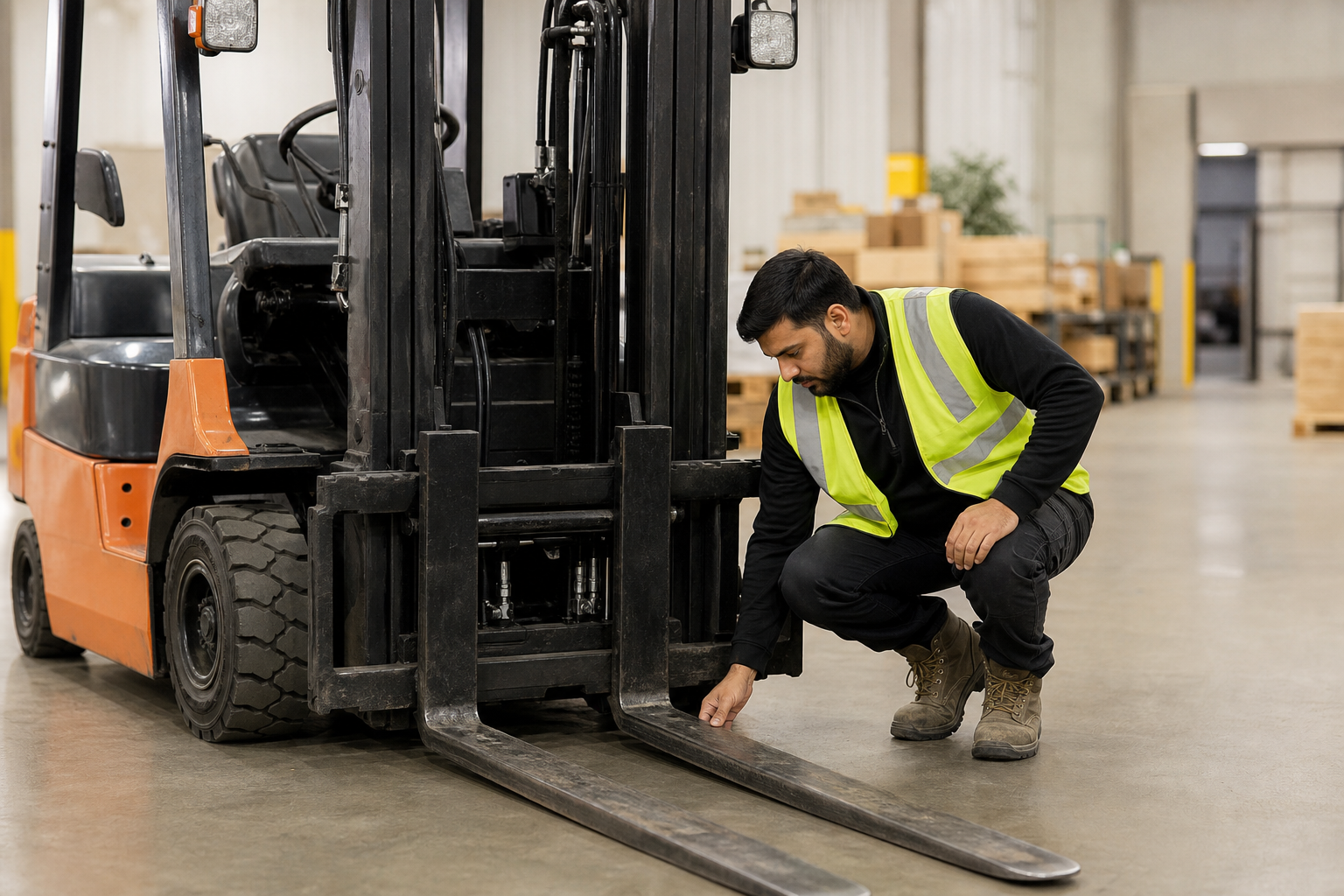
Vehicle inspection is one of the most important forklift safety modules because it creates a decision point before the truck moves. Training should teach you to visually inspect the truck and its attachments, use the employer’s checklist where one is provided, and report defects through the correct workplace process.
Ontario guidance identifies inspection, maintenance, load-handling capacity, recordkeeping, and operator competence as relevant safety areas. It also recommends a visual inspection before operation. Read the official training objectives for powered lift-truck skills for more detail.
Stop point: do not treat an inspection as a paperwork exercise. If a defect, damaged attachment, or unsafe condition is identified, follow the employer’s reporting and removal-from-service procedure rather than continuing to operate.
Inspection checklists and reporting steps can vary by employer and equipment. Ask how the training connects the general inspection process to the actual truck you will operate.
Step 3: Practise controls and manoeuvring under supervision
Classroom instruction can explain controls, but competence develops when a learner applies that knowledge under supervision. Practical modules should include mounting, assuming the correct driving position, starting, stopping, steering, travelling, positioning, and manoeuvring in a controlled environment.
Ontario guidance specifically refers to supervised practice in load handling, manoeuvring, travelling, stopping, and starting. Watching an instructor demonstrate a task is not the same as performing it safely and receiving feedback.
When comparing a course, ask how much individual practice is included, who supervises it, what skills are assessed, and what happens if you need more practice. Beyond forklift safety modules, choosing forklift training should also involve checking whether your employer requires separate site-specific authorization.
Stop point: do not treat watching a demonstration or completing an online lesson as proof of practical competence.
Step 4: Build safe load-handling and load-security skills
Load handling deserves its own module because the truck’s behaviour changes with the load, its position, and surrounding conditions. Training should address how to approach, lift, carry, position, and place loads while considering stability, visibility, clearance, and the information supplied for the equipment.
Load security should explain how a load is positioned and kept stable during movement. A course should not encourage learners to guess at capacity, reach, or attachment limits. Those details must be checked against the truck’s specifications, the load, and the employer’s procedures.
| Module | What it should teach | How to verify it | Workplace follow-up |
|---|---|---|---|
| Equipment fundamentals | Truck components, operating principles, specifications, and controls. | Ask whether the equipment used in practice matches the work you expect to do. | Learn the employer’s equipment and operating procedures. |
| Vehicle inspection | Visual checks, attachment condition, defect reporting, and readiness to operate. | Ask to practise an inspection rather than only review a checklist. | Use the employer’s checklist and reporting process. |
| Load handling | Approaching, lifting, carrying, placing, and maintaining control of loads. | Confirm that practical load handling is supervised and assessed. | Follow site rules and equipment capacity information. |
| Load security | Stability awareness and safe positioning while travelling or placing loads. | Ask how unstable or poorly positioned loads are addressed. | Apply site procedures for load types and storage areas. |
| Workplace safety | Pedestrians, traffic paths, visibility, communication, and changing conditions. | Ask whether the course discusses real workplace hazards. | Complete site orientation and follow local traffic controls. |
| Maintenance and energy handling | Operational maintenance, defect reporting, refuelling, and recharging. | Confirm which tasks operators may perform. | Follow the employer’s maintenance and energy-handling procedures. |
Step 5: Manage pedestrians, traffic, and changing conditions
Workplace safety modules should address the interaction between the forklift, people, and the work environment. That includes visibility, intersections, travel routes, pedestrian activity, communication, loading areas, and conditions that can change during a shift.
A competent operator needs more than general awareness. The operator must understand procedures established by the employer, including where people may walk, how traffic is controlled, and what to do when visibility or site conditions are poor.
Stop point: completing a general course does not mean you already know every workplace’s traffic plan. Site orientation and employer instruction remain important after training.
Step 6: Cover operational maintenance, refuelling, and recharging
Forklift safety modules should extend beyond driving. Learners should understand routine operational care, how to identify and report defects, and safe procedures for refuelling or recharging the equipment they are authorized to use.
JAZ’s listed forklift curriculum includes operational maintenance, refuelling and recharging, powered lift-truck fundamentals, inspection, load handling, load security, and workplace safety. These topics provide a useful benchmark when comparing course outlines.
Operators should not treat general training as permission to carry out maintenance beyond their role. Employers should define which checks and routine tasks operators may complete and which repairs or technical work belong to authorized personnel.
Step 7: Confirm assessment, completion documents, and workplace authorization
Before enrolling, ask how the provider evaluates knowledge and practical performance. Find out whether you will receive instructor feedback, what equipment is used for assessment, and what happens if you need additional practice.
Also ask exactly what documentation is issued after successful completion. Do not assume every employer uses the same certificate format or accepts every document in the same way. Confirm whether the document identifies the training completed, and ask your employer whether a separate site-specific evaluation, authorization, or supervised period is required.
A course completion document can show that you completed a program, but it should not be presented as automatic authorization to operate at every workplace.
Compare forklift safety modules before you enrol
A course outline should distinguish theory from practical training. For example, JAZ’s forklift operator training lists in-class video training alongside hands-on topics such as inspection, load handling, load security, workplace safety, maintenance, and refuelling or recharging.
- Does the course include classroom learning and supervised practical instruction?
- Which type of forklift or powered lift truck will you use during practice?
- Will you practise a pre-use inspection and defect-reporting process?
- Are load handling, load security, pedestrians, and workplace hazards covered?
- How are practical skills assessed, and can you receive additional practice?
- What certificate, photo licence, or other proof of completion is provided?
- Will my employer accept the documentation, or is further site authorization required?
- What is the total cost, schedule, appointment format, and rescheduling policy?
For a broader perspective on load stability and safe movement in handling work, review these appliance moving safety tips. This educational example is not a substitute for forklift training or Ontario workplace procedures.
A local example for Toronto and Scarborough learners
JAZ Truck, Bus & Forklift Driving School lists one-on-one, hands-on forklift training for learners in the Toronto and Scarborough area. Its listed curriculum includes the main safety topics described above, and the school states that successful trainees receive certification and a photo licence.
The school identifies OSL-certified instructors, up-to-date equipment, and flexible part-time scheduling among its training features. Its listed location is 1750 Brimley St Unit 100, Scarborough, Ontario M1P 4K7. Confirm current availability, assessment details, documents, and employer requirements directly before booking.
Forklift training enrolment checklist
- Course content: Confirm fundamentals, inspection, load handling, load security, workplace safety, maintenance, and refuelling or recharging.
- Practical instruction: Ask how much supervised equipment time is included and who provides feedback.
- Equipment: Confirm what type of truck and attachments are used during training.
- Assessment: Ask how knowledge and practical skills are evaluated.
- Documentation: Confirm the certificate, photo licence, or other proof supplied after successful completion.
- Employer requirements: Ask whether the workplace requires a separate evaluation, orientation, or authorization.
- Schedule and cost: Confirm appointment times, total cost, extra fees, and what happens if more practice is needed.
Frequently asked questions
What should forklift safety modules include?
They should cover equipment fundamentals, pre-use inspection, controls and manoeuvring, load handling, load security, workplace hazards, pedestrian awareness, operational maintenance, refuelling or recharging, supervised practice, assessment, and completion documentation.
Why is supervised practical forklift training important?
It lets a learner apply inspection, control, travel, manoeuvring, and load-handling skills while an instructor observes and corrects technique. Theory alone cannot demonstrate that a person can safely perform those tasks.
Does forklift training include a pre-use inspection?
A credible program should include inspection as a core module. Ask whether you will practise inspecting the truck and attachments, use a checklist, and learn how to report defects before operation.
Does completing a forklift course authorize me to operate at every workplace?
Not necessarily. Employers may require site orientation, workplace-specific procedures, an evaluation, authorization, or additional supervision. Confirm those requirements before operating on a new site.
What documents should I ask for after forklift training?
Ask what proof of completion is issued, whether it identifies the training completed, and whether a certificate or photo licence is provided. Then confirm that the document meets your employer’s requirements.
Conclusion: Choose modules that translate into safe workplace skills
The strongest forklift safety modules follow a practical pathway: understand the equipment and hazards, inspect before use, practise controls under supervision, handle and secure loads, manage pedestrians and changing conditions, care for equipment appropriately, and complete a clear assessment.
When comparing forklift training in Toronto or Scarborough, look beyond a short list of classroom topics. Confirm the supervised practice, equipment used, documents provided, and employer-specific steps that follow course completion.
For one-on-one, hands-on forklift training in the Scarborough and Toronto area, contact JAZ Truck, Bus & Forklift Driving School to confirm current scheduling, assessment details, and completion requirements.
Comments are closed