
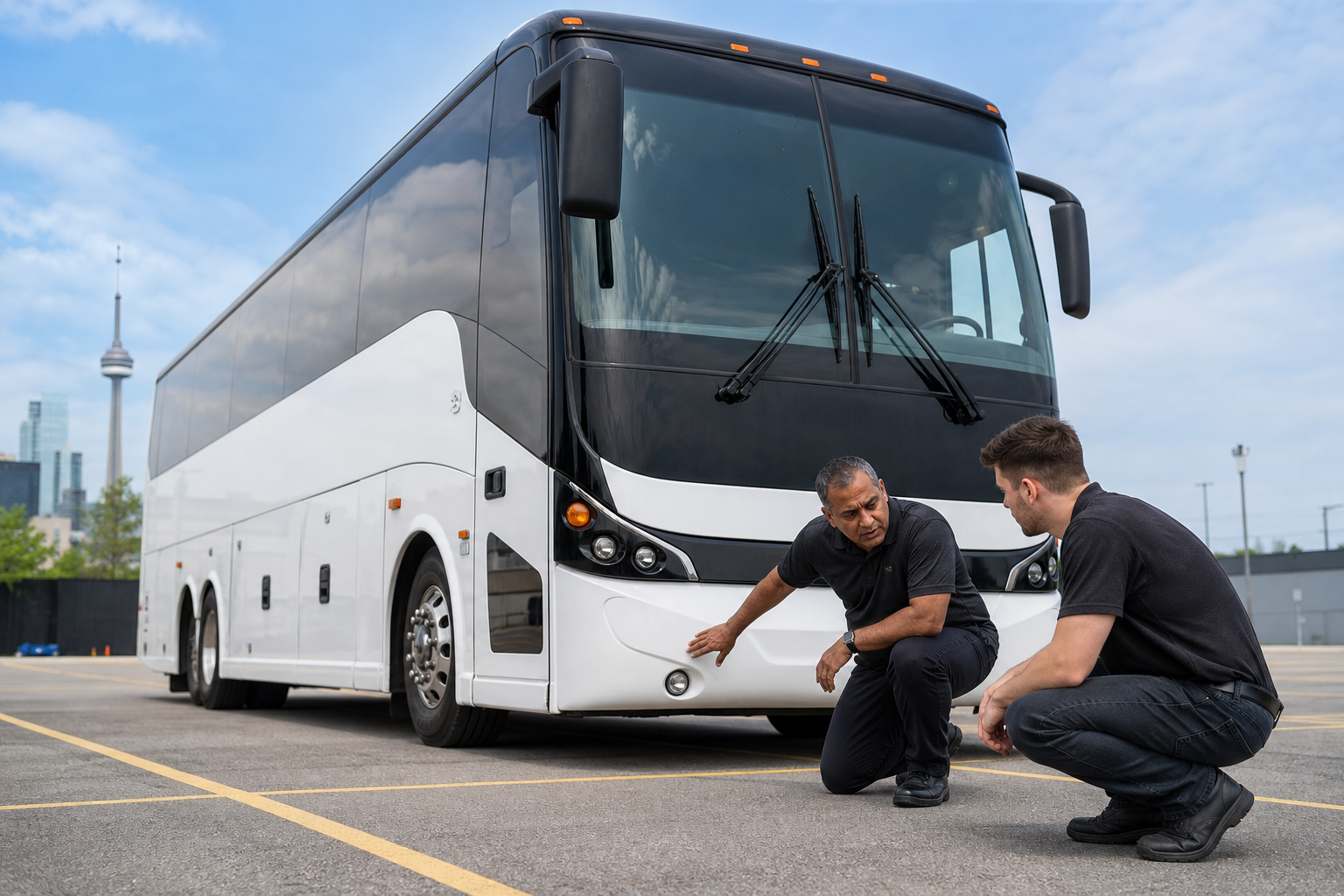
To become a coach bus driver in Ontario, first identify whether the vehicle is a regular, non-school bus with more than 24 passenger seats or one with up to 24. That determines whether you may need a Class C or Class F licence. You then need to verify your eligibility, complete the required medical, vision and knowledge-testing steps, practise inspection and driving manoeuvres, and pass the applicable road test.
A coach bus licence is not the same as a tractor-trailer or school-bus licence. The right training should match the bus you expect to operate and the licence class required by the employer.
Key Takeaways
- Class C applies to a regular, non-school bus with more than 24 passenger seats, while Class F applies to one with up to 24 passenger seats.
- Applicants must be at least 18, hold an eligible Ontario driver’s licence, pass vision screening, submit a valid medical report and complete the applicable knowledge and road tests.
- Preparation should cover vehicle inspection, safe operation, passenger handling, observation, turning, backing and other required manoeuvres.
- Before enrolling, confirm the licence class, vehicle capacity, course scope, road-test vehicle, fees, schedule and cancellation terms in writing.
- JAZ Truck, Bus & Forklift Driving School offers flexible training options and financing to help you start your professional driving career.
Quick summary

- Class C generally applies to a regular, non-school bus with more than 24 passenger seats. Class F applies to one with up to 24 passenger seats.
- Applicants must be at least 18, hold an eligible Ontario driver’s licence, pass vision screening, submit a valid medical report and complete the applicable knowledge and road tests.
- Bus applicants must also complete the Class D truck knowledge test identified in Ontario’s official bus handbook.
- Preparation should cover vehicle inspection, safe operation, passenger handling, observation, turning, backing and other required manoeuvres.
- Before enrolling, confirm the licence class, vehicle capacity, course scope, road-test vehicle, fees, schedule and cancellation terms in writing.
1. Choose the Correct Ontario Coach-Bus Licence
Ontario uses Class C and Class F licences for regular, non-school buses. Passenger capacity is the key starting point, but confirm the employer’s actual vehicle and licensing requirement before paying for training.
| Licence | Vehicle category | What to confirm |
|---|---|---|
| Class C | Regular, non-school bus with more than 24 passenger seats | Confirm the bus capacity and the employer’s licensing requirement. |
| Class F | Regular, non-school bus with up to 24 passenger seats, including a 15-passenger van and an ambulance | Confirm that the vehicle falls within the Class F category. |
Ontario’s bus licence requirements explain the distinction between Class C and Class F. Choosing a course based only on the words “coach bus” may not be enough.
JAZ Truck, Bus & Forklift Driving School publishes a Class C licence and coach-bus training option for learners in Toronto and Scarborough. Its course page lists eligibility and practical topics, but confirm current requirements and course terms independently.
Do Not Confuse Coach-Bus and School-Bus Licences

Class B and Class E are school-bus licence classes. They are not interchangeable with Class C or Class F for a regular, non-school coach bus. Ontario also states that the school-bus driver improvement course does not replace Class C or F requirements for regular non-school buses.
A BZ course may suit someone who intends to drive a school-purpose bus, but it does not automatically prepare someone for a regular coach-bus role. Describe the exact vehicle and work you want to pursue, then ask which licence and course apply.
2. Confirm Basic Eligibility and Required Documents
For a Class C or F application, Ontario’s bus handbook says applicants must be at least 18 and hold a valid Ontario licence other than G1, G2, M, M1 or M2. Applicants must also pass a vision test and submit a valid medical report.
Use the current Ontario Class C and F requirements as the controlling source, because eligibility rules and administrative instructions can change. Depending on the current application process, you may also need documents relating to identity, Ontario residence or legal presence.
Before paying for training, verify your documents through Ontario and DriveTest. A school can explain its course, but it does not replace the licensing authority for determining whether your documents or medical information are acceptable. You can also compare commercial licence classes, knowledge tests and road-test steps before enrolling.
3. Complete the Required Knowledge Testing
Bus licensing involves more than passenger-handling skills. Ontario’s official bus handbook states that a bus applicant must successfully complete a knowledge test for a Class D truck licence, in addition to the applicable bus requirements. Confirm the current testing sequence, booking process and fees through the official process.
Study the current Ontario bus handbook and rules of the road. If a training provider offers classroom preparation, ask which official materials the lessons follow and which tests the preparation supports. Course completion does not replace a government knowledge test.
4. Choose Training That Matches the Road Test
Useful coach-bus preparation should combine the rules and knowledge requirements with repeated practice in a suitable bus. Ask how the course addresses the skills required on the road test and in passenger transport.
- Vehicle inspection: Learn a consistent daily or pre-trip inspection routine and how to identify safety concerns.
- Passenger handling: Practise safe passenger pick-up and drop-off procedures, including observation around the vehicle.
- Vehicle control: Build comfort with turning, backing, lane position, speed control and vehicle dimensions.
- Observation: Rehearse mirror use, blind-spot awareness, railway-crossing procedures and scanning before moving.
- Professional driving: Develop smooth, defensive and predictable habits for a passenger-carrying vehicle.
- Road-test routines: Practise inspection, manoeuvres and safe operation in a compliant vehicle.
JAZ’s published CZ course information lists coach-bus inspection, passenger pick-up and drop-off, railway crossings, professional driving habits, turning, backing and observation. It also states that a bus is included for the MTO road test. Ask the school to confirm that these details and the current course terms apply to your enrolment.
5. Prepare for the Vehicle and Road Test
Ontario’s bus handbook says the road test must use a vehicle that meets the requirements for the licence class. It includes a daily vehicle inspection, safe operation and required driving manoeuvres. Preparation should therefore go beyond simply driving around the city.
- Learn the inspection flow. Practise a logical sequence and understand what you are checking.
- Develop low-speed control. Work on turns, backing and positioning until you can control the bus without rushed corrections.
- Improve observation. Practise mirrors, blind spots, railway-crossing procedures and scanning.
- Rehearse passenger-area habits. Include safe stops, controlled starts and careful observation near passenger stops.
- Complete mock test drives. Ask an instructor to assess the full routine and identify repeat errors.
The road test is only one part of becoming employable. Employers may have additional requirements involving experience, records, availability, route knowledge, customer service or the vehicle they operate.
6. Compare Toronto and Scarborough Coach-Bus Training Options
For learners searching for coach bus driver training in Toronto or Scarborough, location is useful, but it should not be the only deciding factor. Compare the course against the actual Class C or F goal and the road-test vehicle.
JAZ Truck, Bus & Forklift Driving School publishes its location at 1750 Brimley St Unit 100 in Scarborough and states that it serves Toronto and Scarborough. Its business information describes one-on-one, behind-the-wheel instruction, flexible part-time scheduling and OSL-certified instructors across its commercial training programs. Confirm the instructor, schedule and exact CZ arrangements directly before paying.
Ask every provider:
- Is the course designed for Class C, Class F or another licence?
- What passenger capacity and configuration does the training vehicle have?
- How much time is spent driving rather than observing?
- Does training include inspection, backing, turning, railway crossings and passenger stops?
- Will the provider supply a suitable road-test vehicle?
- How are progress and readiness assessed?
- What are the total tuition, test-related, vehicle and additional-practice costs?
- What happens if you miss a lesson, need more practice or cancel?
- Are part-time schedules available?
- Which recognition or eligibility claims can be independently verified?
Coach-Bus Training Enrolment Checklist
- Identify the bus and passenger capacity.
- Confirm whether Class C or Class F applies.
- Verify your eligible Ontario licence and age requirement.
- Confirm current vision, medical and document requirements.
- Identify all knowledge tests, including the Class D test.
- Confirm inspection and manoeuvre coverage.
- Confirm access to a suitable training and road-test vehicle.
- Get instructional hours, behind-the-wheel time and fees in writing.
- Review payment, financing, cancellation and missed-lesson terms.
- Verify government requirements with Ontario or DriveTest.
Frequently Asked Questions
Do I need a Class C or Class F licence to drive a coach bus in Ontario?
It depends on passenger capacity. Class C applies to a regular, non-school bus with more than 24 passenger seats, while Class F applies to one with up to 24 passenger seats.
Is a Class A licence enough to drive a passenger-carrying coach bus?
No. Ontario states that a Class A licence does not allow you to drive a bus carrying passengers. The applicable bus-licensing pathway is required.
Is coach-bus training the same as school-bus driver training?
No. Class B and E apply to school buses, while Class C and F apply to regular, non-school buses. School-bus training does not replace Class C or F requirements.
What does the Ontario coach-bus road test evaluate?
It includes a daily vehicle inspection, safe operation and required driving manoeuvres in a vehicle that meets the licence-class requirements.
Do I need to complete a Class D knowledge test?
Ontario’s official bus handbook says bus applicants must successfully complete a Class D truck knowledge test in addition to applicable bus requirements. Confirm the current process with Ontario or DriveTest.
Can I prepare for a Class C road test in Toronto or Scarborough?
Yes. Compare providers by Class C scope, practical topics, instructor access, suitable test vehicle, schedule and written terms. JAZ publishes CZ training and serves the Toronto and Scarborough area, but confirm current details directly.
Choose the Licence Path Before You Choose the Course
The first step is identifying the vehicle. A regular, non-school bus with more than 24 passenger seats generally points to Class C, while one with up to 24 passenger seats points to Class F. Class B and E school-bus requirements are separate, and a Class A truck licence is not a substitute for a passenger-bus licence.
Once the class is clear, verify your age, licence, vision and medical requirements, complete the knowledge tests, and practise inspection, safe operation and road-test manoeuvres in a suitable bus. Compare providers by training scope, vehicle, instructor access, schedule and written costs.
To discuss current CZ coach-bus training options in Toronto and Scarborough, contact JAZ Truck, Bus & Forklift Driving School and confirm the course details for your intended licence and vehicle.