
If you are searching for forklift training near me, the closest course is not automatically the right one. Before booking, confirm that the provider offers supervised practical instruction, covers inspection and load handling, explains its completion documents, and fits your location, schedule, and employer’s requirements.
For workers in Toronto and Scarborough, a local option may be convenient, but the important decision is whether the training prepares you to operate safely in a real workplace. The steps below will help you compare providers without assuming that every certificate or photo licence meets every employer’s authorization process.
Key Takeaways
Quick summary

Step 1: Confirm the provider fits your location and schedule
Start with the practical details. Check where training takes place, how far you will need to travel, whether appointments are flexible, and whether the provider serves your part of the Greater Toronto Area. A course that is difficult to reach or cannot accommodate your schedule may be harder to complete consistently.
JAZ Truck, Bus & Forklift Driving School lists its location at 1750 Brimley St Unit 100, Scarborough, Ontario M1P 4K7, and provides forklift training for learners in the Toronto and Scarborough area. Its service information also describes flexible appointment arrangements, but you should confirm current availability, appointment length, and the schedule directly before booking.
Step 2: Review what the forklift course actually teaches

A useful forklift course should address more than basic controls. Compare the curriculum line by line and look for training that connects equipment operation with hazard awareness and safe workplace procedures. Ontario guidance places responsibility for safe operation, maintenance, training, and supervision within the broader workplace safety framework, so these areas deserve attention.
JAZ’s listed curriculum includes forklift operator training covering powered lift-truck essentials, vehicle inspection, load handling, load security, workplace safety, operational maintenance, refuelling and recharging, and in-class video training. Those topics give you a useful benchmark when comparing local providers.
Why each topic matters
- Powered lift-truck essentials: Helps you understand the equipment, its components, and operating rules before practical work begins.
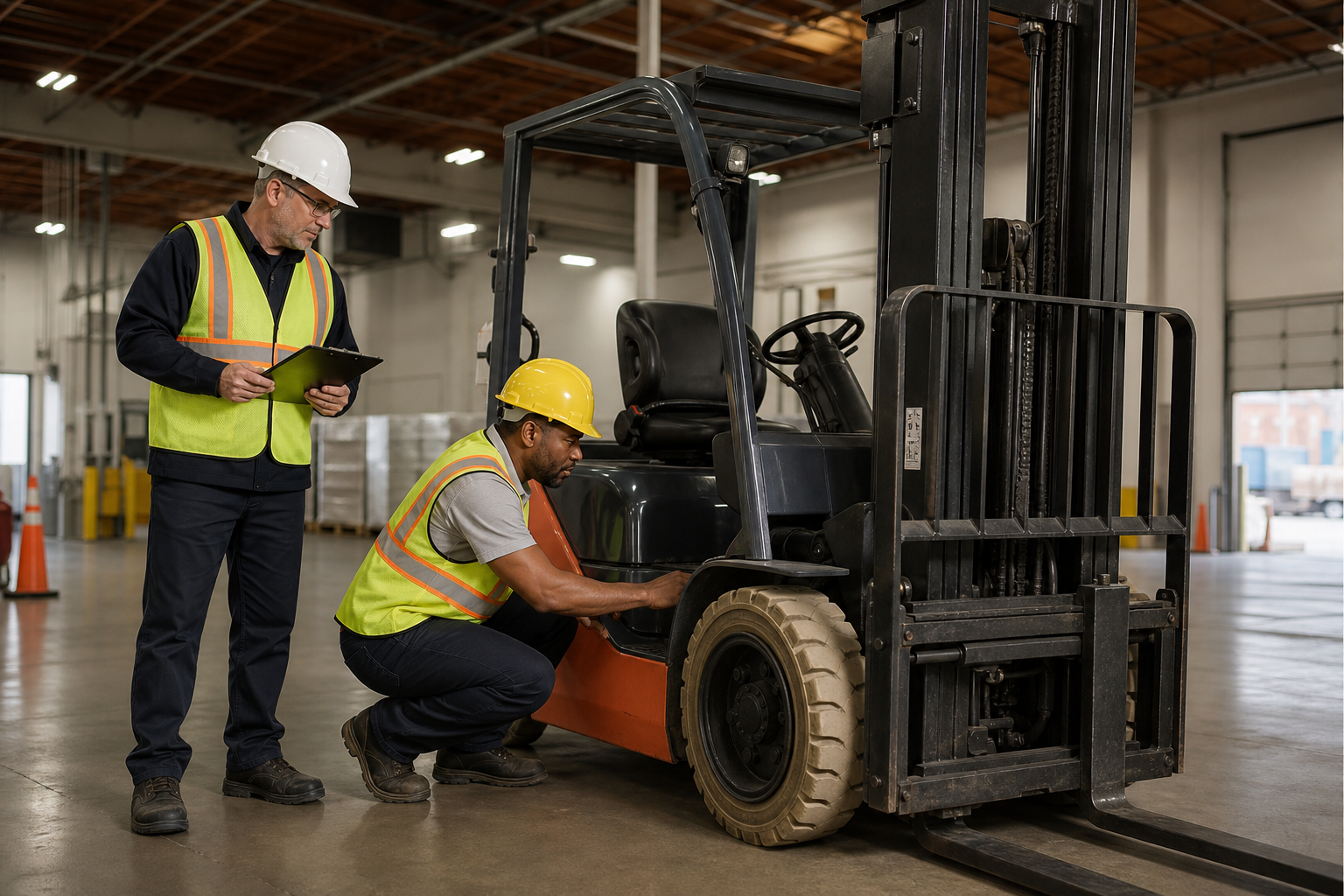
- Vehicle inspection: Builds a habit of checking the truck before use and identifying issues that may affect safe operation.
- Load handling: Develops an understanding of how to approach, lift, move, and place loads in a controlled manner.
- Load security: Reinforces the need to consider stability and the way a load is positioned or transported.
- Workplace safety: Connects operator behaviour with pedestrians, hazards, procedures, and the surrounding work area.
- Maintenance and refuelling or recharging: Covers the operational responsibilities that extend beyond driving the truck.
Ontario’s safety-program guidance recommends a broader approach that includes hazard identification, training for operators and people working near lift trucks, supervision, operating procedures, maintenance, facility design, and truck selection. A course cannot replace your employer’s complete workplace program, but it should help you understand why those controls matter.
Step 3: Verify that training includes supervised practice
Ask whether you will operate the forklift under instructor supervision, rather than only watching demonstrations or completing theory modules. Practical training should give you an opportunity to apply inspection routines, positioning, load handling, and safe movement while receiving correction from an instructor.
One-on-one instruction can be especially useful if you are new to powered lift trucks or need feedback on a particular skill. JAZ describes its forklift program as one-on-one, hands-on training. Confirm what practical activities are included, how your performance is assessed, and whether the equipment and training environment reflect the type of work you expect to perform.
Do not assume that a course includes a specific truck type, number of practice hours, class size, or assessment format unless the provider confirms it. These details can affect how well the training matches your intended workplace.
Step 4: Understand certification and workplace authorization
Three related steps are easy to confuse: completing a training course, receiving documentation from the training provider, and being authorized to operate at a particular workplace. They are not necessarily identical.
A provider may issue certification, a photo licence, or proof of successful completion. Your employer may then require an orientation, site-specific evaluation, additional supervision, or authorization under its own safety procedures. Ontario guidance emphasizes that training works as part of a larger safety program involving employers, workers, supervision, procedures, and maintenance. Confirm the complete process with the employer before assuming that one document is sufficient.
When comparing courses, ask whether the instruction is intended for new operators, refresher learners, a particular workplace, or a specific type of powered lift truck. Also ask how the provider records practical performance and what information appears on the completion documents.
Compare local forklift training options by your goal
| Your goal | What to verify |
|---|---|
| First-time operator | Supervised hands-on practice, inspection instruction, load handling, and feedback from an instructor. |
| Applying for warehouse or logistics work | What proof of completion is issued and whether prospective employers require additional site-specific authorization. |
| Current employee needing qualification | Whether the course matches your employer’s equipment, procedures, evaluation process, and supervision requirements. |
| Learner with work or family commitments | Appointment options, expected attendance requirements, rescheduling terms, and the total time commitment. |
| Toronto learner considering Scarborough | Travel time, training location, parking or transit considerations, and whether the local practical format suits your needs. |
Step 5: Ask what you receive after successful completion
Before paying or reserving a place, request a clear explanation of the documents issued after successful completion. Depending on the provider, this may include a certificate, photo licence, proof of completion, or a record of practical assessment. Ask whether the documents identify the training content, completion date, equipment category, or assessment result.
JAZ’s forklift training page states that successful trainees receive certification and a photo licence. Treat that as a detail to confirm directly, including the exact document name, information shown, and how your intended employer evaluates it. Do not assume that a provider’s document has the same meaning or acceptance in every workplace.
It is also sensible to ask whether you will receive instructions for presenting the documentation to an employer and whether any follow-up workplace evaluation is normally required.
Step 6: Ask focused questions before booking
Use this checklist when you contact a forklift training provider in Toronto or Scarborough:
- Is the course primarily classroom-based, practical, or a combination of both?
- How much supervised practice is included, and what skills will be assessed?
- Does the curriculum include vehicle inspection, load handling, load security, pedestrian awareness, and workplace safety?
- What type of forklift or powered lift truck will be used during practice?
- Who provides instruction, and how much individual feedback should I expect?
- What certificate, photo licence, or proof of completion is issued after successful completion?
- Does my employer need to complete a separate site-specific evaluation or authorization?
- Where is the training held, and what appointment times are currently available?
- What is the total cost, and are there additional charges for assessment, documents, or rescheduling?
- What happens if I need more practice before completing the assessment?
Ask your employer a parallel set of questions. Find out whether it has preferred providers, requires training on a particular equipment type, expects a refresher course, or has site rules that go beyond general operator instruction.
What to verify with a Scarborough provider
JAZ offers a concrete local example of the details you should compare. Its forklift service describes one-on-one, hands-on instruction in the Scarborough and Toronto area, a curriculum that includes inspection, load handling, load security, and workplace safety, and certification with a photo licence after successful completion. The page also states that job-placement assistance is available.
Those features may be relevant if you are seeking a new warehouse or logistics role, but they should still be confirmed before enrolling. Job-placement assistance is not the same as guaranteed employment, and certification does not remove an employer’s responsibility to provide workplace-specific direction, supervision, and authorization.
Safe material handling also fits into the wider movement of goods through warehouses and distribution facilities. For context on how warehouse operations support moving work, readers can review warehouse moving services, while keeping forklift qualification and workplace authorization as separate questions.
Frequently asked questions
What should forklift training near me include?
Look for a combination of theory and supervised practical instruction. Important topics include powered lift-truck essentials, vehicle inspection, load handling, load security, workplace safety, operational maintenance, and refuelling or recharging. Ask how each topic is taught and assessed.
Is a forklift certificate the same as workplace authorization?
Not necessarily. A certificate or photo licence may show that you completed a provider’s course, while an employer may require site orientation, an evaluation, supervision, or additional authorization. Confirm the employer’s process before operating equipment at work.
Can I find hands-on forklift training in Scarborough?
Yes. JAZ lists one-on-one, hands-on forklift training at 1750 Brimley St Unit 100 in Scarborough and serves the Toronto and Scarborough area. Confirm current appointments, practical activities, and documentation directly with the provider.
What should I ask about forklift training documents before enrolling?
Ask what document you receive, what information it contains, whether practical performance is recorded, and whether your employer accepts it as part of its authorization process. Also ask whether there are additional workplace evaluations after the course.
How do I compare forklift training providers in Toronto?
Compare practical instruction, curriculum depth, instructor feedback, location, appointment flexibility, total cost, completion documents, and the provider’s explanation of employer-specific requirements. The lowest travel time or price should not be the only deciding factor.
Conclusion: Choose the provider that makes the requirements clear
The best forklift training near you is not simply the provider with the most convenient address. Choose a course that combines supervised practice with inspection, load handling, load security, and workplace safety instruction. Then confirm what documentation you receive and whether your employer requires additional authorization or evaluation.
If you are comparing forklift training in Toronto or Scarborough, ask JAZ Truck, Bus & Forklift Driving School about its one-on-one hands-on program, current appointment options, curriculum, and completion documents before enrolling. Visit JAZ Truck, Bus & Forklift Driving School to review the local forklift training information and take the next step.
Comments are closed