
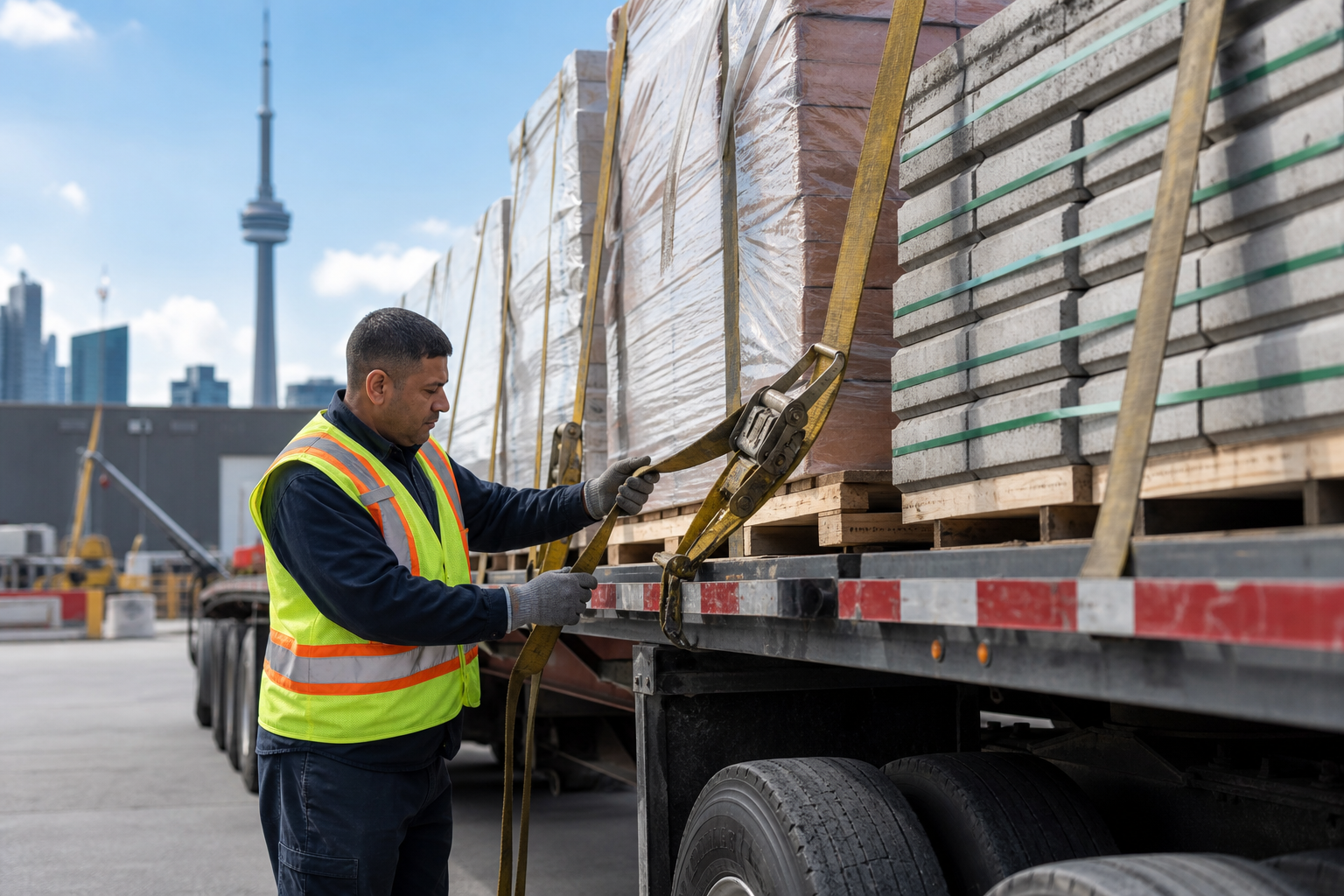
If you are searching for load securement training in Ontario, you may also see the term cargo securement. The two phrases describe the same broad subject, but the right training path depends on the equipment you operate. Commercial truck drivers secure freight for highway travel, while forklift operators develop equipment-specific load-handling skills for a particular workplace.
This guide explains the distinction, the topics a credible programme should cover, and what to ask before enrolling in Toronto or Scarborough. It also explains how JAZ’s verified Class A and forklift programmes address related skills without claiming that JAZ offers a separate course under the exact name “load securement training.”
Key Takeaways
- Truck operators need training in tiedowns, securement devices, cargo placement, anchor points, working-load limits, inspections, and commodity-specific requirements.
- Forklift operators need practical instruction on load assessment, stability, capacity, visibility, pedestrian hazards, inspections, and workplace procedures.
- Ontario commercial-vehicle rules apply to loads carried on highways. Forklift competence must also match the equipment, attachments, hazards, and procedures at the workplace.
- A course certificate does not automatically authorize operation of every forklift or prove competence at every workplace.
- Choosing the right training provider is crucial for ensuring safety and compliance in load securement practices.
Quick summary

- Truck operators need training in tiedowns, securement devices, cargo placement, anchor points, working-load limits, inspections, and commodity-specific requirements.
- Forklift operators need practical instruction on load assessment, stability, capacity, visibility, pedestrian hazards, inspections, and workplace procedures.
- Ontario commercial-vehicle rules apply to loads carried on highways. Forklift competence must also match the equipment, attachments, hazards, and procedures at the workplace.
- A course certificate does not automatically authorize operation of every forklift or prove competence at every workplace.
Which load securement training path applies to you?
Start with the job rather than the keyword. If you will drive a commercial vehicle carrying freight on Ontario highways, look for highway cargo-securement training aligned with the vehicle and load. If you will move pallets or other materials inside a warehouse, yard, distribution centre, or construction environment, look for forklift load-handling training that reflects the truck, attachments, loads, traffic patterns, and site procedures.
The risks overlap, but the controls differ. A truck driver must prevent cargo from shifting, falling, or becoming dislodged during travel, braking, turning, and changing road conditions. A forklift operator must maintain stability while picking up, transporting, stacking, and placing loads around people, structures, docks, aisles, and other equipment.
For that reason, a commercial driver course is not a substitute for workplace forklift training, and forklift training is not preparation for highway cargo-securement compliance.
Commercial truck cargo securement vs. forklift load handling

| Decision point | Commercial truck cargo securement | Forklift load handling |
|---|---|---|
| Typical setting | Highways, yards, loading areas, and commercial vehicles | Warehouses, plants, yards, docks, and controlled workplaces |
| Main concern | Keeping freight restrained throughout a trip | Moving and placing loads without losing stability or exposing people to hazards |
| Core topics | Tiedowns, securement devices, anchor points, cargo placement, restraint, and working-load limits | Capacity, stability, fork positioning, visibility, pedestrian control, inspections, and site rules |
| Proof of competence | Training aligned with the applicable commercial-driver curriculum and requirements | Training, practical evaluation, and employer authorization suited to the workplace |
For warehouse and logistics workers, practical load handling should include more than a classroom explanation. Operators need to demonstrate that they can inspect the truck, assess a load, handle it safely, and respond to site-specific hazards.
What effective commercial cargo securement training should cover
Ontario’s commercial-vehicle safety information warns that improperly secured cargo or equipment can damage vehicles, cause injury, or cause death. It also places responsibility on the operator to ensure that a load is secured so it will not fall, become dislodged, or shift dangerously. Review the Ontario commercial vehicle safety requirements for the government’s safety overview.
A useful course should connect the rules to decisions made before and during a trip. Ask whether the curriculum covers:
- Securement devices and tiedowns: selecting, positioning, tightening, inspecting, and maintaining equipment.
- Load limits and working-load limits: understanding rated capacity and why a strong-looking device may not suit every load.
- Cargo placement: considering weight distribution, centre of gravity, shape, size, and packaging.
- Anchor points and front-end structures: understanding their role and recognizing defects or limitations.
- Commodity-specific requirements: adapting methods for machinery, lumber, pipes, coils, containers, and other freight.
- Inspection and rechecking: identifying loosened tiedowns, damaged devices, movement, shifting, and other unsafe conditions.
- Documentation and responsibility: understanding the load, securement system, and reporting duties before operating.
Ontario’s Commercial Vehicle Operators’ Safety Manual discusses securement devices, tiedowns, anchor points, front-end structures, cargo placement, restraint, working-load limits, and commodity-specific requirements. The province also provides a load-securement training reference covering tie-down requirements and load limits. That reference does not replace required education and assessment.
Ontario Regulation 363/04 requires commercial motor vehicles carrying loads on a highway to comply with applicable cargo-securement and tiedown requirements. Tiedowns must be designed, constructed, and maintained so they can be tightened in transit. A provider should explain how its instruction relates to these requirements.
How cargo securement fits into Class A truck driver training
For a prospective tractor-trailer driver, cargo securement is one part of broader commercial training. JAZ’s Class A curriculum lists cargo securement alongside vehicle systems, emergency handling, driving techniques, professional driving habits, off-road manoeuvres, documentation, and hours-of-service compliance.
The supplied programme information describes a 104-hour MELT course delivered through classroom, yard, in-truck, and on-road instruction. That structure helps place securement knowledge within the complete operating sequence: understanding the freight, checking equipment, preparing the vehicle, completing the trip safely, and correcting unsafe conditions.
Before enrolling, confirm exactly how cargo securement is taught. Ask whether you will study realistic arrangements, discuss rated equipment and load placement, review inspection decisions, and apply the concepts rather than only memorizing terminology.
What forklift load securement and load-handling training should cover
Forklift training has a different focus. The operator controls a powered industrial truck while a load is raised, carried, stacked, retrieved, or placed in a workplace where people and fixed hazards may be nearby.
- Pre-use inspection, defect identification, and reporting equipment that should not be operated.
- Load weight, dimensions, centre of gravity, capacity information, fork spacing, and attachment limits.
- Stability while travelling, turning, reversing, approaching ramps, and placing loads at height.
- Visibility, pedestrians, blind corners, dock edges, narrow aisles, overhead obstructions, and traffic controls.
- Starting, stopping, steering, speed control, parking, battery charging, fuelling, and other relevant procedures.
- Emergency response after a collision, load incident, tip-over, or equipment defect.
- Practical evaluation on equipment and in conditions relevant to the intended workplace.
In Ontario, forklift competence is not the same as holding a universal provincial forklift licence. Employer-established competence, equipment-specific instruction, supervision, and workplace procedures remain important. A course may provide training and documentation, but the employer must still determine whether the operator is competent and authorized for the specific work.
How to compare providers in Toronto or Scarborough
- Terminology: Does the provider distinguish cargo securement from forklift load handling?
- Curriculum: Are tiedowns, load limits, placement, inspections, and working-load limits clearly listed for truck training?
- Equipment relevance: Will practical work use equipment and loads relevant to your intended role?
- Hands-on time: How much time will you spend performing inspections, positioning securement equipment, or handling loads?
- Instructor qualifications: Can the school explain relevant commercial or equipment-specific experience?
- Assessment: How will competence be evaluated, and will you receive specific feedback?
- Documentation: What record or certificate is issued, and what does it confirm?
- Workplace fit: What employer orientation, supervision, or site-specific instruction remains necessary?
- Scheduling: Can the programme accommodate part-time attendance?
JAZ states that it serves Toronto and Scarborough, uses OSL-certified instructors, provides one-on-one behind-the-wheel instruction, and offers hands-on truck, bus, and forklift training. Verify which features and securement activities are included in the specific programme you choose.
Questions to ask before you enrol
- Is cargo securement integrated into the Class A curriculum or offered separately?
- Which tiedowns, devices, anchor points, load limits, and cargo types are covered?
- Will I practise inspecting a securement arrangement and identifying unsafe conditions?
- For forklift training, which truck types, attachments, loads, and workplace hazards are covered?
- How is practical competence evaluated, and what happens if I need more practice?
- What documentation will I receive, and what additional authorization will my employer require?
- Can the schedule accommodate part-time attendance?
Frequently asked questions
Is load securement the same as cargo securement in Ontario?
They are commonly used as equivalent terms. Ontario materials and commercial-driver training often use “cargo securement” when discussing tiedowns, load limits, cargo placement, and restraint on commercial vehicles.
Does forklift training cover the same rules as tractor-trailer training?
No. Tractor-trailer training focuses on restraining freight for highway travel. Forklift training focuses on the truck, load, attachment, stability, traffic, people, and procedures in a particular workplace.
Does a forklift certificate authorize operation at every workplace?
No. A certificate documents training but does not automatically authorize operation of every forklift, attachment, or load. Employers must address workplace hazards, equipment, supervision, and competence.
Does JAZ offer a standalone load securement course?
The supplied JAZ information verifies that cargo securement is included in its Class A curriculum and that forklift training includes load handling and load security. It does not establish a separate course called “load securement training,” so ask how the subject is included in the programme you are considering.
Conclusion: Choose training that matches the equipment and work
Load securement training is not one universal credential. Commercial truck drivers need cargo-securement knowledge connected to highway rules, tiedowns, load limits, cargo placement, inspections, and the freight they carry. Forklift operators need practical load-handling competence connected to a particular truck, attachment, workplace, and employer authorization process.
When comparing providers in Toronto or Scarborough, confirm the curriculum, equipment, practical assessment, documentation, scheduling, and any training that remains the employer’s responsibility.
JAZ Truck, Bus & Forklift Driving School serves Toronto and Scarborough with Class A tractor-trailer and forklift training, including related cargo-securement and load-handling topics.