
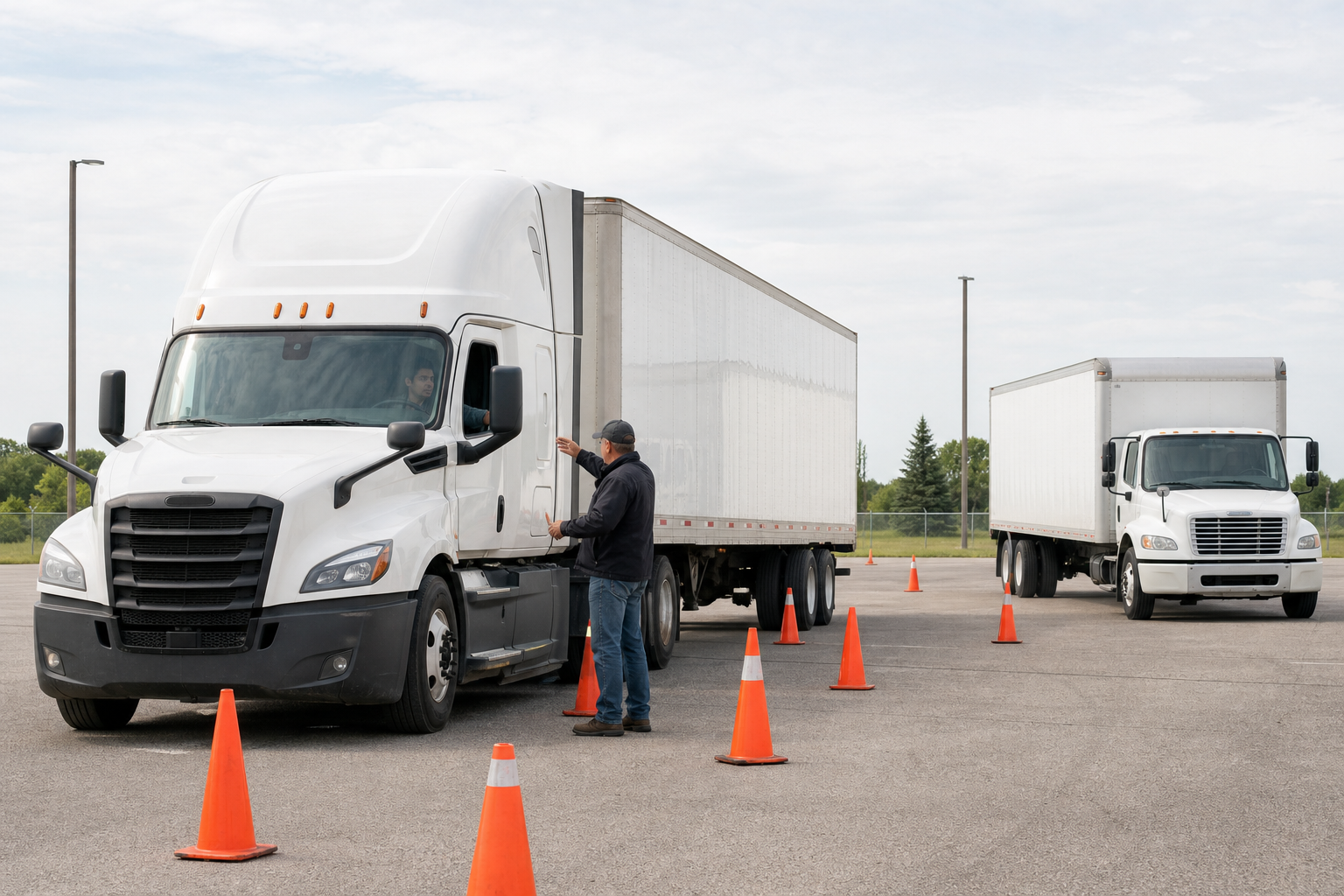
For long-haul jobs involving long combination vehicles, Class A tractor-trailer training is generally the better-aligned path. Ontario requires Class A applicants to complete mandatory training before the road test, while DZ is better suited to eligible heavy straight-truck roles such as local delivery, construction, municipal services and utilities.
Job Bank identifies a Class 1 or Class A licence as the requirement for long combination vehicles. The vehicle, route and employer requirement should decide your course, not the course name alone.
The short answer for long-haul work
Choose Class A if your target job involves a tractor pulling a semi-trailer over regional, provincial or international routes. Choose DZ if your target vehicle is a heavy straight truck and your preferred work is local delivery, construction, waste collection, municipal services or utilities.
Ontario requires applicants for a Class A commercial truck driver’s licence to complete mandatory training with an approved provider before taking the Class A road test. A full Class A licence also depends on the vehicle used for testing. If that vehicle does not meet the full requirements, the result can be an A Restricted licence. Review the mandatory Class A training rule and the MTO’s A and D licence requirements before enrolling.
Class A and DZ at a glance
| Decision point | Class A tractor-trailer | DZ heavy straight truck |
|---|---|---|
| Vehicle | Tractor with a qualifying trailer combination | Heavy straight truck, with the exact vehicle and combination confirmed before training |
| Best fit | Long-haul, regional and freight work using long combinations | Local delivery, construction, municipal, waste and utility work |
| Handling skills | Trailer tracking, coupling, uncoupling, backing and combination-vehicle positioning | Inspection, braking, backing and manoeuvring without the same tractor-trailer articulation |
| Training issue | Mandatory training is required before the Class A road test | Training must match the Class D vehicle, brake system and intended job |
| Lifestyle | May involve overnight trips, extended routes and more time away from home | More often associated with local or regional schedules, although employers vary |
| Future flexibility | Directly aligned with tractor-trailer work | Useful for straight-truck work, but not a replacement for the Class A pathway |
Before choosing between the Class A and DZ licence paths, write down the vehicle used by the jobs you are considering. Ask which licence the employer requires, whether the vehicle has a trailer and whether your road-test vehicle will match the work.
Choose by the work you want
If you are committed to long-haul freight
Choose Class A training directly if you want to operate tractor-trailer combinations over long distances. This puts your preparation on coupling, trailer control, highway positioning, inspections and the Class A road-test standard. Related reading: Cheapest Long-Distance Moving Options Compared.
Ask employers whether routes are local, regional, provincial or cross-border; whether drivers operate solo or as a team; and whether loading, unloading or cargo securement is part of the role. These details affect your daily work as much as the licence category.
If you prefer local or straight-truck work
DZ may be the better fit when your target jobs use heavy straight trucks. Construction, waste collection, municipal operations, utilities and local delivery can involve different vehicle dimensions, work sites and home-time expectations from long-haul freight.
Do not select DZ simply because it sounds like a quicker version of Class A. Confirm the exact truck, weight, brake system, trailer arrangement and road-test requirement before paying a deposit.
If you are undecided
Compare two real job postings. Record the vehicle, required licence, route, start time, overnight expectations, physical duties and endorsements. If the postings specify different licence paths, choose the one that matches the work you are most likely to pursue in the next two years.
Ontario’s commercial licensing process can include medical, vision, knowledge, mandatory-training and road-test requirements depending on the licence class. Use the province’s truck driver licensing overview to separate legal requirements from optional school services.
What Class A training adds
Class A training develops the combination-vehicle skills needed to control a tractor and trailer as one system. The trailer tracks differently through turns, requires different backing inputs and changes how you manage space before, during and after a trip.
A useful Class A programme should connect classroom learning with yard practice and on-road instruction. Ask how the training covers vehicle inspections, coupling and uncoupling, trailer manoeuvring, air brakes, highway driving, cargo responsibilities and road-test preparation. The exact schedule and allocation of practical hours should be provided in writing.
Ask about the tractor, trailer, transmission, air-brake system and road-test vehicle before registering. Readers leaning toward long-haul work can also review the Class A training requirements, including MELT, vehicle configuration, practical driving time and road-test preparation.
What DZ training is better suited to
DZ training is designed for a heavy straight-truck job when the truck does not require the full Class A tractor-trailer pathway. Useful preparation should cover inspections, safe braking, positioning, backing, traffic awareness and the manoeuvres required for the road-test vehicle.
JAZ offers truck training in Toronto and Scarborough, including one-on-one behind-the-wheel instruction, OSL-certified instructors, current equipment and part-time scheduling. For a DZ decision, ask the school to identify the vehicle, brake configuration, practical driving allocation and test preparation included.
DZ training does not qualify you to operate every tractor-trailer combination. If an employer says “AZ,” “Class A” or “tractor-trailer,” ask for the licence and vehicle requirement in writing.
Compare the learning curve
Many new drivers find low-speed manoeuvring and backing the most demanding part of tractor-trailer training. The trailer does not follow the tractor’s path exactly, so mirror use, space management and small steering corrections matter.
| Skill | Class A emphasis | DZ emphasis |
|---|---|---|
| Inspection | Tractor, trailer, coupling equipment, lights, tires and air-brake components | Straight-truck components, braking system, tires, lights and load area |
| Low-speed control | Combination length, turning path and trailer swing | Clearance, turning path and rear overhang |
| Backing | Mirror use and controlled corrections to place the trailer | Controlled backing for the truck’s dimensions |
| Coupling | Safe coupling, uncoupling and connection checks | Usually not a tractor-trailer coupling task |
| On-road driving | Lane position, following distance, turns, highway entry and trailer clearance | Size, braking distance, traffic position and work-site conditions |
Both paths require inspections, safe following distance, load awareness and defensive driving. Class A adds the challenge of controlling a connected vehicle, so budget time for repeated supervised practice if backing and space management are new to you.
The long-haul lifestyle is part of the decision
Long-haul work can mean urban, interurban, provincial or international routes. Depending on the employer, you may spend nights away from home, plan fuel and rest stops, work around delivery windows and manage changing traffic and weather.
Ask employers about home time, solo or team driving, overnight expectations, dispatch practices, loading and unloading duties, and how pay is calculated. A Class A licence alone does not tell you what daily life will look like.
If predictable evenings at home are your priority, compare local DZ roles carefully. If you are comfortable with extended routes and overnight travel, Class A may align more closely with your preferred work pattern.
Should you start with DZ and move to Class A?
You can pursue Class A later after starting with DZ, but DZ training does not replace Ontario’s Class A mandatory-training requirement. A staged route can make sense when you genuinely want straight-truck experience first, have a confirmed DZ opportunity or are testing whether commercial driving suits you.
Hypothetical example: Priya wants local utility work and finds an employer operating heavy straight trucks. She chooses DZ because that vehicle and schedule match her immediate goal. Two years later, she decides that long-haul freight suits her better. She must then meet the current Class A prerequisites, complete required Class A training and prepare for the appropriate road test. Her DZ experience may help with commercial-vehicle routines, but it does not guarantee a shorter or cheaper Class A route.
Choose direct Class A training if long-haul tractor-trailer work is already your clear objective. Consider DZ first only when straight-truck work is a genuine target, not an assumed shortcut.
Plan time, cost and enrolment questions
Training time and tuition vary by licence path, provider, practical driving allocation, road-test vehicle and included services. Request a written comparison instead of assuming DZ is automatically faster or less expensive.
- Which licence and vehicle configuration does the programme prepare me for?
- How are classroom, yard and individual driving hours divided?
- Which tractor, trailer, transmission and brake system will I use?
- Does the road-test vehicle meet the requirements for my intended licence?
- Are booking, vehicle rental, examination and retest costs included?
- How much backing, coupling, inspection and highway practice is included?
- Are part-time appointments available?
- What financing options, repayment terms and fees apply?
- What employment or recruiting assistance is offered, and what does it not guarantee?
Once you confirm that long-haul tractor-trailer work is your goal, review the A tractor-trailer driver training programme and compare its structure with your schedule, vehicle goal and road-test plan.
Earnings depend on the job, not only the licence
There is no single answer to which type of trucking pays more. Earnings vary with the employer, route length, vehicle, experience, schedule, endorsements, loading duties, team or solo operation and time away from home.
Compare guaranteed or variable pay, unpaid waiting time, benefits, home-time policy, overnight expenses, training requirements and route responsibilities. Neither a Class A nor a DZ licence guarantees a particular wage, job offer or career outcome.
Questions to settle before paying a deposit
- Vehicle: Will I drive a tractor-trailer or heavy straight truck?
- Licence: Does the programme lead toward the Class A or DZ outcome I need?
- Eligibility: Do I have the required licence, medical documents, vision clearance and knowledge tests?
- Training: Is the Class A programme mandatory-training compliant, with documented individual driving hours?
- Equipment: Does the vehicle match my target employer’s transmission, trailer and brake configuration?
- Practice: Will I practise inspections, backing, coupling where applicable, air brakes and road-test manoeuvres?
- Total cost: What tuition, test, vehicle, retest and financing charges apply?
- Schedule: Can I attend consistently while working?
Training supports preparation but does not guarantee licensing, employment or earnings. Ask the school to put programme inclusions and terms in writing.
FAQ
Can I start with DZ training and later move to Class A?
Yes, but you must complete the Class A pathway that applies at that time. DZ experience does not guarantee a shorter programme, lower cost or long-haul employment.
Does DZ training replace Ontario’s Class A MELT requirement?
No. DZ training does not replace the mandatory training required before an Ontario Class A road test.
Which type of trucking pays more?
Neither licence guarantees higher earnings. Pay depends on route, employer, vehicle, experience, schedule, endorsements, loading duties and home-time arrangements.
What is the hardest part of driving a tractor-trailer for a new driver?
Many new drivers find low-speed manoeuvring and backing most demanding because the trailer responds indirectly to the tractor’s steering. Supervised practice with mirrors, space management and controlled corrections builds the necessary foundation.
Choose the path that matches your first target job
If your first target is long-haul freight in a tractor-trailer, Class A is generally the direct and better-aligned choice. If your target is heavy straight-truck work with local or regional routes, DZ may fit more closely. Toronto and Scarborough learners can discuss the intended vehicle, schedule and road-test plan with JAZ Truck, Bus & Forklift Driving School through its Class A tractor-trailer training programme.