
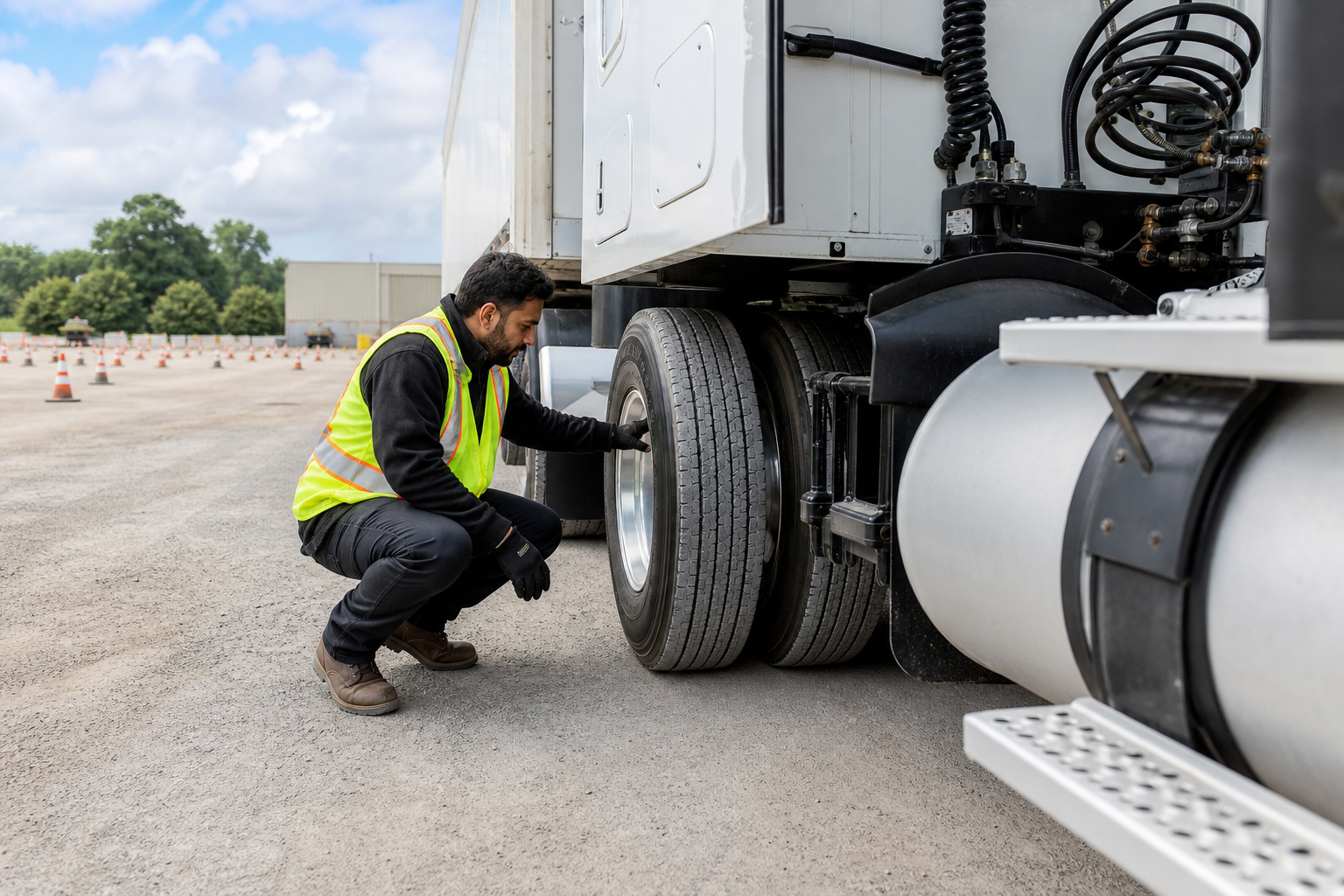
In Ontario, truck driver requirements depend first on the vehicle you plan to drive. Tractor-trailer applicants generally follow the Class A pathway, which includes mandatory training before the road test, while a straight-truck applicant may fit Class D or DZ if the truck and towed-vehicle weights meet the applicable limits. Before enrolling, verify your licence, medical report, vision standards, tests, training and air-brake needs.
Start with the vehicle, not the course name
The better question is not “Which truck course should I buy?” It is “What vehicle and job will I operate?” The answer determines whether you should investigate Class A, Class D, an Air Brake (Z) endorsement, or a different commercial pathway.
| Your intended work | Path to investigate | First checks |
|---|---|---|
| Tractor-trailer or a combination outside the Class D limits | Class A, commonly called AZ when the Z endorsement applies | Trailer configuration, air brakes, Class A eligibility and mandatory training |
| Straight truck or a permitted truck-and-trailer combination | Class D, often described as DZ when air brakes apply | Truck weight, towed-vehicle weight, braking system and job requirements |
| School bus | Class B or E, depending largely on passenger capacity | Bus type, passenger seats and school-bus-specific requirements |
| Coach bus | The applicable passenger-vehicle class | Vehicle type, seating and the employer’s licence requirement |
In the Class D context described by JAZ, the truck or combination must have a towed vehicle of no more than 4,600 kg. A heavier trailer can move you into the Class A decision, so record the truck’s registered or gross weight and the trailer’s weight before choosing a programme. Ontario’s official handbook on Class A and D licence requirements explains the categories and learner requirements, while the truck configuration requirements deserve a separate check before you pay tuition.
“AZ” is common industry shorthand for a Class A licence with the Z air-brake endorsement. Ontario’s official terminology centres on Class A, Class D and the applicable endorsement, so ask a school to state exactly which licence and test its programme supports.
Ontario truck driver requirements at a glance
What do you need for truck driving in Ontario? You need the correct regular licence, the applicable commercial eligibility, medical and vision clearance, knowledge and road testing, required training for your licence class, and enough supervised practice to demonstrate safe vehicle control. Employers can add hiring requirements that are separate from the government licensing process.
Licence status and age
- For Class A learning and licensing, Ontario requires a Class G or higher licence. The Official MTO Truck Handbook says a learner must be accompanied by an appropriately licensed Class A driver when learning to operate a tractor-trailer. Review the current Ontario Class A licensing requirements before applying.
- JAZ’s DZ course information states that its Class D pathway is for applicants aged 18 or older who hold a valid Ontario G or higher licence and meet medical and vision standards. Treat that as a programme entry description, not a complete decision for every applicant.
- For Class A road-test applicants, Ontario states that a G or higher licence must have been held for at least six months beginning January 1, 2027. That future rule is not yet effective on November 15, 2026, the publication date of this guide.
Previous trucking employment is not the same as licence eligibility. A beginner can take suitable entry-level training without having already worked as a truck driver, but the school and Ontario licensing authority still need to assess the licence, documents and pathway that apply to the learner.
Medical and vision requirements
Ontario requires drivers with Class A, B, C, D, E and F licences to file a medical report completed by a physician or nurse practitioner licensed in Ontario. The report is one part of the commercial licensing process and does not guarantee that every applicant will be approved.
Vision standards are separate from the medical appointment itself. Ask the licensing authority or the healthcare professional completing your report which forms, measurements and submission process apply to your application. Ontario’s current medical and vision standards are the right place to verify the individual rule.
Testing and practical ability
- Study the handbook for the licence and vehicle class you intend to pursue.
- Complete the applicable knowledge tests before the road-test stage.
- Learn the vehicle inspection sequence, including defects that make a vehicle unsafe to operate.
- Practise turning, backing, observation, space management and speed control on the actual type of vehicle.
- Complete the required training before a Class A road test, and arrange road-test preparation for the licence you are pursuing.
The government decides whether you meet Ontario’s licensing requirements. A driving school can teach, coach and prepare you, but it cannot replace the government tests or make the licensing decision.
The step-by-step path from a G licence to a commercial road test
The usual sequence is vehicle identification, regular-licence verification, knowledge testing, medical documentation, suitable training, supervised practice and the commercial road test. Some administrative steps can happen at the same time, but do not book training around an assumed licence class until the vehicle configuration is clear.
1. Identify the vehicle and job
Ask a prospective employer or fleet manager for the truck’s configuration, the maximum trailer weight, the braking system and the licence class they expect. A job description that simply says “truck driver” is not detailed enough to select between Class A and DZ.
2. Confirm your regular licence and documents
Check that your Ontario G or higher licence is valid and gather the identification and licensing documents required for your application. If your licence is from another jurisdiction or your driving history includes suspensions, medical restrictions or conditions, raise that issue with the licensing authority before paying for training.
3. Study and complete the applicable knowledge testing
Use the current MTO handbook for the licence class and vehicle type. Knowledge-test readiness means more than recognizing a few terms: you should understand inspection duties, safe operation, traffic rules, vehicle limitations and the air-brake material that applies to your intended vehicle.
4. Handle the medical report and vision requirements
Arrange the required medical report early enough to avoid building a training schedule around an unresolved application. Medical clearance, vision standards and the commercial licence decision remain separate from a school’s enrolment process.
5. Choose the required training and practical preparation
Class A applicants must complete Ontario’s mandatory training before taking the Class A road test, provided they meet the other requirements. See the province’s guidance on mandatory training for Class A applicants. The province describes this as mandatory training for Class A applicants, not as a substitute for every useful lesson a school may offer.
Additional coaching can address the areas that are difficult to learn from a handbook: a complete pre-trip inspection, coupling and uncoupling, controlled backing, wide turns, mirror use and on-road decisions. For DZ applicants, the practical programme should match the Class D vehicle and the road-test requirements instead of being presented as Class A training.
6. Practise under supervision
Use supervised practice to turn individual actions into a repeatable routine. A learner who can name a vehicle component but misses a defect during an inspection still needs more practical work before test day.
7. Take the road test and complete employer onboarding
After the required prerequisites and training are complete, book the applicable road test. Passing the test creates a licensing result, not automatic employment. A carrier may still review your driving record, experience, availability, communication, safety habits, references and ability to meet company policies.
Medical, vision, air brakes and the Z endorsement
An Air Brake (Z) endorsement is required for vehicles to which Ontario’s air-brake rules apply. Most large commercial vehicles use air brakes, but you should identify the braking system on the actual vehicle you intend to operate instead of assuming that every truck course includes the same endorsement.
The Z endorsement is related to the braking system, not a replacement for Class A or Class D. For example, a straight-truck applicant may need Class D plus Z, while a tractor-trailer applicant may need Class A plus Z. The applicable combination depends on the vehicle and Ontario’s licensing requirements.
Air-brake preparation should connect handbook knowledge with inspection and operating decisions. Learn practical air-brake checks under qualified supervision because an incorrect inspection or missed defect can affect vehicle control and safety.
Ask these questions before booking:
- Does the vehicle I plan to drive use air brakes?
- Is the programme preparing me for the Z knowledge or practical requirement that applies?
- Does the instruction include the inspection sequence for the vehicle I will operate?
- Will I need a separate Class A, Class D, bus or other licence in addition to the endorsement?
Ontario’s official Air Brake Handbook explains the endorsement pathway and the vehicles to which it applies.
What MELT covers, and what it does not replace
MELT, or Mandatory Entry-Level Training, applies to Class A applicants before the Class A road test. It is a government-required training component for that pathway. Ontario’s mandatory-training guidance sets out this requirement. Ontario does not treat general interest in truck driving as a substitute for completing mandatory Class A training.
MELT should be distinguished from extra school preparation. A provider may also offer one-on-one coaching, inspection practice, backing and turning work, road-test preparation and additional time in the vehicle. Those additions can be useful, but ask which hours or modules satisfy the mandatory requirement and which are supplementary.
JAZ Truck, Bus & Forklift Driving School identifies MELT-oriented commercial driver programmes, OSL-certified instructors, hands-on training with current equipment, one-on-one behind-the-wheel instruction and preparation for A, Z, BZ, CZ and DZ road tests. Ask the school to map its current programme to your intended licence and to identify what is included in the quoted tuition. Related reading: DZ (D-TRUCK DRIVER TRAINING) – JAZ Driving School.
Legal requirements versus school and employer expectations
Ontario licensing rules answer whether you can pursue a licence and operate a vehicle under that class. A school’s curriculum answers how it will prepare you. An employer’s hiring process answers whether it will select you. These three questions overlap, but they are not interchangeable.
| Topic | What it usually answers | What to verify |
|---|---|---|
| Age, regular licence, medical and vision | Whether you can meet commercial licensing eligibility | The current Ontario rule for your class and circumstances |
| Knowledge and road tests | Whether you can demonstrate required knowledge and driving ability | The test class, prerequisites, vehicle and booking process |
| Training | Whether you complete mandatory Class A training or receive practical coaching | Course scope, equipment, instructor time and test preparation |
| Driving record | Whether an employer will consider you for a job or insurance purposes | That employer’s screening standards and your current driver’s abstract |
| Education and communication | Whether you can understand instruction, records and workplace communication | The employer’s expectations and your ability to study safely |
Job Bank says secondary school is usually required for truck-driver work, on-the-job training is provided, and an accredited driver-training course may be required. Those are typical employment requirements, not a replacement for Ontario’s licensing rules.
There is no universal minimum salary that can be used as a truck-driver licensing requirement. Pay varies with the employer, route, vehicle, experience, schedule and compensation structure, so treat earnings as an employment question rather than a qualification promise.
Communication matters because you must understand instructions, read safety information, describe defects and respond to road conditions. Ontario’s licensing process and an employer’s language expectations are separate questions, so ask the employer what the job requires instead of assuming that one standard applies everywhere.
Plan the total cost before you enrol
How much does it cost to get a truck licence in Canada? There is no single Canada-wide price. For an Ontario budget, separate the costs below instead of treating a school’s tuition as the complete licensing cost.
- Licensing and knowledge tests: government charges connected with the applicable licence and tests.
- Medical examination: the healthcare provider’s fee for completing the required report.
- Training tuition: mandatory Class A training where applicable, or the appropriate Class D, air-brake or other programme.
- Additional practical coaching: extra lessons, inspection practice or road-test preparation if the base programme does not include them.
- Road testing: test-related charges and any vehicle arrangements required for test day.
- Retesting: additional government, vehicle or training costs if another attempt is needed.
- Transportation and time: travel to lessons, time away from work and any equipment or documentation the programme requires.
- Employer-specific extras: items such as onboarding, internal training or other credentials required for a particular job.
Ask the school directly for current tuition, any available payment or financing arrangements, what each fee includes, cancellation conditions, and whether extra practice or retesting is charged separately. A useful external comparison of Class 3 truck-driving options can help you frame questions, but it should not be treated as an Ontario licensing decision.
Questions about CRA rules are separate from truck driver requirements. Tax treatment of employment income, expenses or self-employment depends on your work arrangement and current Canada Revenue Agency rules, so do not assume that a training receipt or a driving job creates the same tax result for every person.
Choose training that matches the requirement
A suitable provider should be able to tell you exactly which licence, endorsement and test its programme supports. It should also explain how classroom learning, inspections, manoeuvres, on-road practice, road-test vehicle arrangements and any additional lessons fit together.
Ask the following before enrolling:
- Is this mandatory Class A training, supplementary coaching, DZ training or air-brake preparation?
- Which vehicle will I practise on, and does its configuration match my intended work?
- How much of the instruction is one-on-one behind the wheel?
- Will I practise pre-trip inspections, backing, turning, observation and on-road driving?
- Are the instructor’s qualifications and the equipment suitable for the programme?
- What schedule is available if I need part-time training?
- What are the total fees, payment terms, cancellation rules and retest charges?
- Who supplies the vehicle for the road test, and what happens if I need more practice?
JAZ operates in the Toronto and Scarborough area and identifies OSL-certified instruction, hands-on equipment and one-on-one driving classes. Its DZ information also lists pre-trip inspection, log-book inspection, turning, backing and road-test vehicle support, so ask how those elements fit your specific Class D plan.
If truck driving is not your intended work
Not every commercial driving goal calls for Class A or DZ. School-bus work follows the applicable Class B or E pathway and includes school-bus-specific requirements. Coach-bus work follows the passenger-vehicle class that applies to the vehicle and job.
Forklift operation is different again. Ontario focuses on employer-established operator competence, suitable instruction, supervised practical work and workplace authorization. A course certificate does not automatically authorize you to operate every truck, attachment or forklift at every site.
If you are considering work in Canada from outside the country, immigration or work authorization is a separate issue from Ontario truck licensing. Nationality alone does not replace the need to meet Ontario licence requirements or the legal conditions to work for an employer.
Questions to answer before you contact a school
Prepare these details before making an enquiry:
- What vehicle will you drive, and what are the truck and trailer weights?
- Does the vehicle use air brakes?
- Are you pursuing Class A, Class D, a bus class or forklift competency?
- Do you hold a valid Ontario G or higher licence?
- Have you checked the medical report and vision requirements?
- Have you studied or completed the applicable knowledge test?
- What job, employer or vehicle led you to this licence choice?
- Do you need part-time scheduling?
- What is your complete budget for licensing, medical, tuition, testing, travel and possible retesting?
- If you plan to pursue Class A, have you considered the six-month G-or-higher holding rule that begins January 1, 2027?
If the trailer is heavier than the Class D scope or the job involves tractor-trailer work, revisit the Class A decision before enrolling. If the vehicle is a permitted straight-truck configuration, compare the Class D requirements with the employer’s actual job description rather than choosing a course because “AZ” sounds broader.
FAQ: specific Ontario truck-driver requirement questions
Do I need previous truck-driving experience before training?
No. You do not need previous trucking employment to begin suitable entry-level training. You still need the regular licence, eligibility documents and applicable medical, testing and training requirements for the commercial class you pursue.
Do I need a G licence before starting DZ training?
Yes, JAZ’s DZ course information states that applicants must hold a valid Ontario G or higher licence. The licensing authority remains responsible for your individual eligibility decision, so discuss any unusual licence history or restriction before enrolling.
What does a truck driver’s driving record need to look like?
There is no single driving-record standard that guarantees employment with every carrier. An employer may review convictions, suspensions, collisions and current licence status, while the government determines licensing eligibility under its rules. Request your driver’s abstract and ask the intended employer which issues affect hiring.
How long does it take to complete the Ontario truck-driver requirements?
The timeline varies with your licence class, knowledge-test readiness, medical appointment, training schedule, road-test availability and the amount of practice you need. Class A applicants must also complete mandatory training before the road test, while a DZ learner follows the applicable Class D sequence and practical preparation.
What does “42” mean in trucking, and does it affect new drivers?
“42” is informal CB-radio slang sometimes used to mean “yes” or agreement, depending on the group using it. It is not an Ontario licence class, test requirement, endorsement or qualification, so it has no effect on a new driver’s licensing pathway.
For a defined goal, bring your vehicle configuration, current licence details and intended job to JAZ Truck, Bus & Forklift Driving School and discuss the Class A tractor-trailer training that fits your Ontario licensing plan.