
In Ontario, flatbed work generally starts with the Class A commercial truck licensing pathway, not a separate flatbed licence. Flatbed-specific preparation adds open-deck skills such as cargo securement, tarp handling and repeated load inspections, so ask whether a provider teaches and assesses those skills in addition to general tractor-trailer driving. Related reading: Pickup Truck Detailing Tips for Mud, Salt, and Grease.
Flatbed work starts with the Class A licensing foundation
Flatbed driver training has two layers. The first is the licence foundation needed to operate the tractor-trailer. The second is preparation for open-deck freight, where the driver has added responsibility for exposed cargo, securement systems, tarps and load checks.
Ontario requires a Class A commercial truck licence applicant to complete mandatory training before taking the road test. The provincial requirement includes at least 103.5 hours of instruction covering the entry-level knowledge and skills needed to operate a large truck safely. Read the current Ontario Class A mandatory-training requirement before comparing course descriptions. Source: Mandatory training for Class A driver’s licence applicants | ontario.ca.
The official truck-licence pathway also includes the written knowledge test, licensing steps and the road test. Ontario directs applicants to the Official MTO Truck Handbook for written-test preparation and explains that a government-approved training course may be required depending on the licence pathway. The current process is set out in the province’s truck-driver licensing guidance.
JAZ Truck, Bus & Forklift Driving School advertises A (Tractor-Trailer Driver Training) in Toronto and Scarborough. Ask the school whether flatbed-specific equipment, tarp practice or a separate practical assessment is included, and how its current programme is structured before enrolling.
Flatbed work is an occupational application of tractor-trailer driving, not a separate licence category established in Ontario’s truck-licensing guidance. Job Bank’s Ontario occupational page says an accredited driver-training course of up to three months through a vocational school or community college may be required for flatbed-truck work, but that is employment guidance rather than a universal licensing rule. Employers can also set expectations beyond the provincial licence requirement. Related reading: Truck Driver in Ontario: Licence and Training Paths.
What flatbed-specific training should add
General Class A instruction gives you the foundation for operating a tractor-trailer. Flatbed preparation should then show you how to plan, secure, inspect and protect an exposed load before departure and throughout the trip. These topics should be confirmed with the provider or employer because they are not automatically included in every Class A course.
Cargo securement
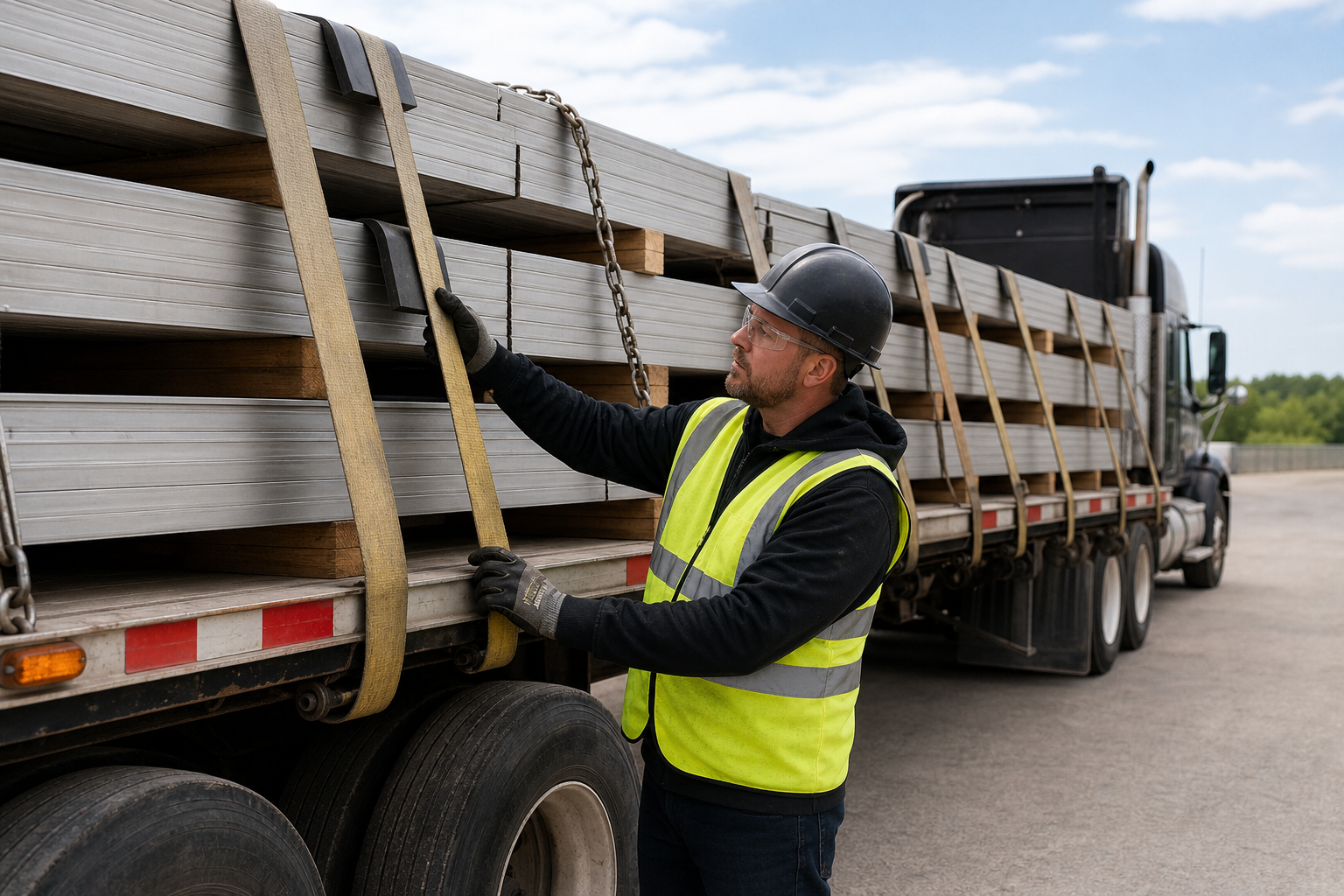
A flatbed driver needs to understand how the cargo, trailer, securement devices and weather conditions work together. Training should cover selecting suitable chains, straps, binders and edge protection for the load, placing securement points correctly, checking for movement and recognizing damaged or unsuitable equipment.
The lesson is not simply how to tighten a strap. You should be able to explain why a load needs a particular securement arrangement, identify vulnerable edges, account for the shape and weight of the cargo, and recognize when the arrangement needs correction before the vehicle moves.
Tarping and open-deck work
Tarping is a practical skill that combines load protection, equipment handling and safe positioning around the trailer. A useful programme should explain how to choose and position a tarp for the load, manage folds and tie-down points, protect the tarp from sharp surfaces and work without placing yourself in an unstable position.
Ask whether the training includes access to a flatbed or comparable open-deck equipment. Do not assume that a school’s tractor-trailer instruction includes tarp handling simply because its course mentions cargo securement.
Inspections and load checks
Flatbed preparation should include a deliberate inspection routine before departure and after conditions change. That means checking the load, straps, chains, binders, tarp, edge protection, lights and surrounding equipment, then repeating the check after driving, weather exposure or a significant change in the route.
A competent learner should practise making a decision, not only reciting a list. If a strap loosens, a tarp shifts or cargo appears to move, the correct response is to stop in a suitable safe location, assess the problem and correct it before continuing.
Flatbed and enclosed-trailer work are not the same
Flatbed and enclosed-trailer drivers share core tractor-trailer skills such as turning, backing, braking, space management, inspections and regulatory compliance. The main difference is that flatbed work exposes the cargo and places more of the loading, securement and weather-management responsibility in the driver’s daily routine.
| Decision area | Flatbed work | Enclosed-trailer work |
|---|---|---|
| Licence foundation | Generally begins with the Class A tractor-trailer pathway. | Generally begins with the same Class A tractor-trailer pathway. |
| Cargo exposure | Cargo is exposed to wind, rain, snow, road spray and temperature changes. | Cargo is enclosed, although the trailer and load still require inspection. |
| Securement responsibility | Chains, straps, binders, edge protection and load checks are visible and central to the work. | Securement still matters, but the cargo is usually loaded inside the trailer and is not managed in the same open-deck way. |
| Tarping | Some loads require tarp selection, placement, fastening and inspection. | Tarping is generally not part of standard enclosed-trailer operation. |
| Weather exposure | Loading and tarp work can involve wind, precipitation, cold and slippery surfaces. | Drivers still work in changing weather, but cargo handling is usually less exposed. |
| Equipment familiarity | You need practice with open-deck trailers and their securement equipment. | You need familiarity with enclosed trailers, doors, docks and interior load arrangements. |
This comparison does not mean one path is universally more difficult. It means the training emphasis differs. If your intended employer uses flatbeds, a basic Class A road-test course may be necessary but not sufficient for the employer’s operating procedures.
A sensible training sequence for a new flatbed driver
A complete flatbed-readiness plan should move from licensing fundamentals to supervised open-deck practice. Use the sequence below to assess whether a provider’s programme addresses both the road-test foundation and the job-specific skills you will need.
- Confirm eligibility and the licence target. Identify whether the job requires a Class A tractor-trailer licence, an Air Brake (Z) endorsement or other employer-specific credentials. Review the written-test and medical requirements that apply to your situation before paying a deposit.
- Build the classroom foundation. Look for instruction on vehicle systems, professional driving habits, cargo securement, documentation, hours of service and emergency response. These subjects help connect a flatbed decision to the wider responsibilities of commercial driving.
- Practise yard manoeuvres. Coupling, uncoupling, backing, turning and positioning should be practised in a controlled area before you face busy roads or loading sites. Repetition matters because small steering or positioning errors become more consequential with a loaded combination.
- Drive the tractor-trailer on the road. Road practice should develop observation, lane positioning, speed control, turns, braking, following distance and decision-making around other road users. JAZ advertises hands-on A tractor-trailer training in Toronto and Scarborough. Ask the school for the current balance of classroom, yard and road instruction.
- Add open-deck securement practice. Ask for supervised practice with chains, straps, binders, edge protection and load checks. If the provider does not offer this component, ask whether an employer supplies it during onboarding or whether you need a separate course.
- Practise tarp handling where the job requires it. Confirm whether you will work with actual flatbed equipment, what types of tarps are available and how the school teaches positioning, fastening and inspection in changing conditions.
- Complete a readiness review. Before accepting a flatbed position, you should know what the employer expects you to perform independently, what remains supervised and how competency will be assessed. A road-test pass does not by itself prove proficiency with every employer’s open-deck equipment or securement procedure.
Readers comparing local options can also review the broader tractor-trailer training pathway in Scarborough while keeping the flatbed-specific questions above in the discussion.
Choose your starting point by experience and job goal
Your best starting point depends on your current licence, tractor-trailer experience and intended work. Use these decision rules to avoid paying for the wrong type of preparation.
- If you hold a G licence and have not operated a tractor-trailer: begin by confirming Class A eligibility and the mandatory-training pathway. You need the broad foundation before specialized open-deck work will be useful.
- If you are already enrolled in Class A training: ask whether the programme uses flatbed equipment and whether cargo securement is taught through practical exercises or only classroom discussion. Arrange additional instruction if your target employer expects skills the course does not assess.
- If you hold a Class A licence but have only driven enclosed trailers: seek supervised orientation to the flatbed equipment, securement systems, load checks and tarp procedures used by the employer. Your road experience transfers, but the open-deck workflow still needs practice.
- If you have previous flatbed experience: identify the exact gap. You may need a refresher on securement, a new equipment orientation, documentation practice or employer-specific onboarding instead of repeating an entire entry-level programme.
- If an employer has already offered you work: ask for its equipment type, cargo categories, securement standards, tarp expectations and assessment process. Employer onboarding may be the most relevant source of job-specific preparation.
Flatbed hazards that training should make practical
Flatbed safety training should use realistic situations so you can identify a problem, choose a safe place to respond and correct the issue before it becomes a road hazard. The following examples are hypothetical training scenarios, not claims about any particular employer’s procedure.
A load appears to shift
You notice that the cargo no longer sits in the position you expected during a planned check. Training should rehearse stopping safely, inspecting the load and securement system, identifying the cause of movement and escalating the issue when the correction is outside your authority or equipment.
A strap or binder is damaged
A damaged securement device should not be treated as a minor inconvenience. Training should help you identify defects, understand when equipment must be removed from service and select a compliant replacement rather than improvising with an unsuitable device.
Wind affects tarp work
A tarp can become difficult to control in wind or wet conditions. A useful lesson should address planning the task, maintaining stable footing, avoiding uncontrolled material and stopping when conditions make the work unsafe. Tarping should never be taught as a rushed task performed around moving vehicles.
A busy loading area creates conflicting movements
Loading yards combine pedestrians, forklifts, loaders, trucks and changing instructions. Training should cover communication, controlled positioning, blind spots and the need to confirm that people and equipment are clear before a movement begins.
What JAZ confirms, and what to ask before enrolling
JAZ Truck, Bus & Forklift Driving School operates in the Toronto and Scarborough area and confirms hands-on training, one-on-one behind-the-wheel instruction, OSL-certified instructors, current equipment and convenient scheduling. Those are useful provider-selection factors for a learner building the Class A foundation.
JAZ advertises tractor-trailer training, not a separately named flatbed driver training course. Ask the school to answer the following questions in writing or during your enrolment conversation:
- Does the current programme provide access to a flatbed or another open-deck trailer?
- Will I practise chains, straps, binders, edge protection and load-securement inspections?
- Is tarp handling included, and if so, how much supervised practice is provided?
- Are open-deck skills assessed separately from the Class A road-test preparation?
- What does the current course duration include: classroom, yard, on-road and practical securement time?
- What is the current tuition, and which items are included or charged separately?
- Which tractor-trailer will be used for training and road-test preparation?
- Can the schedule work for part-time study, and how are driving lessons arranged?
- What documentation or completion record do I receive, and what licence outcome does it support?
- Can the school explain how its training connects with the requirements of my intended employer?
Ask how often you should drive to maintain steady progress if you are balancing lessons with work or family commitments. The answer will help you judge whether the available schedule suits your learning pace and road-test goal.
Flatbed driver training questions to settle before you commit
Does Ontario require a separate flatbed licence or endorsement?
No separate flatbed licence or endorsement is identified in Ontario’s truck-licensing guidance. Flatbed work generally begins with the Class A commercial truck pathway, followed by the open-deck preparation required by the employer or equipment used.
Is Class A training enough to start flatbed driving?
Class A training is the licensing foundation, but it may not cover every flatbed task. Ask specifically about practical experience with open-deck trailers, securement devices, tarp handling, load checks and the employer’s operating procedures before accepting that you are fully prepared.
Does JAZ offer a dedicated flatbed driver training course?
JAZ advertises A (Tractor-Trailer Driver Training), not a separately named flatbed course. Its Class A information mentions cargo securement among the training topics, but flatbed equipment, tarp practice and specialized assessment remain unconfirmed.
How long does flatbed driver training take?
There is no confirmed JAZ flatbed-specific duration. Any additional open-deck instruction depends on your experience, equipment exposure and the employer’s expectations, so ask the school for the current schedule and practical hours before enrolling.
What should I ask a school about flatbed equipment and securement practice?
Ask whether you will use an actual flatbed or open-deck trailer, practise chains and straps under supervision, handle tarps, inspect the load after movement and receive a practical assessment. Also ask what completion record you receive and whether the training supports only the Class A road test or includes additional job-specific preparation.
Choose the next training conversation
If you are new to commercial driving, start with the Class A foundation and then identify the flatbed skills your intended employer expects. If you already hold Class A, focus the conversation on equipment orientation, securement, tarping and assessment instead of assuming that general tractor-trailer experience covers every open-deck task.
For the licensing foundation, speak with JAZ Truck, Bus & Forklift Driving School about its A tractor-trailer driver training in the Toronto and Scarborough area, and ask which flatbed-specific preparation is currently available for your experience and employment goal.