
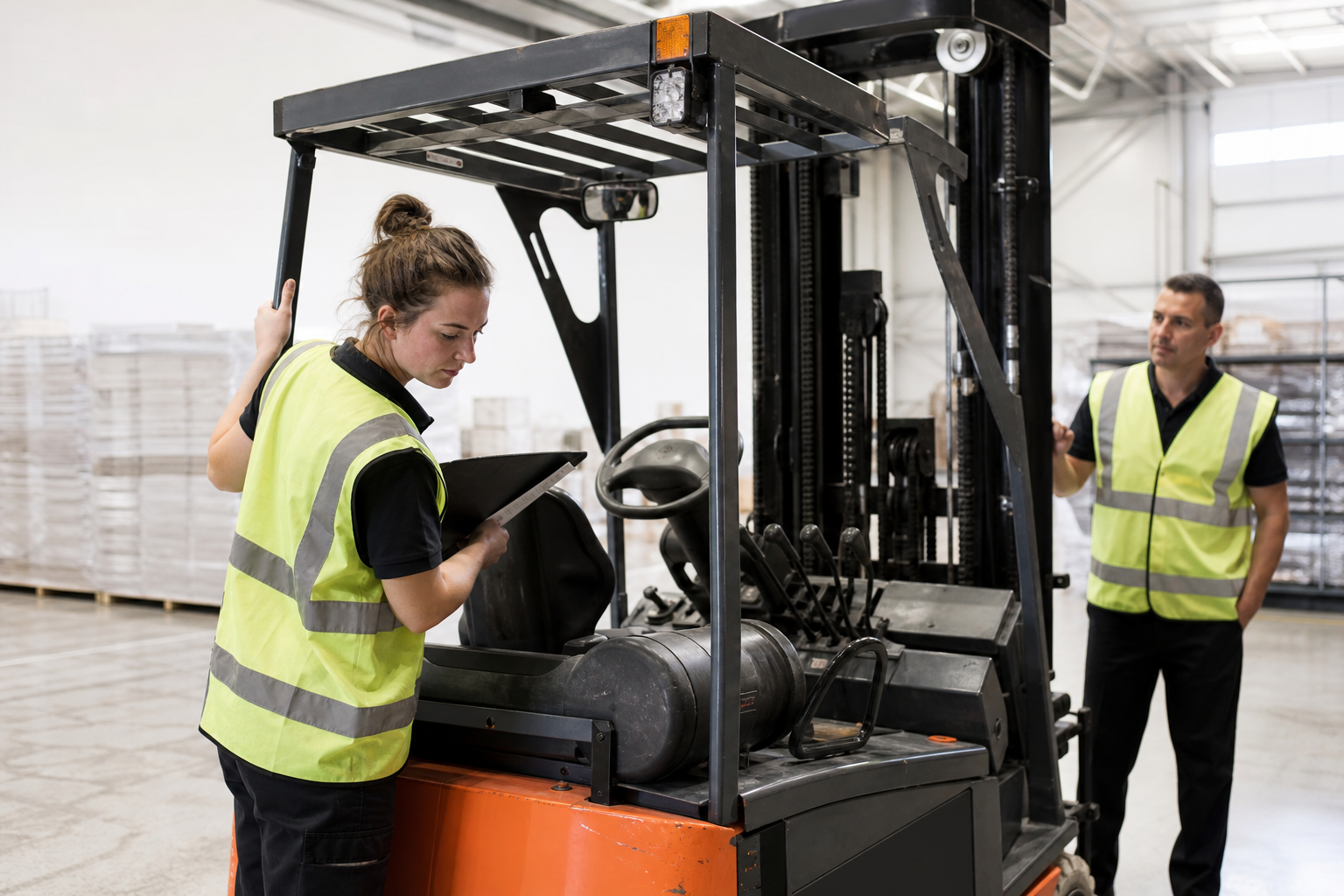
Ontario does not use one universal government forklift licence or certificate as the sole proof that a person may operate a lift truck. The practical requirement is demonstrated operator competency, supported by instruction, supervised practice, employer evaluation and workplace-specific authorization.
That distinction matters for both workers and employers. A training course can teach safe operation, but the employer remains responsible for establishing competence for the equipment, hazards and procedures at the workplace.
Key Takeaways
- Ontario’s framework centres on employer-established competency, not a universal provincial forklift licence.
- Training should address the specific truck, loads, workplace hazards, manufacturer guidance and site procedures.
- Workers need information, instruction and supervision before operating independently.
- A course certificate does not automatically authorize operation at every workplace or on every type of forklift.
- Ask the provider and employer how practical evaluation, documentation and workplace authorization will be handled.
Quick summary

- Ontario’s framework centres on employer-established competency, not a universal provincial forklift licence.
- Training should address the specific truck, loads, workplace hazards, manufacturer guidance and site procedures.
- Workers need information, instruction and supervision before operating independently.
- A course certificate does not automatically authorize operation at every workplace or on every type of forklift.
- Ask the provider and employer how practical evaluation, documentation and workplace authorization will be handled.
What Ontario requires for forklift operators
Ontario’s powered lift truck guidance says the employer is responsible for establishing a worker’s competence to operate a powered lift truck. A competent operator should understand the occupational health and safety requirements that apply to the work, associated hazards, the manufacturer’s specifications for the truck type and the workplace’s safety procedures. Ontario’s competency guidance sets out this employer-focused approach.
Training is part of a wider workplace safety programme. Employers must provide suitable information, instruction and supervision, and operator training should fit the workplace rather than exist as an isolated classroom exercise. Ontario’s powered lift truck safety guidance explains this broader approach.
This framework does not prescribe one course length, examination format, certificate design or expiry period for every forklift operator in Ontario. It also does not create a single public registry or universal government-issued forklift licence. Employers must still be able to show that their operators are competent for the work they perform.
What effective forklift training should cover

A useful programme combines foundational knowledge with practical instruction on the equipment and conditions the operator will encounter. The exact content should reflect the truck class, manufacturer instructions, loads, work area and employer procedures.
Core topics to look for
- Truck familiarization: Controls, capacity information, stability principles, attachments and manufacturer operating instructions.
- Pre-use inspection: Identifying defects, checking safety-critical components and reporting equipment that should not be operated.
- Safe load handling: Assessing loads, positioning forks, maintaining stability and avoiding overloads.
- Workplace hazards: Pedestrian traffic, blind corners, narrow aisles, ramps, dock edges, uneven surfaces and overhead obstructions.
- Operating practices: Starting, stopping, steering, reversing, parking, speed control and maintaining visibility.
- Fueling or charging: Following designated procedures for the relevant power source and equipment.
- Emergency response: Knowing what to do after a collision, tip-over, load incident or equipment defect.
- Supervised practical work: Demonstrating safe operation on relevant equipment before independent work is considered.
Manufacturer instructions and workplace conditions matter. An operator trained on one truck type may need additional instruction before using a different model, attachment or power system. Federal materials also emphasize instruction and training for inspection, fuelling and safe use where the federal framework applies. The applicable federal materials provide additional context.
A provider’s general course is not a substitute for site orientation. The employer should explain local traffic routes, pedestrian controls, loading areas, emergency procedures, restricted zones and the equipment actually used at the site.
Training is not the same as workplace authorization
The safest way to understand the process is as a sequence:
- Learn: Receive theory and safety instruction relevant to powered lift trucks.
- Practise: Operate the relevant equipment under suitable supervision.
- Demonstrate: Show the employer or designated evaluator that you can perform the required tasks safely.
- Orient: Learn the site’s layout, hazards, procedures and emergency controls.
- Authorize: The employer decides whether the worker is competent to operate the relevant equipment at that workplace.
A wallet card or course certificate should not be treated as automatic authorization. It may document that training occurred, but it does not remove the employer’s responsibility to evaluate workplace-specific competence and provide supervision where needed.
Training may also need review when the operator changes workplaces, equipment types, attachments, tasks or operating conditions. Clear records of completed training and demonstrated skills can also help workers explain their qualifications when pursuing new opportunities. For broader context on documenting skills and qualifications, keep the same principle in mind: records should accurately describe what was completed.
Forklift training versus commercial driver credentials
Forklift operator training is separate from Ontario highway licensing. A Class A or DZ licence concerns specific commercial vehicles operated on public roads. An Air Brake Z endorsement concerns air-brake systems, while Mandatory Entry-Level Training applies to covered Class A applicants before the relevant road test. None of these credentials, by themselves, establishes competence to operate a forklift.
Likewise, forklift training does not replace a commercial driver licence, MELT or an air-brake endorsement where a driving job requires one. Forklift training and commercial licence classes address different work and regulatory questions.
| Credential or process | What it addresses | What it does not prove |
|---|---|---|
| Forklift operator training | Safe operation principles, equipment use and practical skills | Automatic authorization at every workplace |
| Employer competency assessment | Whether the worker can safely perform relevant work on the employer’s equipment and site | A provincial forklift licence or universal transferability |
| Class A or DZ licence | Eligibility to drive specified commercial vehicles on public roads | Forklift operating competence |
| Air Brake Z endorsement | Use of applicable air-brake systems | Competence with powered lift trucks |
| MELT | Mandatory training for covered Class A applicants before the road test | Forklift authorization |
Mandatory Entry-Level Training is part of the commercial driver licensing path, not the forklift operator competency process.
Questions to ask before choosing forklift training
Whether you are a job seeker arranging training or an employer selecting a provider, ask:
- Which truck types, attachments and power systems are covered?
- How much practical instruction is included, and on what equipment?
- Is there a practical skills evaluation, and what does it assess?
- Will documentation identify the training completed, equipment covered and assessment date?
- What instructor qualifications and relevant operating experience can the provider confirm?
- What must the employer still complete after outside training?
- How will workplace hazards, pedestrian routes, loading areas and emergency procedures be addressed?
- What additional instruction may be needed if the operator changes equipment or sites?
- What are the total fees, schedule, cancellation terms and requirements for missed practical sessions?
Do not choose solely on the promise of a certificate. The stronger question is whether the training and follow-up process will help the employer establish competence for the actual work.
Finding forklift training in Toronto or Scarborough
For learners looking for forklift training in the Toronto and Scarborough area, JAZ Truck, Bus & Forklift Driving School states that it offers hands-on forklift instruction and safety training. The school also identifies OSL-certified instructors and serves the Toronto and Scarborough area.
Before enrolling, confirm the current equipment covered, practical training format, assessment process, documentation and how the course fits with the employer’s evaluation and authorization requirements.
Frequently asked questions
Does Ontario issue a government forklift licence?
No universal Ontario government forklift licence is the standard proof of authorization. The employer must establish that the worker is competent for the powered lift truck, workplace hazards and procedures involved.
Does a forklift certificate expire in Ontario?
Ontario does not set one universal expiry period for every forklift training certificate. Employers should determine when reassessment, refresher instruction or additional training is appropriate based on equipment changes, workplace conditions, incidents, observed performance and company policy.
Can forklift training transfer from one workplace to another?
Not automatically. Previous training may be useful evidence, but the new employer must still address its equipment, attachments, hazards, layout, procedures and competency expectations before authorizing operation.
Does Class A or DZ truck training qualify someone to operate a forklift?
No. Class A and DZ training concerns commercial road vehicles. A forklift has separate operating hazards and competency requirements, so commercial driving credentials do not replace forklift instruction and employer evaluation.
What should an employer verify before authorizing a forklift operator?
The employer should verify relevant training, practical ability, understanding of the truck and manufacturer requirements, awareness of workplace hazards and familiarity with site procedures. Appropriate supervision and required records should also be in place.
Build competence for the actual workplace
The most accurate answer to “what are the forklift operator training requirements in Ontario?” is that a course alone is not the complete process. Safe operation depends on suitable instruction, practical experience, employer-established competency, workplace orientation and supervision appropriate to the task.
Choose training that reflects the equipment and work involved, then ask the employer how evaluation and authorization will be completed. Keep forklift training separate from Class A, DZ, Air Brake Z and MELT requirements, because each addresses a different type of operation.
For current forklift training details in the Toronto and Scarborough area, contact JAZ Truck, Bus & Forklift Driving School and confirm the programme’s practical components, equipment coverage and documentation before enrolling.