
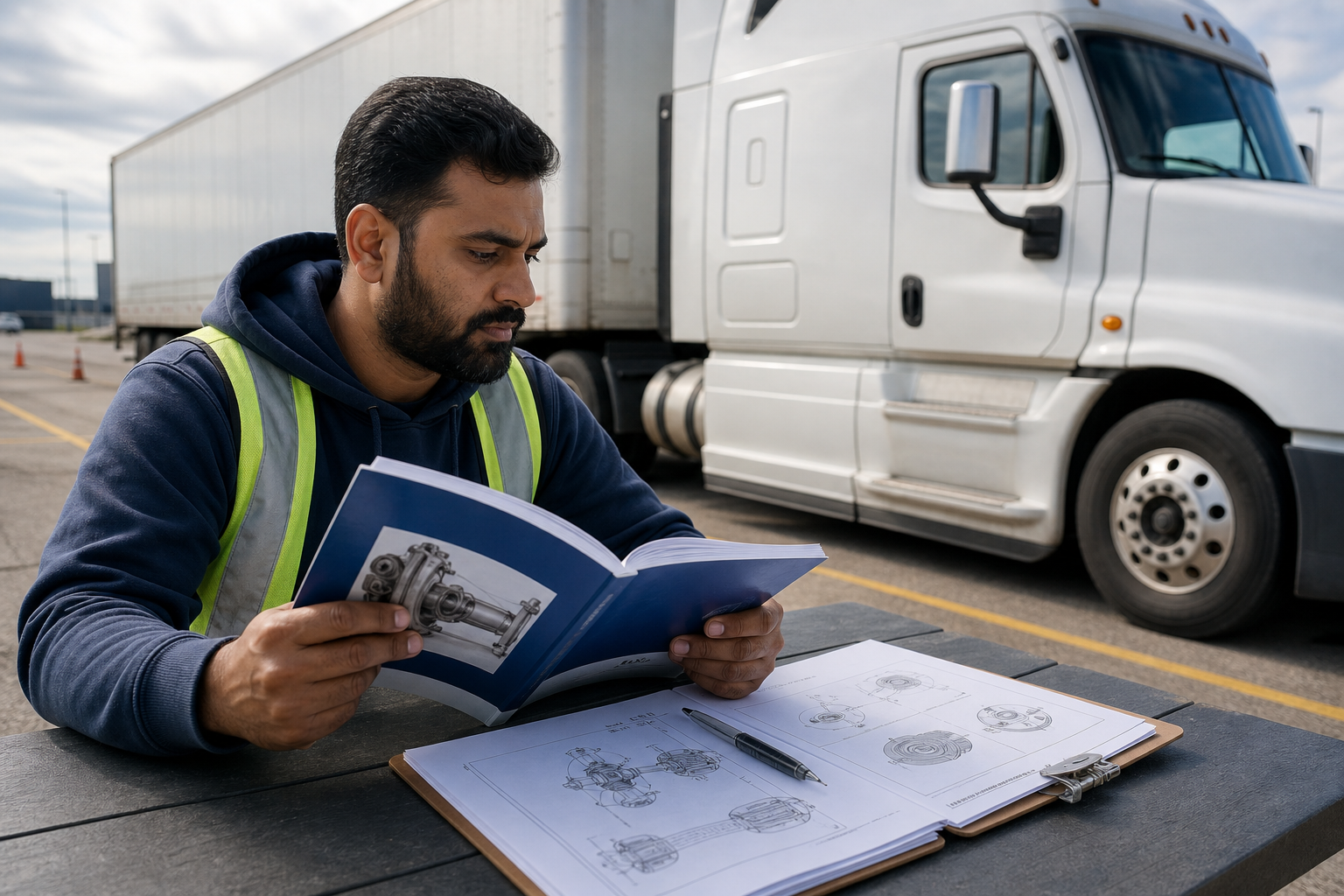
Effective air brake exam preparation in Ontario involves more than memorizing terminology. You need to confirm that the Z endorsement applies to the vehicle you intend to operate, study the current official handbook, understand both the knowledge and practical examination requirements, and decide whether self-study is enough for your experience.
Ontario requires a Z endorsement to operate a vehicle equipped with air brakes or an air-over-hydraulic brake system. The Official Air Brake Handbook is the primary study reference, while the examination remains a separate licensing step from any private training course.
Key Takeaways
- Confirm the vehicle, licence class and brake system before booking preparation.
- Study system components, maintenance, defect identification, inspection checklists, charts and circuit diagrams.
- Prepare for both the air brake knowledge examination and the practical examination where applicable.
- A course can provide structured theory and hands-on practice, but it does not itself grant the provincial Z endorsement.
- JAZ describes its Scarborough and Toronto course as a two-day, 12-to-16-hour theory-and-practical programme. Confirm current fees, recognition, equipment and documentation directly before enrolling.
What the Ontario Z endorsement means
The Z endorsement is connected to the vehicle’s braking system, not simply to the job title “truck driver” or “bus driver.” Ontario states that drivers need the endorsement to operate a vehicle equipped with air brakes or an air-over-hydraulic brake system. The requirement can therefore affect people pursuing different commercial licence classes.
Before paying for preparation, identify the vehicle you expect to drive, its brake system and the licence or employer requirement attached to it. A Class A, DZ, bus or other commercial pathway may involve additional eligibility, medical, knowledge, training and road-test steps. The Z endorsement addresses air-brake operation and does not replace those other requirements.
It is also worth separating the endorsement from related training. A course may teach the theory and practical skills needed for preparation and may issue its own completion certificate. The provincial endorsement still depends on completing the required official licensing process.
If you are unsure whether the vehicle and job match the route you are considering, review the distinction between vehicle and job requirements before selecting a DZ or air-brake programme.
Knowledge and practical examinations: what each one tests

Air brake preparation should cover two different kinds of understanding. The knowledge examination assesses what you know about the system, while practical preparation focuses on applying inspection and safety concepts to an air-brake-equipped vehicle. The current handbook supports preparation for the Air Brake (Z) Endorsement examination and includes material relevant to both areas.
| Preparation area | What to focus on | How to use it |
|---|---|---|
| Knowledge examination | Air-brake components, operation, maintenance, defects, compliance and inspection principles | Read the handbook carefully and test yourself on why each component or inspection step matters. |
| Practical examination | Inspection checklists, charts, circuit diagrams, defect recognition and safe inspection concepts | Practise explaining the inspection sequence and identifying what would make a system unsafe. |
| Official handbook | Definitions, system information, checklists and diagrams | Use the current Ontario edition as your foundation rather than relying only on informal notes. |
| Instructor-led preparation | Structured theory plus access to relevant equipment and guided practice | Use an instructor to clarify technical concepts and correct misunderstandings before testing. |
The handbook indicates that air brake examinations are conducted at DriveTest Centres. A private school can prepare you for the content and practical expectations, but it does not turn a training session into the official examination. Confirm the current testing process, documents and appointment requirements with the appropriate Ontario authority.
What to study for the air brake examination
Start with the system as a complete operating and safety system rather than attempting to memorize isolated parts. You should be able to connect components with their functions, understand the role of maintenance, and recognize why a defect can affect safe operation.
System components and operation
Review the major air-brake components and how air moves through the system. Pay attention to the purpose of each component, the relationship between pressure and braking, and the conditions that can affect system performance. Diagrams are useful because they help you understand connections instead of learning a list of names without context.
Maintenance, defects and brake adjustment
Study the difference between normal operation and a defect that requires attention. This includes understanding maintenance responsibilities, identifying defective components and learning the principles of brake adjustment. JAZ’s air brake training information specifically identifies components, maintenance, defect identification and brake adjustment as course topics.
For a structured explanation of these areas, the school’s air brake system and brake adjustment training page describes its theory and practical scope. Use it to compare the course content with your own preparation needs, then verify current details directly.
Inspection checklists and diagrams
Do not skip the handbook’s checklists, charts and circuit diagrams. These sections help you organize an inspection and understand the system relationships that practical preparation requires. Read each checklist with two questions in mind: what am I checking, and what finding would indicate a defect or unsafe condition?
Compliance and safe inspection practice
Ontario’s official guidance states that a defective air-brake system must not be operated on a road or highway. It also identifies situations where wheel chocks or blocks must be used when an inspection procedure requires the driver to leave the seat with the parking brakes released. These are safety requirements, not optional exam details.
A step-by-step air brake exam preparation plan
- Confirm the endorsement need. Identify the vehicle’s brake system and verify that the Z endorsement is the correct requirement.
- Check your starting requirements. Confirm your current Ontario licence, eligibility and other licensing steps. JAZ states that applicants for its course must hold a valid Ontario Class G licence or higher.
- Obtain the current handbook. Use Ontario’s Official Air Brake Handbook as your main study reference.
- Study in connected topics. Cover components, operation, maintenance, defects, brake adjustment, inspection checklists, charts, circuit diagrams and compliance.
- Practise inspection thinking safely. Work through inspection and defect-recognition concepts. Practical work should take place with suitable equipment and qualified supervision.
- Choose the right preparation format. Select self-study if you can interpret technical material confidently. Consider instructor-led preparation if you need guided explanations or access to suitable equipment.
- Confirm the official testing process. Verify the examination location, identification, appointment details and documentation through the official source.
Self-study or instructor-led preparation?
Self-study can work well for an applicant who is comfortable reading technical material, reviewing diagrams and following a structured schedule. It gives you control over the pace, but it may leave gaps if you misunderstand a component, inspection concept or defect.
Instructor-led preparation adds a second perspective and can connect handbook concepts with supervised practical learning. The tradeoff is that you must confirm the provider’s current recognition, course scope, schedule, equipment, fees and documentation. Neither approach guarantees a pass or removes the official examination requirement.
| Choose self-study when you need | Consider instructor-led preparation when you need |
|---|---|
| Flexible pacing and independent review | A planned timetable and an instructor who can answer questions |
| Low commitment while assessing the pathway | Practical exposure to relevant equipment |
| Time to work through the handbook repeatedly | Help connecting diagrams, components and inspection concepts |
| Confidence interpreting technical material independently | Guidance identifying gaps before the official examination |
If you have been away from commercial driving for some time, a refresher can help rebuild familiarity before a formal test. A useful independent review of refresher lessons for lapsed drivers can help frame that decision, although it does not replace Ontario’s official requirements.
What JAZ’s Air Brake course includes
JAZ Truck, Bus & Forklift Driving School states that its Air Brake (Z Endorsement) course is Ministry-approved and delivered in Scarborough and Toronto. The school describes the programme as two consecutive days totalling 12 to 16 hours, with theory and practical components, and says courses start every weekend at its Scarborough/Toronto location.
The stated course scope includes air-brake components, maintenance, defect identification and brake adjustment. JAZ also states that its instructors are certified or approved by the Ontario Safety League and that successful candidates receive an Ontario Safety League certificate.
These details describe the school’s training offer, not the result of the provincial licensing examination. Before enrolling, ask the school to confirm the current course recognition, exact practical equipment, attendance rules, fees, schedule, completion documentation and how the course fits with the separate DriveTest process.
Questions to ask before enrolling
- Does the course currently match the Ontario Z endorsement route for my vehicle and licence situation?
- Which theory topics and practical activities are included?
- What air-brake equipment will I use?
- Is the course still delivered over two consecutive days and 12 to 16 hours?
- What are the current fees, payment terms and cancellation rules?
- What licence must I hold before attending?
- What certificate or completion record will I receive?
- How does the course fit with the official examination process?
- Where and how do I book the official examinations?
Air brake exam preparation checklist
- Identify the vehicle and confirm its brake system.
- Verify that the Z endorsement is the correct requirement.
- Confirm your current licence and official eligibility requirements.
- Read the current Official Air Brake Handbook.
- Review components, operation, maintenance, defects and brake adjustment.
- Work through inspection checklists, charts and circuit diagrams.
- Understand the safety implications of a defective system.
- Choose self-study or supervised preparation based on your experience.
- Record course details, fees, schedule and documentation before enrolling.
- Confirm DriveTest arrangements before examination day.
Frequently asked questions
Do I need a Z endorsement to drive every truck or bus in Ontario?
No. The requirement depends on the vehicle’s braking system and applicable licensing rules. Ontario requires it for a vehicle equipped with air brakes or an air-over-hydraulic brake system.
What is the Official Air Brake Handbook used for?
It is Ontario’s primary preparation reference for the Air Brake (Z) Endorsement examination. It covers inspection-related checklists, charts and circuit diagrams.
Does completing an air brake course replace the Ontario Z endorsement examination?
No. A course provides preparation and may issue its own certificate, but it does not by itself grant the provincial endorsement.
Where are Ontario air brake examinations conducted?
Ontario’s Official Air Brake Handbook states that air brake examinations are conducted at DriveTest Centres. Confirm current booking and identification requirements before attending.
Conclusion: choose preparation that matches your licensing path
The strongest air brake exam preparation plan begins with the correct vehicle and endorsement requirement. Study the Official Air Brake Handbook, focus on system components, defects, maintenance, brake adjustment and inspection concepts, and prepare for the difference between knowledge and practical testing.
Self-study may suit applicants who can interpret technical material and practise consistently. Instructor-led preparation may be better when you need structured theory, supervised practical exposure or help connecting handbook concepts to equipment. In either case, verify the official DriveTest process.
For applicants in Toronto and Scarborough, JAZ Truck, Bus & Forklift Driving School offers the stated Air Brake (Z Endorsement) course with theory and practical instruction. Contact the school to confirm current eligibility, schedule, fees, equipment and course documentation before enrolling.