
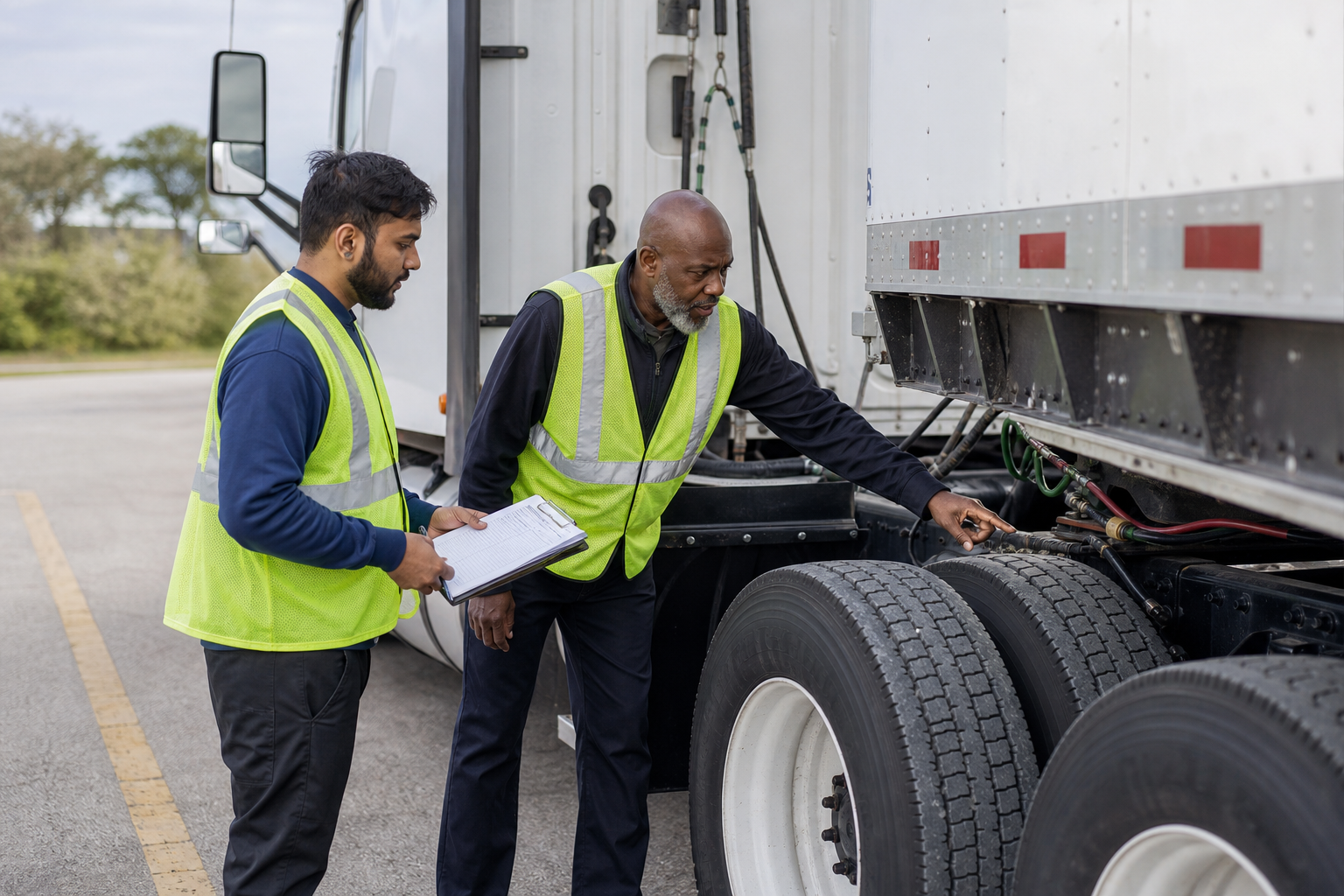
If you plan to drive a tractor-trailer in Ontario, start by confirming the vehicle and brake configuration, then investigate the Class A licensing pathway. Do not assume that any truck course, including DZ training, will prepare you for the vehicle you intend to operate.
Ontario’s Class A process includes eligibility checks, knowledge testing, medical and vision requirements, required training for applicable applicants, and a road test. The training provider can prepare you, but Ontario licensing authorities determine whether you qualify and what licence conditions apply.
Start with the tractor-trailer job and vehicle
A job title such as “truck driver” does not identify the correct licence by itself. Before contacting a school, record the vehicle you expect to drive, whether it pulls a trailer, the trailer’s configuration, the registered weight and the braking system. If an employer is involved, ask which licence and endorsements are mandatory for its equipment.
Ontario states that a full Class A licence covers full air-brake systems on both the tractor and trailer. The province also uses the transmission in the road-test vehicle to determine which types of Class A trucks a driver may operate. Review the Ontario truck driver licence requirements before paying for training.
In everyday conversation, people often use “AZ” to describe a full Class A licence with the Z air-brake qualification. However, Class A, the Z endorsement and a training programme are not identical concepts. A school should explain exactly which licence, endorsement and vehicle configuration its course addresses.
For a practical overview of how licence classes, training and road testing fit together, review Class A tractor-trailer training before comparing providers.
Class A tractor-trailer training versus DZ training

Class A and DZ training serve different driving goals. A Class A pathway is generally relevant when the work involves a tractor-trailer combination. A Class D pathway may be appropriate for certain straight-truck jobs or combinations within the applicable weight and vehicle limits, but it should not be selected for a tractor-trailer role without confirming the legal requirement.
| Decision point | Class A tractor-trailer path | DZ path |
|---|---|---|
| Typical vehicle goal | Tractor-trailer combinations | Applicable straight-truck or permitted truck combinations |
| Trailer question | Confirm the tractor and trailer configuration | Confirm the towed vehicle and applicable limits |
| Brake question | Check whether full air brakes apply to the tractor and trailer | Confirm whether a Z endorsement is required for the vehicle |
| Training decision | Ask about Class A requirements, MELT and the road-test vehicle | Ask whether the course matches the intended Class D vehicle |
| Best next step | Verify the employer’s tractor-trailer requirements | Verify the straight-truck job and licence requirements |
The distinction matters because completing the wrong course can leave you with training that does not match the vehicle or job. If you are comparing options, read about DZ truck driver training and confirm the vehicle, trailer and brake details with the employer or licensing authority.
Ontario Class A eligibility and licensing steps
Ontario’s stated requirements for Class A and D applicants include being at least 18 years old, holding a valid Ontario Class G or higher licence or an equivalent, passing the operating-knowledge test, meeting vision standards, providing a satisfactory medical certificate and demonstrating driving competence during a road test. See the MTO handbook requirements for Class A and D applicants for current details.
In practical order, your preparation may involve:
- Identifying the vehicle and confirming the required licence class.
- Checking your current licence, age and eligibility documents.
- Completing the required knowledge, vision and medical steps.
- Confirming whether you are subject to Mandatory Entry-Level Training.
- Choosing a programme that matches the vehicle and road-test requirements.
- Completing the required training and arranging the road test.
- Practising the inspection, control and driving skills required for the test.
These steps are not a substitute for checking current provincial instructions. A school can explain its course and help you prepare, but it cannot make the licensing decision or waive an Ontario requirement.
What MELT means for Class A applicants
Mandatory Entry-Level Training, commonly called MELT, is the required training framework for applicable Class A applicants before they attempt the Class A road test. Ontario’s official licensing information confirms that the required training must be successfully completed before the road test for applicants subject to those Class A requirements.
When comparing a Scarborough provider, ask for the programme’s current recognition details and the documentation you will receive after completion. Do not rely on a general statement such as “truck training” if you need a Class A pathway. Confirm that the course is the specific programme required for your situation.
Also ask whether classroom learning, vehicle inspection, air-brake content, manoeuvring, road driving and assessment are included. Request the written scope rather than assuming that a course title describes every component.
Check transmission and road-test implications
The transmission used for your Class A road test matters. Ontario states that it can affect which types of Class A trucks you may operate, so the training vehicle should be discussed before you enrol.
Ask the school:
- What transmission does the training vehicle use?
- What transmission and configuration will be used for the road test?
- Will the vehicle match the type of work you plan to pursue?
- Is the road-test vehicle included, and under what conditions?
- What happens if you need additional practice before testing?
This is especially important if an employer expects you to drive a particular type of tractor-trailer. A course may help you prepare for a road test, but your licence conditions and workplace requirements still need to match the equipment you will operate.
How to compare Class A training providers in Scarborough
Location is useful, but it should not be the only selection criterion. Compare providers against the same questions so that a low advertised price or a broad promise does not hide differences in practical access and terms.
| What to compare | Questions to ask |
|---|---|
| Programme status | Is this the current Class A programme, and can you explain its MELT recognition? |
| Practical driving | How much behind-the-wheel practice is included, and how is progress assessed? |
| Equipment | What tractor, trailer, transmission and braking system will I use? |
| Instructor access | Will I receive individual coaching, and who will provide it? |
| Road-test preparation | Which inspection, manoeuvring and road skills are practised? |
| Schedule | Are part-time appointments available, and how far in advance are they booked? |
| Test arrangements | Does the school provide a suitable road-test vehicle, and are booking costs separate? |
| Support after training | What employment or recruiting assistance is offered, and what does it not guarantee? |
JAZ Truck, Bus & Forklift Driving School serves Toronto and Scarborough and describes its commercial training as hands-on, with one-on-one instruction and road-test preparation. Those features may be useful if you learn best through individual coaching, but ask the school to confirm the current Class A programme scope, vehicle configuration and MELT documentation before enrolling.
For another provider-comparison perspective, consider how to choose Class A training before you enrol. The same evaluation principles apply whether you are comparing schools in Scarborough, Toronto or elsewhere in the Greater Toronto Area.
Confirm the full cost, schedule and written terms
Ask for the complete financial picture in writing. Tuition may not be the only cost. Clarify whether the quoted amount includes classroom instruction, practical driving, the road-test vehicle, test booking support, additional practice, retesting and required documentation.
Also request the cancellation, transfer and refund terms before making a payment. If a school offers financing or payment arrangements, ask about eligibility, total repayment, timing and what happens if you pause or cancel training. Never assume that financing approval or an advertised monthly payment represents the full cost.
Flexible scheduling can make training more manageable for a part-time learner, but confirm the actual appointment availability rather than relying on a general “flexible” claim. Ask how missed sessions, instructor changes and additional lessons are handled.
Finally, separate licensing preparation from employment support. A recruiting introduction, resume assistance or employer connection is not a job offer, and a training provider cannot guarantee licensing, hiring, income or a particular driving role.
Class A training enrolment checklist
Use this checklist before paying a deposit or signing an agreement:
- Write down the tractor, trailer, weight, transmission and braking system for the job you want.
- Confirm whether the job requires Class A, a Z qualification or another licence condition.
- Check your current licence, age, medical and vision eligibility.
- Ask for the provider’s current MELT recognition details if you are subject to Class A MELT requirements.
- Request the full course outline, including classroom and behind-the-wheel components.
- Confirm the training and road-test vehicle configuration.
- Ask how much practical driving is included and what extra lessons cost.
- Review the total fees, test arrangements, cancellation policy and payment terms.
- Ask what road-test preparation covers and who makes the final licensing decision.
- Get any employment-support description in writing and treat it separately from licensing.
Frequently asked questions
Do I need Class A or DZ training to drive a tractor-trailer in Ontario?
Start by identifying the tractor-trailer combination, trailer and braking system. A full tractor-trailer goal generally points you toward investigating the Class A pathway, while DZ may apply to a different vehicle configuration. Confirm the legal requirement with Ontario and the employer before selecting a course.
Does the transmission used for my Class A road test matter?
Yes. Ontario states that the transmission in the road-test vehicle affects which types of Class A trucks you may operate. Ask the school to explain the transmission restriction and ensure the training and test vehicle suit your intended work.
What should I verify about a school’s MELT programme?
Ask whether the specific programme is currently recognized for the Class A requirements that apply to you, what completion documentation you receive and which training components are included. A generic commercial truck course should not be assumed to satisfy MELT.
Can Class A training guarantee that I will pass the road test or get hired?
No. Training can provide instruction and practice, but Ontario authorities decide licensing outcomes. Employers may also impose requirements involving experience, records, availability, insurance or additional training. Treat job connections as support, not a guarantee.
What should I ask about practical driving time and extra lessons?
Ask how driving time is scheduled, whether it is individual or shared, which manoeuvres are practised, how readiness is assessed and what additional lessons cost. Confirm whether the road-test vehicle and any test-day services are included in the quoted price.
Choose the course that matches the truck you plan to drive
The safest enrolment decision starts with the vehicle, not the course name. Confirm the tractor-trailer configuration, air-brake system, transmission and employer requirement, then map those facts to Ontario’s current Class A eligibility, MELT and road-test rules.
Once the pathway is clear, compare providers on practical driving access, instructor support, equipment, schedule and written terms. A Scarborough location and one-on-one coaching may be valuable, but the programme must still match your licensing goal and the equipment you expect to operate.
For current Class A tractor-trailer course details, programme scope and scheduling in Scarborough, contact JAZ Truck, Bus & Forklift Driving School and ask the verification questions in this guide before committing your money or time.