
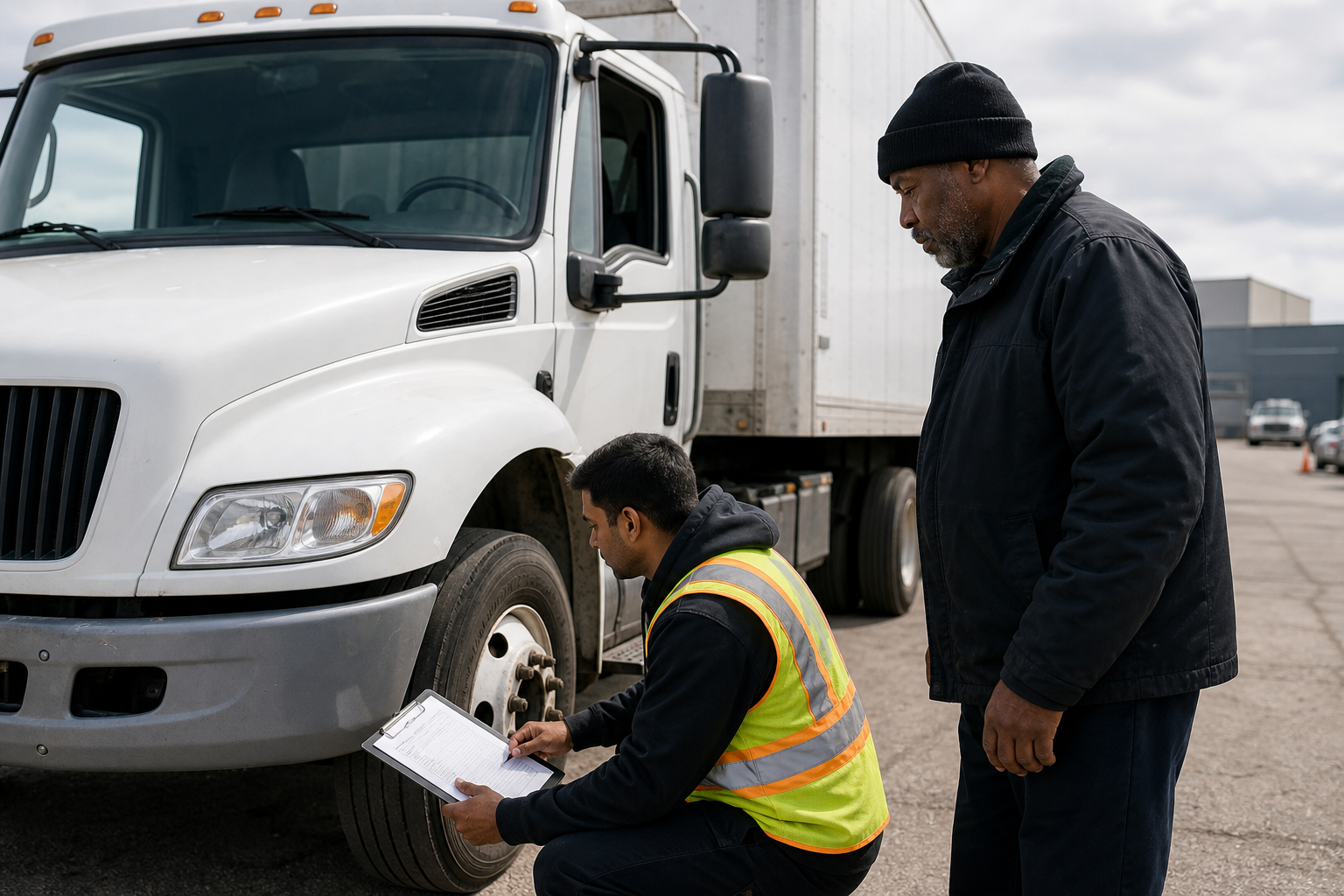
The right pre-trip inspection training should do more than provide a checklist to memorize. It should match your vehicle and licence pathway, combine explanation with hands-on practice, teach you to recognize potential defects, and prepare you to describe your inspection clearly during the Ontario road test.
Whether you are preparing for DZ truck training, BZ school bus driver training, or CZ coach bus driver training, the inspection routine must relate to the vehicle you will operate. You should also learn how inspection connects with in-cab checks, passenger responsibilities, documentation, and the decision to delay driving when a safety concern is identified.
What effective pre-trip inspection training should cover
Ontario treats a daily vehicle inspection as a safety responsibility, not simply an examination exercise. The Ministry of Transportation states that drivers must inspect their vehicles and determine whether they are in safe operating condition. For applicable commercial vehicles, this is commonly called a pre-trip inspection or circle check.
Strong training should combine several elements:
- A logical inspection sequence: Know where to begin, how to move around the vehicle, and how to avoid skipping areas.
- Vehicle-specific knowledge: A straight truck, school bus, and coach bus do not have identical inspection or operating responsibilities.
- Defect recognition: Learn to identify a possible problem and understand how it may affect safe operation.
- In-cab checks: Practise the controls, gauges, safety equipment, and other checks relevant to the vehicle.
- Clear verbal explanation: Road-test preparation requires you to explain what you are checking, what a concern could mean, and what action would follow.
- Repeated practical attempts: Skills become more reliable when you inspect the vehicle, receive corrections, and repeat the sequence.
Classroom learning can explain terminology and procedures, but it cannot replace time examining the type of vehicle you plan to drive. Ask how much training involves your own inspection attempts rather than watching an instructor demonstrate.
Daily inspection duties versus road-test preparation

A daily inspection is part of responsible commercial vehicle operation. Ontario’s commercial vehicle safety requirements explain that specified trucks, trailers, and converter dollies above the applicable weight threshold require an inspection within the permitted period before driving. The official MTO Truck Handbook inspection guidance emphasizes that drivers must determine whether the vehicle is in safe operating condition.
Road-test preparation has an additional performance dimension. Ontario says the truck road test includes a daily vehicle inspection test, with six randomly generated items and an in-cab check. You must be able to inspect and describe the items, explain potential defects, and state what you would do if a concern is found. Confirm current requirements through the Ontario truck driver licence information.
This distinction matters when comparing providers. A course may discuss inspection rules without giving you enough practice to complete the sequence aloud under test conditions. Ask whether instructors simulate the inspection portion, correct your terminology, and assess both what you do and what you say.
How inspection training changes by vehicle type
The broad purpose is the same across commercial vehicles: identify safety concerns before driving. The practical context changes with the vehicle, licence, and work it is designed to perform.
| Training pathway | Inspection focus | Related preparation |
|---|---|---|
| DZ straight truck | Pre-trip truck inspection, vehicle condition, and in-cab checks | Log book inspection, manoeuvring, backing, and road-test preparation |
| BZ school bus | Pre-trip bus inspection and checks relevant to a school-purpose bus | Passenger procedures, observation, emergency exits, and in-cab theory |
| CZ coach bus | Pre-trip coach bus inspection and vehicle-specific observations | Passenger loading and unloading, emergency exits, observation, and professional driving habits |
Do not assume that training for one category automatically prepares you for another. If your employment goal involves passengers, the inspection lesson should sit within a wider discussion of observation, passenger procedures, and emergency equipment.
DZ and truck inspection training
For a straight-truck learner, inspection practice should connect to the complete driving routine. That includes examining the vehicle before departure, completing relevant in-cab checks, understanding log book expectations, and knowing how inspection findings affect the decision to proceed.
JAZ Truck, Bus & Forklift Driving School’s DZ programme specifically lists pre-trip truck inspection, log book in-cab inspection, one-on-one training, and truck access for the MTO road test. These details are useful questions for any provider, whether you are comparing a Scarborough truck driving school or another Toronto option.
Ask to practise the inspection on the same general vehicle type used for your preparation. You should also ask how the instructor handles a missed item, an unclear explanation, or a possible defect. The objective is not to memorize gestures. It is to develop a repeatable process for determining whether the vehicle is ready to operate.
BZ and CZ bus inspection training
Bus inspection training needs to account for both the vehicle and the people it carries. School bus and coach bus learners should ask whether instruction includes pre-trip bus inspection, observation, emergency exits, in-cab theory, and passenger procedures.
JAZ’s BZ course information identifies pre-trip bus inspection, passenger pick-up and drop-off procedures, railway crossings, in-cab theory, emergency exits, and observation. Its CZ course information also refers to pre-trip coach bus inspection, passenger procedures, emergency exits, observation, and professional driving habits.
The distinction between BZ and CZ matters. A learner preparing for school bus work should ask about school-purpose bus responsibilities, while a coach bus learner should confirm that the vehicle and passenger environment reflect the intended licence pathway. In both cases, inspection practice should include explaining what is being checked and how a concern would be handled before passengers are carried.
Why hands-on practice and instructor feedback matter
Pre-trip inspection training is easier to evaluate when the provider can describe exactly what you will do, not only what the course discusses. Useful questions include:
- Will I inspect the relevant truck or bus myself?
- How many individual practice attempts are included?
- Will the instructor correct missed checks and unclear explanations?
- Will I practise in-cab inspection as well as the exterior walk-around?
- How will I learn to identify a possible defect and explain the next step?
- Will practice reflect the inspection component of the applicable road test?
JAZ describes its commercial driver instruction as hands-on, one-on-one training delivered by OSL-certified instructors, with current equipment and flexible scheduling in the Toronto and Scarborough area. These are relevant selection factors, but confirm the exact vehicle, schedule, practical format, and road-test preparation included in the programme you are considering.
A checklist for comparing pre-trip inspection training
- Confirm the credential: Is the programme for A, DZ, BZ, CZ, or another specific pathway?
- Match the vehicle: Will you train on the truck, school bus, or coach bus relevant to your goal?
- Ask about individual practice: How much time will you spend performing the inspection yourself?
- Check in-cab coverage: Does training include relevant controls, gauges, and safety equipment?
- Discuss defects: How are possible defects explained and handled before driving?
- Verify verbal coaching: Will the instructor assess whether you can describe each check clearly?
- Ask about road-test preparation: Does the provider practise the inspection demonstration and explain current testing expectations?
- Review documentation: What licence, medical, vision, identification, or other documents are required?
- Compare scheduling: Are part-time lessons available if you are working or changing careers?
- Confirm costs directly: Ask for current tuition, payment terms, and financing information in writing.
A provider that answers these questions clearly gives you a better basis for comparison than one that only advertises a broad commercial driving course. For additional selection factors, review how to compare truck driving schools in Toronto, while keeping your questions focused on inspection practice.
Choosing training in Toronto or Scarborough
Local convenience matters because inspection skills benefit from repeated practice. A nearby provider may make it easier to attend part-time lessons, return for additional coaching, and practise on relevant equipment rather than relying on one short session.
JAZ Truck, Bus & Forklift Driving School operates at 1750 Brimley St Unit 100 in Scarborough and serves learners in Toronto and Scarborough. Its programmes cover truck, bus, Air Brake (Z), and forklift pathways, but the correct choice still depends on your intended credential and the practical instruction available in that programme.
Before enrolling, ask whether the schedule allows enough time for repeated inspection attempts, one-on-one feedback, and preparation for the applicable road test. Confirm current programme details directly, since course structure, availability, and requirements can change.
Frequently asked questions
Is pre-trip inspection training the same for DZ, BZ, and CZ licences?
No. All three require vehicle-specific inspection knowledge, but the vehicle and operating context differ. DZ training centres on a truck, while BZ and CZ preparation should also address passenger procedures, observation, emergency exits, and the relevant bus environment.
Does Ontario’s truck road test include a pre-trip inspection?
Yes. Ontario states that the truck road test includes a daily vehicle inspection test with six randomly generated items and an in-cab check. Training should prepare you to perform the checks and explain potential defects clearly.
What should I ask a training provider about defect recognition?
Ask how instructors teach you to identify a possible defect, explain its significance, and decide what should happen before the vehicle is driven. Avoid relying on a course that only provides a list without practical examples and feedback.
Can pre-trip inspection practice be completed one on one?
It can be, depending on the provider and programme. Ask how much individual time is included, whether you perform the inspection yourself, and whether the instructor corrects your sequence, observations, and verbal explanation.
Should bus training include passenger procedures and emergency exits?
Yes. These topics are relevant because inspection is part of a wider responsibility for operating a passenger vehicle. Confirm that content matches your BZ or CZ pathway rather than assuming truck inspection instruction transfers directly.
How should you choose your next step?
Start with the credential and vehicle you intend to use. Then choose pre-trip inspection training that gives you hands-on practice, individual feedback, in-cab instruction, defect recognition, and preparation for explaining the inspection during the applicable Ontario road test.
If you are comparing providers in Toronto or Scarborough, ask for the exact programme structure rather than relying on a general promise of commercial driver training. Learners can ask JAZ Truck, Bus & Forklift Driving School about the relevant DZ, BZ, CZ, Air Brake (Z), or other available training pathway, along with current schedules, requirements, and practical inspection preparation.
Comments are closed