
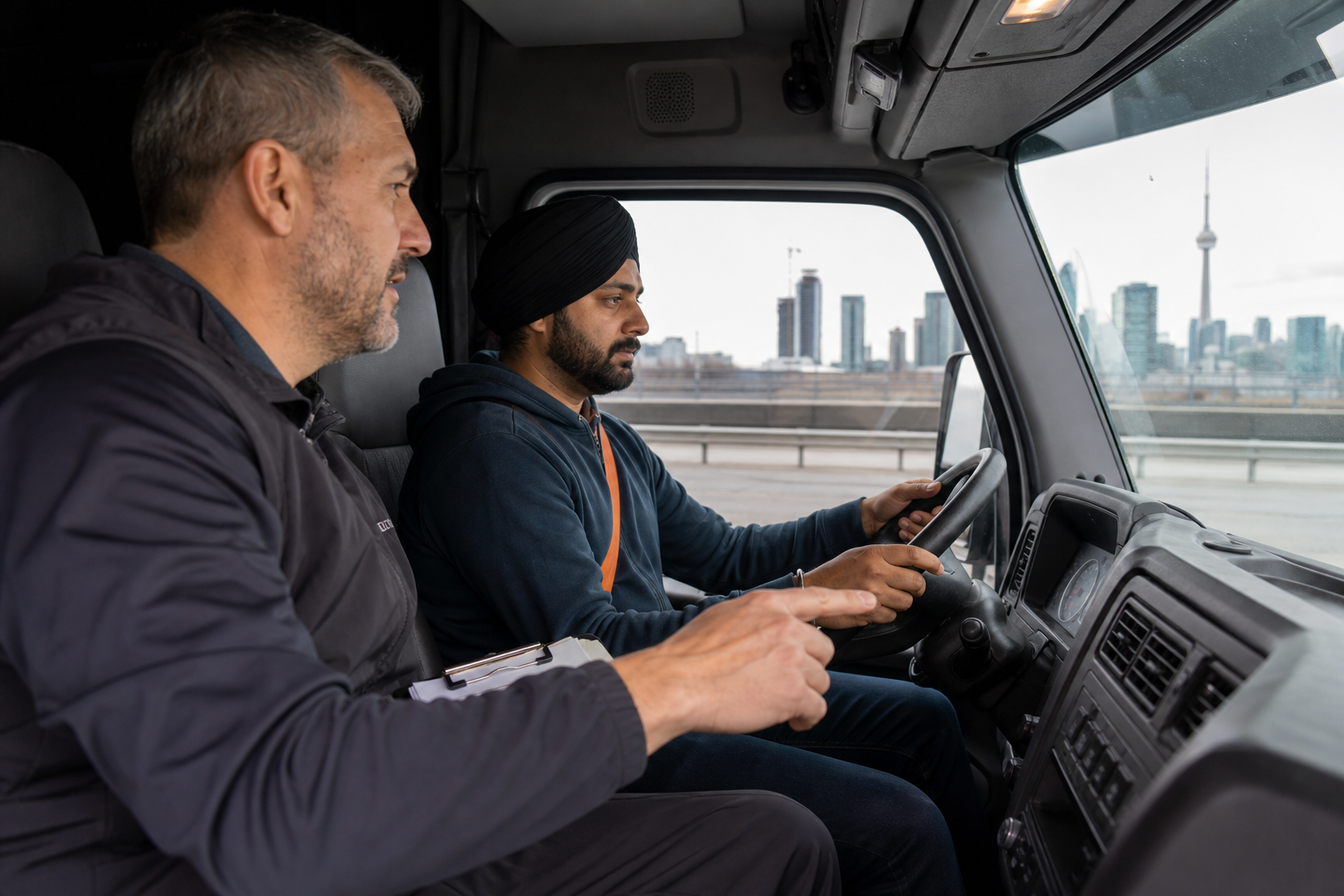
One-on-one behind-the-wheel training can be a strong choice when you need direct feedback, targeted repetition, and practical coaching for a commercial licence or workplace certification. However, the label alone does not tell you how much time you will personally spend driving or what the course includes.
This article focuses on commercial driver training in Toronto and Scarborough, not regular passenger-car lessons. Use the criteria below to compare individual instruction with shared practice and decide whether a Class A, BZ, CZ, DZ, Air Brake (Z), or forklift program fits your goal.
Key Takeaways
- Confirm your exact licensing or certification goal before comparing lesson formats.
- Ask how much individual driving time is included, rather than assuming every scheduled hour is hands-on.
- Check instructor credentials, equipment, feedback methods, road-test preparation, scheduling, and total cost.
- Part-time training can help with work or family responsibilities, but it still needs regular practical practice.
- Individual coaching can support readiness, but it cannot guarantee a road-test pass, licence, or job.
Quick summary

- Confirm your exact licensing or certification goal before comparing lesson formats.
- Ask how much individual driving time is included, rather than assuming every scheduled hour is hands-on.
- Check instructor credentials, equipment, feedback methods, road-test preparation, scheduling, and total cost.
- Part-time training can help with work or family responsibilities, but it still needs regular practical practice.
- Individual coaching can support readiness, but it cannot guarantee a road-test pass, licence, or job.
What one-on-one behind-the-wheel training should mean
Genuine one-on-one commercial instruction means you operate the vehicle while an instructor gives you direct attention. The instructor can observe your decisions, identify specific skill gaps, explain corrections, and give you another opportunity to practise the same skill.
That differs from sharing a vehicle with other learners and spending part of the session observing. Observation can have value, but it should not be confused with personal driving time. Ask whether the quoted practical hours are individual, shared, or a combination of both.
Useful individual coaching should include clear explanations, safety-focused feedback, opportunities to repeat difficult manoeuvres, and a way to discuss your progress. A behind-the-wheel instruction checklist can help you ask about the structure of each practical session.
Availability also matters. The format, frequency, vehicle, and times may vary by course, so confirm the current arrangement for the specific programme you are considering.
One-on-one instruction versus shared practice

Neither format is automatically right for every learner. The better choice depends on how much practice you need, how you learn, your schedule, and whether the package provides enough direct vehicle time.
| Factor | One-on-one instruction | Shared practice |
|---|---|---|
| Driving time | You can ask for a clear account of your own time operating the vehicle. | Scheduled time may be divided between driving and observing. |
| Feedback | Feedback can focus closely on your habits, decisions, and technique. | Feedback may be delivered while several learners rotate through the vehicle. |
| Repetition | The instructor can spend more time on a difficult skill. | Practice may follow the group’s overall schedule. |
| Scheduling | Sessions may be easier to tailor, subject to availability. | Sessions may depend on multiple learners’ schedules. |
| Cost clarity | Ask whether the individual format is included or priced separately. | Ask how tuition relates to driving and observation time. |
Do not ask only, “Is this one-on-one?” Ask, “How much time will I personally drive, how is progress recorded, and what happens if I need more practice?”
Match the coaching format to your training goal
Class A tractor-trailer training
Class A applicants need instruction addressing tractor-trailer handling, safety routines, vehicle control, and road-test preparation. Individual coaching may help identify problems with observations, turns, positioning, backing, or other skills requiring repeated correction.
Ontario’s mandatory Class A training requirement should be confirmed separately from the lesson format. Ask whether the current programme meets the applicable requirement, how classroom and practical instruction are organised, and how much individual tractor-trailer driving is included.
BZ and CZ bus training
BZ school bus training and CZ coach bus training involve different vehicle contexts and passenger-transport goals. Ask what vehicle you will use, which skills are covered practically, and how the school prepares you for the relevant licensing assessment. Do not assume truck training automatically covers bus-specific requirements.
DZ straight-truck training
DZ training is intended for straight-truck driving. Ask how practical sessions reflect the course vehicle and whether instruction includes the manoeuvres and road skills relevant to the assessment. A few private lessons may not replace structured commercial training or road-test preparation.
Air Brake (Z) and forklift training
An Air Brake (Z) course has a different purpose from full vehicle-class training. Ask whether the programme covers the required knowledge and practical elements, what equipment is used, and whether instruction is individual.
Forklift training combines safety knowledge with practical operation. Individual instruction can let an instructor watch control technique, load handling, positioning, and workplace safety habits more closely. Confirm what certification or completion documentation the programme provides.
How individual coaching supports road-test preparation
One-on-one coaching can make it easier to identify a weakness and build practice around it. Ask how readiness is assessed, whether feedback follows each session, and how remaining skill gaps are communicated.
For Class A applicants, the supplied provincial guidance summarised by JAZ states that mandatory training must be completed before the road test and includes at least 103.5 hours of instruction. That requirement applies to the Class A pathway, not automatically to BZ, CZ, DZ, Air Brake, or forklift training.
JAZ’s information recommends examining individual driving time, practical instruction, feedback, equipment, and preparation before choosing a programme. Review its questions about Class A road-test preparation when comparing providers.
Individual coaching supports preparation, but it does not guarantee a pass. You must meet the applicable requirements and demonstrate the required skills during the assessment.
Check the instructor and equipment before booking
Ask who will teach your practical sessions and what credentials are relevant to the programme. JAZ states that it uses OSL-certified instructors for truck, bus, and forklift courses. Because the supplied evidence does not define the full scope of that certification, ask what it means for your selected course.
Equipment should match the training goal. Ask what vehicle or forklift you will use, whether it is up to date, and how much hands-on time is included. JAZ states that it uses up-to-date equipment and hands-on instruction across its courses.
Balance individual practice with schedule and cost
Flexible scheduling can help adults balance work, family, or other responsibilities. JAZ states that it offers flexible schedules for learners studying part time in the Toronto and Scarborough area.
Convenience should not come at the expense of regular practice. Ask how frequently sessions should be scheduled, whether long gaps are likely, and how cancellations or rescheduling work. JAZ’s information on flexible part-time Class A training provides a useful comparison framework.
- How many individual driving hours are included?
- Are classroom, vehicle, and assessment preparation included?
- Is additional practice charged separately?
- What is the current tuition and are administrative costs separate?
- What financing options and approval terms apply?
One-on-one commercial training enrolment checklist
- Goal: Which licence, endorsement, or forklift certification are you pursuing?
- Requirements: What prerequisites, documents, medical information, or testing steps apply?
- Driving time: How much time will you personally operate the vehicle?
- Session format: Are any lessons shared, and how is observation counted?
- Feedback: How are progress and skill gaps recorded?
- Instructor: Who teaches the sessions, and what credentials do they hold?
- Equipment: What vehicle or forklift will you use?
- Preparation: What road-test or workplace preparation is included?
- Cost: What extra practice or administrative charges may apply?
- Support: What do financing or recruiting connections actually provide?
Ontario’s government-approved driving school information explains requirements for in-class and in-vehicle training, administration, and advertising. You should still confirm the details of the specific commercial package directly.
Frequently asked questions
Does one-on-one coaching guarantee that I will pass a commercial road test?
No. It can provide focused feedback and practice, but it cannot guarantee a pass, licence, or certification.
Is this instruction for commercial licences or regular passenger-car lessons?
The discussion concerns Class A, BZ, CZ, DZ, Air Brake (Z), and forklift goals. It should not be assumed to include regular passenger-car or G-licence lessons.
What should I ask before booking?
Ask about personal driving time, shared sessions, credentials, equipment, feedback, preparation, scheduling, tuition, extra costs, financing, and recruiting support.
Is individual instruction available for every course?
Not necessarily. Availability can vary by course, instructor, vehicle, package, and time slot. Confirm the current format before enrolling.
Choose the format that matches your goal
One-on-one behind-the-wheel training is most useful when you need direct feedback, targeted repetition, and clear progress guidance. Its value depends on actual driving time, course fit, instructor, equipment, schedule, preparation, and cost.
For learners in Toronto and Scarborough, JAZ Truck, Bus & Forklift Driving School states that it provides one-on-one instruction, OSL-certified instructors, hands-on training, up-to-date equipment, flexible scheduling, and truck, bus, Air Brake (Z), and forklift programs. Contact the school to confirm current availability, requirements, individual-training arrangements, and tuition before enrolling.
Comments are closed