
Last updated: October 2026
If you are looking for forklift training in Scarborough, the most useful question is not simply whether a provider offers a certificate. You need to know what you will practise, how your skills will be assessed, and whether the training reflects the loads, aisles, docks, attachments, and traffic conditions found at work.
This guide explains what a well-structured course normally covers, how Ontario’s competency approach affects operators and employers, what to ask before booking, and how to prepare for practical training. It is intended for new operators, experienced workers seeking a refresher, supervisors, and employers comparing local options.
Ontario forklift training basics
In Ontario, forklift operation is tied to demonstrated competence rather than a single universal government-issued licence for every operator. The employer has a responsibility to establish that a worker is competent to operate the powered lift truck used in the workplace, while the worker must follow training, supervision, and site procedures.
That distinction matters when you compare courses. A provider’s completion document can show that you attended training and passed an assessment, but it does not replace workplace orientation or authorization. Your employer still needs to address the specific truck, attachments, loads, traffic routes, hazards, and operating practices at the site.
The Ontario Ministry’s guideline for powered lift trucks describes the need for training in equipment fundamentals, environmental conditions, operating skills, and safe operating rules. Use that guidance as a reference point when asking a provider to explain its curriculum.
Who should consider a course?
Entry-level learners often take training before applying for or starting a warehouse, manufacturing, logistics, construction, or distribution role. A structured course gives beginners a controlled environment in which to learn inspections, controls, load handling, and pedestrian awareness before they face the pressure of a busy shift.
Experienced operators may benefit from refresher training after a long break, a near miss, a change in equipment, or a move to a different workplace. A person who has used one counterbalance truck may still need additional instruction for another truck type, attachment, or operating environment.
- New operators: Build foundational habits before workplace authorization.
- Experienced operators: Review safe procedures and correct inconsistent habits.
- Job seekers: Add relevant material-handling training to their employment preparation.
- Supervisors: Better understand stability, capacity, traffic separation, and operator expectations.
- Employers: Create a more consistent starting point for site-specific orientation and assessment.
What a completion document does – and does not – mean
Ask the provider what document you receive, what skills were assessed, and which equipment class the training covered. Avoid assuming that every document has the same scope or that training on one truck automatically authorizes you to operate every powered lift truck.
Workplace competency is broader than classroom attendance. It includes understanding the hazards, operating within manufacturer specifications and rated capacity, completing required inspections, and following local procedures. The strongest forklift training in Scarborough helps you develop a foundation that can then be applied during employer-specific orientation.
What you learn in a forklift course
A useful forklift training course combines theory with practical operation. The exact schedule varies, but learners should receive clear explanations, demonstrations, supervised practice, and a hands-on evaluation rather than only a short discussion followed by paperwork.
Equipment fundamentals and pre-use inspection
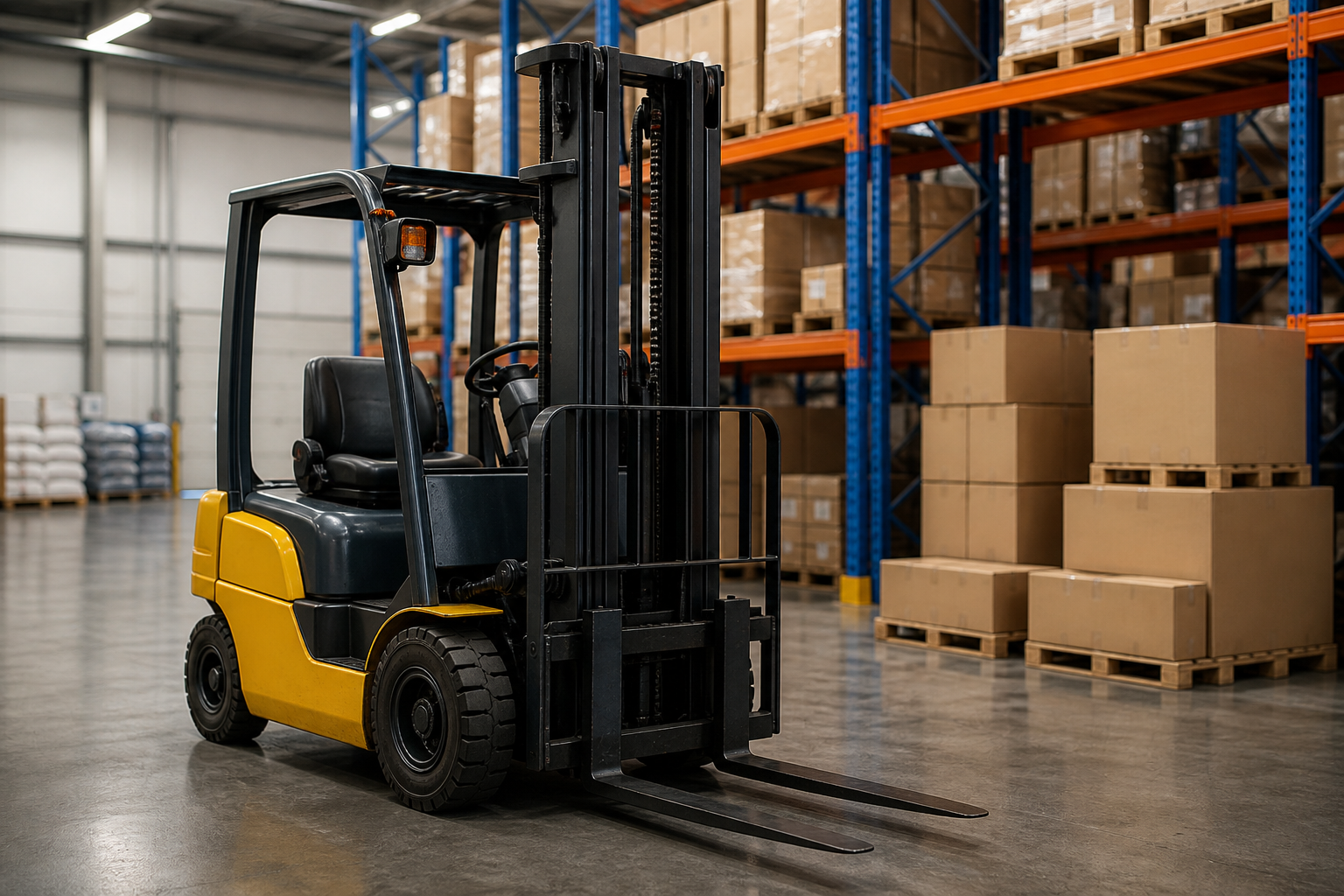
Training normally begins with the parts and controls of the truck. You may review the mast, carriage, forks, load backrest, counterweight, tires, overhead guard, steering controls, warning devices, brakes, and gauges. The goal is not to turn an operator into a mechanic; it is to help the operator recognize normal operation and identify conditions that must be reported.
A pre-use inspection should be methodical rather than rushed. Depending on the equipment and provider procedure, you may check visible damage, forks, chains, hydraulic components, tires, controls, horn, lights, alarms, seat belt, brakes, steering, and fluid leaks. If a safety-critical defect is found, the correct response is to stop, report it, and follow the workplace process for holding the truck out of service.
Stability, capacity, and load centre
Forklifts can appear stable while carrying a load, but their balance depends on the relationship between the truck’s stability system, the load weight, the load centre, the lift height, the mast position, and the surface. Training should explain why a load must be within the truck’s rated capacity and why capacity can change when an attachment is fitted or the load centre increases.
You should learn to read the capacity plate or other manufacturer information supplied with the truck. Do not estimate whether a load is safe based only on its size. A compact, dense load may be heavier than it appears, and an uneven or unsecured load may shift during travel even when its total weight seems acceptable.
Controls, travel, and manoeuvring
Hands-on practice should cover starting and stopping smoothly, steering, reversing, inching, mast movement, tilt, fork positioning, and parking. The instructor should explain how speed, visibility, surface conditions, and load position affect each movement.
Good operators make their actions predictable. They travel with the forks positioned safely for the conditions, slow down before intersections and turns, maintain a clear view where possible, and stop when visibility is inadequate. The safest choice is often to pause and reassess rather than continue through a blind area.
Loads, racks, docks, and trailers
If the training environment permits, practise approaching a load squarely, inserting the forks fully and evenly, lifting only when positioned correctly, and placing the load without striking racks or adjacent materials. The sequence should be deliberate: stop, align, verify, lift, check stability, and move only when the path is clear.
Dock and trailer work introduces additional hazards. Training may discuss dock plates, trailer floors, chocking or restraint procedures, edges, changing surfaces, overhead clearance, and the need to confirm that the route can support the truck and load. These tasks must always be performed according to the employer’s site procedure.
Pedestrians, communication, and workplace awareness
A forklift course should address blind corners, mirrors, intersections, doors, aisles, ramps, uneven surfaces, noise, and pedestrian routes. Operators need to understand that a horn is a warning tool, not permission to proceed without checking the path.
Make eye contact with pedestrians when practical, maintain separation, and stop if a person enters the travel path. Where visibility or the task requires it, follow the site’s rules for a spotter or other communication method. Never assume that a pedestrian has seen you simply because you have used the horn.
How to choose a Scarborough provider
Comparing forklift training providers is easier when you ask the same questions of each one. Look for specific answers rather than broad claims about being comprehensive or convenient. A provider should be able to explain what the learner does, what the instructor observes, and what happens if additional practice is needed.
Compare the curriculum and equipment
Ask for a written or clearly explained outline of the theory and practical components. It should address inspections, stability, rated capacity, load handling, travel, pedestrian awareness, parking, defect reporting, and the evaluation process.
Then ask what equipment you will use. If your intended workplace uses a counterbalance forklift, reach truck, side shifter, or attachment, find out whether your course covers that equipment or whether separate familiarization is required. Training on a different truck can still provide useful fundamentals, but it should not be presented as identical preparation for every machine.
Check instructor experience and practice time
Ask who delivers the instruction and how practical coaching is organized. Relevant instructor experience, clear demonstrations, and calm correction are more useful than simply spending time seated in a truck without feedback.
Class size also affects the learning experience. Ask how many learners share each machine, how practice time is allocated, and whether every learner completes the key manoeuvres. A course can sound affordable until you discover that most of the session is spent watching rather than operating.
Understand the evaluation
A practical evaluation should involve observable behaviours, not an unexplained pass or fail. Ask whether the assessor will review the inspection, starting and stopping, steering, load handling, visibility checks, communication, parking, and response to instructions.
Also ask what feedback is provided. A useful evaluation identifies both strengths and corrections, such as approaching loads more squarely, reducing speed at blind corners, or completing the inspection in a consistent order. Confirm what happens if you need more practice or do not meet the required standard on the first attempt.
Ask about scheduling, access, and documentation
Choose a schedule that allows you to arrive alert and on time. Confirm the session dates, expected arrival time, location, parking or transit considerations, clothing requirements, identification or forms, and whether missed sessions can be rescheduled.
Before booking, ask what documentation you receive and how it identifies the course or equipment covered. Keep your records, but remember that the employer must still complete any site-specific orientation, supervision, and authorization required for the job.
Use Ontario guidance as a comparison point
The Ministry’s guidance explains that a safety program should address training, operating procedures, inspection, maintenance, load-handling capacity, and recordkeeping. The section on a powered lift truck safety program can help you turn those broad expectations into practical questions for a provider or employer.
You do not need to memorize regulatory language before enrolling. You do need to recognize whether a course treats safety as a complete process or reduces it to operating controls alone.
How to prepare for training
Preparation does not require prior forklift experience. It means arriving ready to listen, practise, and respond to coaching. Small practical details can make the first session less distracting and help you concentrate on safe operation.
Before the first session
- Confirm the requirements: Ask what identification, forms, footwear, eye protection, hearing protection, or other equipment is required.
- Plan your route: Check the journey to the Scarborough training location in advance and allow extra time for the first visit.
- Wear suitable clothing: Choose closed-toe, slip-resistant footwear and comfortable clothing that will not catch on equipment.
- Arrive rested: Fatigue reduces attention and makes it harder to process instructions during hands-on work.
- Bring questions: Write down the truck type, attachment, load, or workplace situation you want to understand.
- Set one learning goal: For example, focus on smooth braking, accurate fork placement, or completing a consistent inspection.
Useful terms to recognize
Knowing basic terminology can make instruction easier to follow. Review terms such as mast, carriage, forks, load backrest, tilt, side shift, counterweight, rated capacity, load centre, stability, inching, and pre-use inspection.
You do not need to teach yourself to operate a forklift from a glossary. The purpose of preparation is simply to recognize the language used during demonstrations so you can ask better questions and connect the explanation to what you see on the machine.
How to learn during practical practice
Listen to the complete instruction before moving the truck. When you begin a manoeuvre, make each step visible: scan the area, position the truck, confirm the load, move smoothly, and stop if the conditions change.
Ask for correction early rather than repeating an uncertain technique. Instructors can help more effectively when you describe what you are trying to do – for example, whether you are unsure about fork height, turning clearance, or how to position for a rack.
Practical skills and evaluation
Although evaluation formats differ, assessors generally look for safe, controlled, repeatable performance. The objective is not to drive quickly. It is to demonstrate that you can operate deliberately, recognize hazards, and follow the required sequence without avoidable prompting.
Inspection and start-up
Begin with a complete inspection appropriate to the truck. Look for damage, leaks, worn or unsafe components, and warning-device problems. Once seated, adjust the position, use the restraint system, confirm the controls, and start according to the instructed procedure.
If the inspection reveals a defect, explain what you would do instead of silently operating. The ability to identify and report a problem is part of safe competence.
Travel and load handling
Evaluation may include forward and reverse travel, turns, stops, intersections, and changes in direction. The assessor may watch whether you control speed, maintain visibility, scan for pedestrians, use warnings appropriately, and keep the truck stable.
For a load task, approach squarely, stop before entering, position the forks evenly, verify that the load is secure, and lift only as instructed. Avoid unnecessary corrections. Smooth, accurate movements show that you are managing the truck rather than reacting to it.
Placement, reverse travel, and parking
When placing a load, check the rack or staging area, align before raising, and keep clear of people and obstructions. Set the load down gently and confirm that it is stable before withdrawing the forks.
At the end of the task, lower the forks as required, place the controls in the instructed position, set the parking brake, switch off the truck, and secure it. A good parking routine is as important as a good start because an unattended truck can create a hazard.
A simple practice sequence
- Inspect the truck and report any defect.
- Set up safely, secure the restraint, and confirm the controls.
- Scan the route and identify pedestrians, blind areas, surfaces, and overhead hazards.
- Approach the load squarely and stop before entering.
- Position the forks, verify the load, and lift or place as instructed.
- Travel at a controlled speed with suitable visibility and fork height.
- Stop, place the load, reverse only after checking the path, and park securely.
This is a learning framework, not a replacement for your instructor’s directions or the manufacturer’s instructions. Follow the procedure demonstrated for the specific truck and workplace.
Safety responsibilities after training
Training is the beginning of safe operation, not the end. When you move from a practice environment to a working site, the layout, loads, weather, surfaces, pedestrians, and production pressures may all be different. Complete the employer’s orientation and ask for site-specific instruction before operating independently.
Follow workplace authorization and supervision
An employer should establish that an operator is competent for the work and equipment involved. The Ontario guidance on powered lift truck competency highlights the importance of understanding applicable requirements, workplace hazards, manufacturer specifications, load handling, and site procedures.
Do not assume that a course completion document authorizes you to use an unfamiliar attachment, truck, or route. Ask for familiarization and supervision whenever the equipment or task changes materially.
Inspect, report, and stop when necessary
Continue the pre-use inspection on every shift or at the interval required by the workplace. Report damage, unusual noises, weak brakes, steering problems, hydraulic leaks, warning-device failures, or other concerns promptly.
Do not try to compensate for a defect by driving more carefully. A safety issue must be handled through the employer’s reporting, isolation, and repair process. The Ontario guidance on powered lift truck maintenance explains why inspection and maintenance procedures are part of the overall safety system.
Carry the habits into busy conditions
Keep pedestrians separated from truck routes where possible, slow down at corners and doorways, and stop when you lose visibility. Treat ramps, wet floors, debris, ice, uneven surfaces, dock edges, and changing light as reasons to reassess speed and route.
Never carry passengers unless the truck is specifically designed and authorized for that purpose. Do not use forks as a work platform, exceed capacity, lift people without approved equipment and procedure, or modify the truck without authorization. If production pressure conflicts with safe operation, stop and raise the concern.
Questions to ask before enrolling
Use this checklist during a phone call, email exchange, or site visit. Clear answers help you compare the course itself rather than relying on a title or advertised completion document.
- Which truck types and attachments are included?
- How is theory delivered, and how much supervised hands-on practice does each learner receive?
- How many learners share each machine?
- Does the practice area include aisles, racks, loads, intersections, or dock-related scenarios?
- What inspection, load-capacity, stability, and pedestrian-awareness topics are covered?
- Who conducts the practical evaluation, and what behaviours are assessed?
- What feedback is provided if a learner needs more practice?
- What documentation is issued, and what equipment or course scope does it identify?
- What should learners bring and wear?
- How does the course fit with the employer’s later site-specific orientation?
The provider’s communication is useful evidence. Look for a willingness to explain the training sequence, limitations, safety expectations, and next steps without promising that one course eliminates every workplace responsibility.
Forklift training in Scarborough FAQ
How long does forklift training in Scarborough take?
Course length varies according to the provider, truck type, learner experience, class format, and amount of practical practice. Ask for a breakdown of theory, hands-on seat-time, evaluation, and any additional practice rather than relying only on the number of scheduled days.
Do I need previous forklift experience?
No. Entry-level training is designed for beginners, while experienced operators may take refresher or equipment-specific training. Tell the provider about your experience and intended workplace so the instructor can explain what the course does and does not cover.
Does Ontario require one universal forklift licence?
Ontario does not appear to require one universal government-issued forklift licence for all operators. Employers establish operator competence through appropriate information, instruction, supervision, practical skills, and workplace-specific assessment, so a course document does not replace employer authorization or site orientation.
What should I wear to forklift training?
Wear closed-toe, slip-resistant footwear and comfortable clothing that fits securely and does not interfere with movement. Confirm the provider’s requirements before attending, including any need for eye protection, hearing protection, or other personal protective equipment.
Will the course include a practical evaluation?
A well-structured operator course should include supervised hands-on assessment, but the format varies. Ask whether the evaluation covers inspection, control, travel, load handling, visibility, communication, parking, and defect reporting, and ask how feedback or further practice is handled.
Choose a practical starting point
Forklift training in Scarborough is most valuable when it gives you more than basic familiarity with the controls. Compare the hands-on practice, equipment, instructor guidance, evaluation, documentation, and connection to workplace competency before you enrol.
To review local commercial driver and forklift training options, visit JAZ Truck, Bus & Forklift Driving School and contact the school about the program that fits your goals.
Comments are closed