
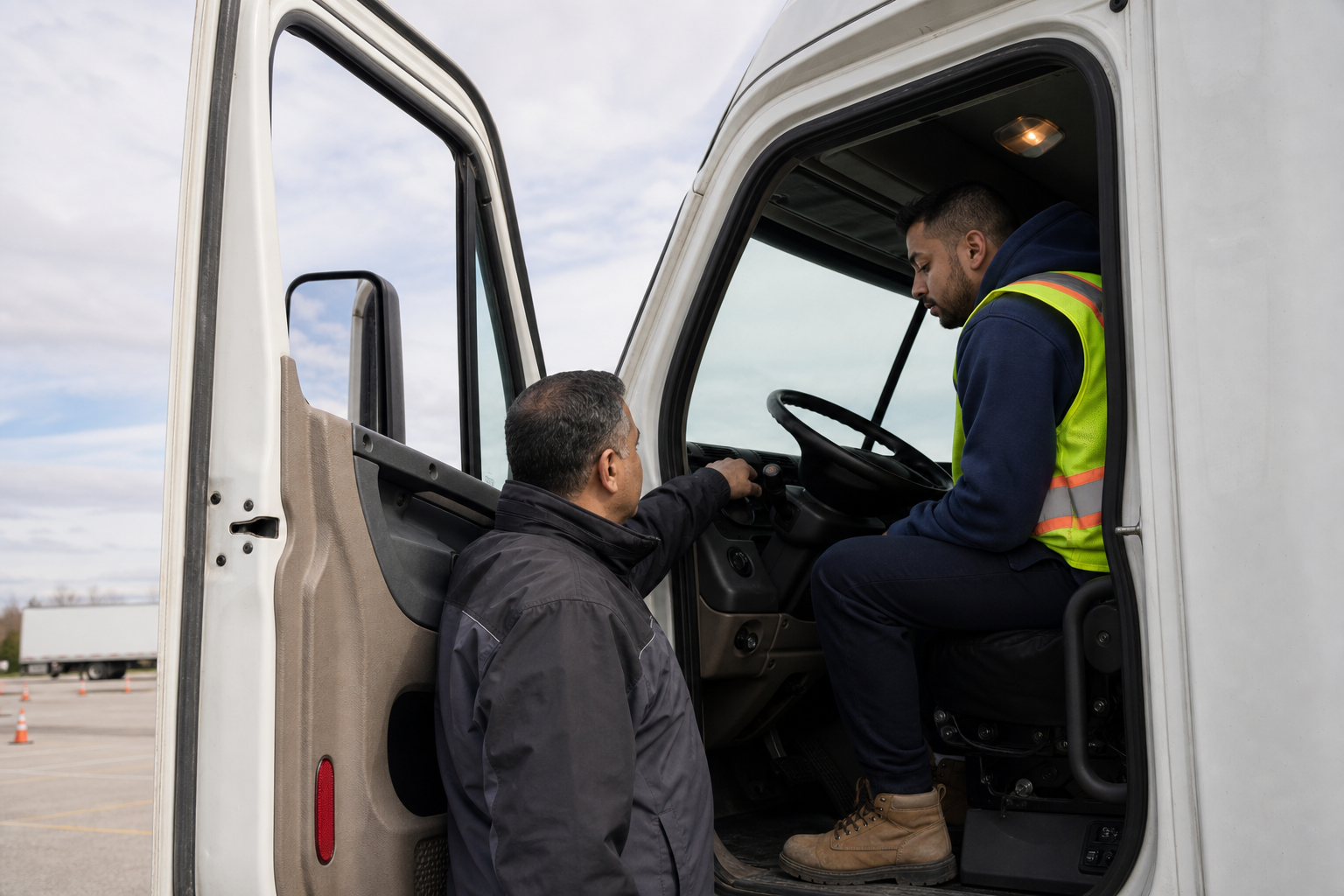
Commercial vehicle training combines classroom learning with supervised practical instruction for people preparing for commercial driving credentials or forklift work. In Toronto and Scarborough, the right programme depends on the vehicle you intend to operate, the credential or endorsement you are pursuing, and your intended work. JAZ Truck, Bus & Forklift Driving School provides training across these pathways.
What commercial vehicle training means
Commercial vehicle training is structured instruction for operating larger or specialized vehicles safely and preparing for applicable licensing or workplace requirements. Unlike ordinary passenger-vehicle lessons, it addresses the vehicle’s size, controls, handling characteristics and operating environment. Depending on the programme, learning may include classroom concepts, supervised driving or equipment practice, individual coaching and road-test preparation.
The term can cover several distinct goals: tractor-trailer work, school bus or coach bus driving, straight-truck employment, an air brake endorsement, or forklift operation in a warehouse or logistics setting. These goals are not interchangeable. Forklift training prepares a learner to operate workplace equipment; it is not a commercial driver licence programme.
JAZ’s commercial training courses include MELT-certified programmes designed for Ontario commercial licensing, alongside air brake and forklift training. MELT should be considered in relation to the applicable commercial licensing pathway rather than assumed to apply to every type of training.
Choose training by the vehicle or work path

Start with the vehicle or role you want to pursue. This helps prevent enrolling in a course that sounds relevant but does not match your intended work.
| Programme | Focus | Next decision |
|---|---|---|
| A tractor-trailer training | Tractor-trailer operation and the Class A pathway | Confirm current Ontario Class A requirements. |
| BZ school bus training | School bus driving | Ask how practical instruction supports your intended role. |
| CZ coach bus training | Coach bus operation | Check that practice matches coach bus driving. |
| DZ straight-truck training | Straight-truck operation | Discuss the driving work you are targeting. |
| Air Brake (Z) training | Air brake knowledge and endorsement preparation | Confirm how theory and practical learning are delivered. |
| Forklift training | Forklift operation and workplace safety | Ask about equipment practice and certification. |
What a strong training programme includes
Classroom learning
Theory provides a foundation for vehicle operation, safety and the knowledge expected for the chosen pathway. It should be relevant to the vehicle or equipment being used.
Supervised, hands-on instruction
Large vehicles and specialized equipment require practice. Ask how much practical instruction is included, what equipment is used and how feedback is provided.
One-on-one coaching
Individual behind-the-wheel coaching can help identify specific areas for improvement. JAZ describes its training as one-on-one and behind the wheel, supported by OSL-certified instructors.
Equipment and road-test preparation
Equipment should be appropriate for the programme. Road-test preparation is a separate component that helps learners organize and apply their skills for the assessment associated with their pathway. JAZ offers road-test preparation for its A, BZ, CZ and DZ programmes. See this Toronto commercial licence road-test resource for further preparation guidance.
How Ontario requirements fit into your decision
Training is only one part of the licensing process. Requirements vary according to the credential, so check current provincial information before committing to a course. Ontario provides specific information for applicants for an Ontario Class A driver’s licence; review the official Class A training requirements.
Also confirm which documents and steps apply to your situation. JAZ provides information about commercial licence requirements and documentation, but regulatory details should be verified with the relevant provincial source.
How to compare providers in Toronto
- Programme match: Confirm that the school offers the truck, bus, air brake or forklift pathway you need.
- Instructor qualifications: Ask about relevant certification. JAZ uses OSL-certified instructors across its programmes.
- Practical instruction: Clarify whether supervised practice and one-on-one coaching are included.
- Equipment: Ask whether it is appropriate and up to date for your course.
- Road-test preparation: Find out how preparation is delivered for your pathway.
- Schedule and location: Confirm that regular attendance is realistic. JAZ offers flexible part-time scheduling in Toronto and Scarborough.
- Tuition and financing: Request current pricing and ask about options such as Health Smart Financial/PayBright. Review JAZ’s funding information.
A practical sequence before you enrol
- Identify your intended vehicle or workplace role.
- Review current Ontario requirements and gather relevant documents.
- Shortlist programmes that match your goal.
- Ask how theory, hands-on practice, coaching and road-test preparation fit together.
- Confirm instructors, equipment, location, schedule, tuition and financing.
- Choose based on fit rather than a generic course label.
A Toronto and Scarborough training option
JAZ Truck, Bus & Forklift Driving School is a local option at 1750 Brimley St Unit 100, Scarborough, ON M1P 4K7. Its programmes cover A tractor-trailer, BZ school bus, CZ coach bus, DZ straight truck, Air Brake (Z) and forklift training. The school describes its approach as classroom learning, hands-on instruction, one-on-one coaching and road-test preparation.
JAZ also identifies OSL-certified instructors, up-to-date equipment and flexible part-time schedules. Its relationships with transportation-industry recruiting partners can help graduates connect with employment opportunities, but do not represent a guarantee of employment. Review the career and recruiting information when considering next steps.
Conclusion
Commercial vehicle training is a category of structured learning, not one universal licence course. Begin with the vehicle or workplace role you want, then compare relevant theory, supervised practice, coaching, equipment and road-test preparation. Verify current Ontario requirements and ensure the schedule, location, tuition and financing information suit your circumstances.
For programme details, current availability and next steps in Toronto or Scarborough, contact JAZ Truck, Bus & Forklift Driving School.
Comments are closed