
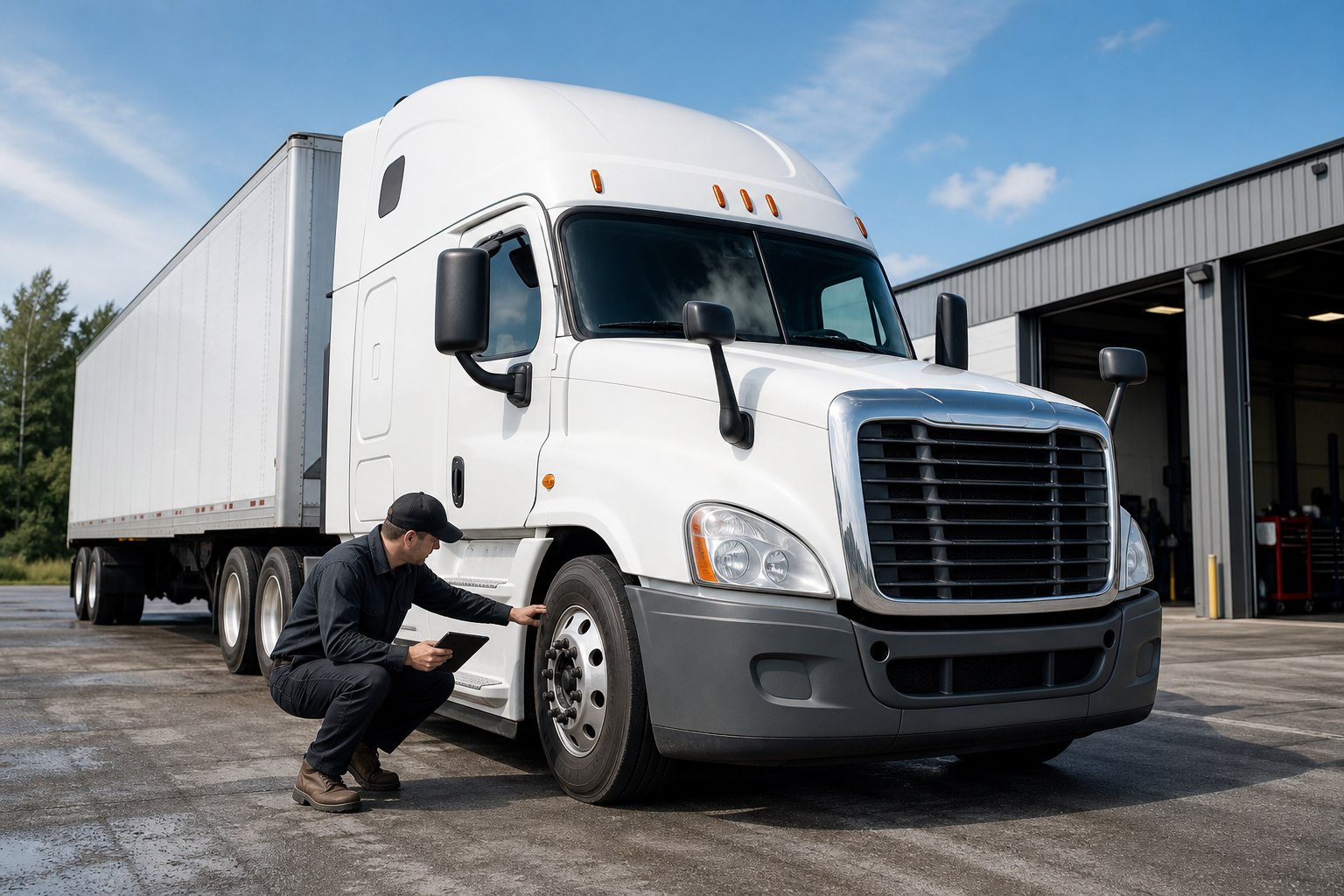
Vehicle preventive maintenance is planned work that identifies defects early, keeps commercial vehicles mechanically fit, and documents inspections and repairs. In Ontario, operators need a written inspection and maintenance system. Daily checks, qualified-technician maintenance, and required periodic inspections serve different purposes.
Vehicle preventive maintenance in the commercial context
For a truck, bus, or forklift, preventive maintenance is more than changing oil or filters. It combines pre-use inspections, planned servicing, defect reporting, repairs, statutory inspections, and records.
Ontario’s Highway Traffic Act requires operators to establish a system for periodically inspecting and maintaining commercial motor vehicles and to keep written records. Preventive maintenance inspections must also form part of the operator’s maintenance plan and schedule and be completed by a qualified technician at prescribed intervals. See Ontario’s commercial vehicle safety requirements for the current framework. Related reading: Motor Vehicle Accident Rehabilitation Guide: What to Do After a Collision in Ontario.
Four maintenance activities that should not be confused

Commercial maintenance has four connected parts: daily or pre-use inspections, planned preventive maintenance, corrective repairs, and periodic mandatory inspections.
| Activity | Purpose | Typical responsibility | Does not replace |
|---|---|---|---|
| Daily or pre-use inspection | Find visible or functional defects before operation. | Driver or forklift operator. | Servicing, repairs, or statutory inspections. |
| Planned preventive maintenance | Service components before wear causes a defect. | Employer and qualified maintenance personnel. | The operator’s pre-use check. |
| Corrective repair | Fix a defect found during inspection or service. | Qualified maintenance personnel. | Routine planning or required inspection sign-off. |
| Periodic mandatory inspection | Verify legal safety requirements at the required interval. | Registered or licensed inspection personnel. | Daily inspection or the wider maintenance programme. |
Before use, the operator should check items relevant to the vehicle, such as tyres, wheels, lights, mirrors, windows, coupling equipment, steering, suspension, brakes, and fluid leaks. A daily inspection is a readiness decision, not a full service. It can identify a problem requiring removal from service, but it does not replace required maintenance or inspection sign-off.
Who does what: operator, employer, technician, and inspector
| Role | Responsibility |
|---|---|
| Driver or forklift operator | Complete the pre-use inspection, recognize obvious defects, follow workplace procedures, and report problems promptly. |
| Employer or operator | Establish the maintenance system, set reporting and removal-from-service procedures, schedule work, and retain records. |
| Qualified technician | Perform maintenance, diagnosis, adjustment, and repairs requiring technical competence or authorization. |
| Registered inspecting technician | Perform and sign off applicable safety inspections after confirming minimum mechanical fitness. |
Ontario records must identify the vehicle and record repairs and maintenance, including the nature and date of the work and the odometer reading when applicable. Under DriveON, only the registered inspecting technician can perform and sign off applicable safety inspections. A driver’s circle check is not the same as a technician’s inspection or legal sign-off.
How to build a maintenance schedule
Start with the manufacturer’s instructions and the vehicle’s actual use. Add age, condition, kilometres, engine hours, route severity, seasonal exposure, load demands, previous defects, and the inspection intervals applying to that vehicle type.
- List each asset: Record every truck, trailer, bus, or forklift separately.
- Map the checks: Separate every-shift inspections, scheduled servicing, repairs, and periodic inspections.
- Add manufacturer guidance: Use instructions for the vehicle, engine, brakes, attachments, and energy source.
- Adjust for conditions: Heavy loads, frequent stops, dust, winter exposure, and high engine hours can accelerate wear.
- Use defect history: Repeated leaks, brake findings, or warning-device faults may require a schedule review.
- Assign responsibility: Identify who checks, receives reports, authorizes return to service, and completes inspections.
- Record outcomes: Keep findings, decisions, repairs, dates, and odometer or hour-meter information together.
What does a 30-60-90 maintenance schedule mean?
A 30-60-90 schedule is planning shorthand for recurring mileage or time-based service. It is not a universal Ontario legal schedule for every commercial vehicle and cannot override manufacturer instructions, operating conditions, or an immediate defect.
How long does preventive maintenance take?
There is no single duration. A pre-use inspection may be brief, while servicing, diagnosis, brake work, or a statutory inspection can take longer depending on the vehicle, task, parts, defects, and technician availability.
The MTO Truck Handbook states that each vehicle and trailer must be inspected annually by a licensed motor-vehicle inspection mechanic against applicable National Safety Code 11 requirements. Source: Vehicle safety, maintenance and daily inspections | The Official Ministry of Transportatio….
What changes by vehicle type
| Vehicle or system | Priorities | Planning point |
|---|---|---|
| Tractor-trailer or straight truck | Tyres, wheels, steering, suspension, coupling equipment, lights, fluids, load-related wear, and brakes. | Separate tractor, trailer, and coupling checks. |
| School or coach bus | Brakes, steering, tyres, doors, emergency equipment, passenger systems, visibility, and body condition. | A motor-coach under-vehicle inspection is required every 30 days or 12,000 kilometres, whichever occurs last. Buses, school-purpose vehicles, and accessible vehicles require full inspections every six months. |
| Air-brake system | Components, pressure, operation, leaks, adjustment, hoses, chambers, and defect identification. | Air-brake condition belongs in maintenance and inspection planning. |
| Forklift | Forks, attachments, tyres, controls, warning devices, steering, brakes, leaks, capacity information, and energy-handling equipment. | Use the employer’s checklist. Course completion does not provide authorization for every workplace or attachment. |
For commercial vehicles using air brakes, planning should include air brake system maintenance, component condition, defect identification, and brake adjustment.
The operator’s role in forklift maintenance

A forklift operator contributes by inspecting the truck before use, recognizing unsafe conditions, and reporting defects through the workplace process. The operator should not turn a pre-use check into an unauthorized repair.
Depending on the employer’s checklist, checks may cover forks, attachments, tyres, controls, steering, brakes, warning devices, leaks, guards, capacity information, and charging or refuelling areas. If a defect is found, follow the workplace process for tagging, isolating, or reporting the equipment.
JAZ lists vehicle inspection, load handling, load security, workplace safety, and operational maintenance among its forklift training topics. Employer evaluation, supervision, and authorization remain separate requirements.
Records turn maintenance into a working system
- Identify the vehicle, trailer, or forklift.
- Record the inspection, defect, or service trigger.
- State whether it remained in service or was removed.
- Document the repair or maintenance, including its nature and date.
- Record the odometer or hour-meter reading where applicable.
- Record who completed the work and any return-to-service decision.
Ontario commercial vehicle inspections have been completed under the digital DriveON programme since April 1, 2025. DriveON does not replace daily inspections or employer maintenance records. It provides the process for applicable safety inspections and sign-off. Source: Commercial vehicle safety requirements | ontario.ca.
How maintenance knowledge fits training
Training should help learners understand what to inspect, what a defect can mean, how to report it, and which tasks belong to qualified maintenance personnel. Truck and bus learners may also need air-brake fundamentals. Forklift learners need equipment-condition and workplace-hazard awareness.
Training does not replace employer procedures, site-specific evaluation, supervision, qualified maintenance work, or statutory inspection sign-off. JAZ Truck, Bus & Forklift Driving School provides hands-on truck, bus, and forklift training in Toronto and Scarborough with one-on-one instruction and OSL-certified instructors. Related reading: Forklift Safety Modules: What Effective Training Should Cover – JAZ Truck, Bus & Forklift….
A practical review checklist
- What manufacturer schedule applies to this exact vehicle?
- Which checks happen before each shift or trip?
- Who receives defect reports?
- What condition removes the equipment from service?
- Which tasks require a qualified technician?
- Which inspections apply by vehicle type?
- Where are repairs, service dates, and readings recorded?
- Who authorizes return to service?
- Does a forklift employer require site evaluation or authorization after training?
Choose training that teaches maintenance responsibilities clearly
Preventive maintenance works best when operators, employers, technicians, and inspectors understand their separate roles. If you are preparing for forklift work, JAZ Truck, Bus & Forklift Driving School offers forklift training in Toronto and Scarborough. Ask how the course connects with your employer’s authorization and maintenance procedures before enrolling.
Comments are closed