
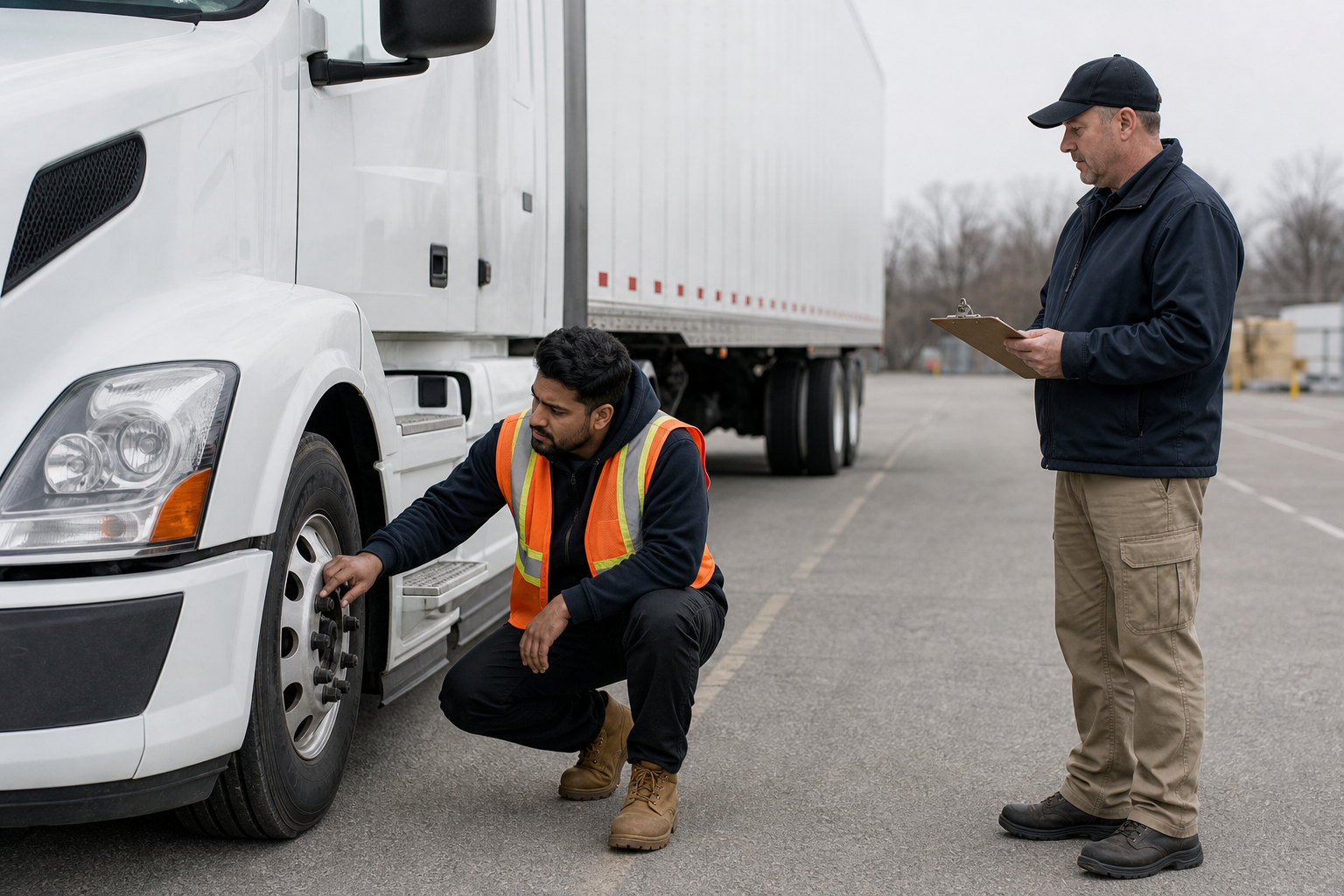
An effective Class A road-test checklist covers more than a memorized pre-trip script. Before test day, confirm your eligibility and training, understand the daily inspection test, practise coupling and uncoupling, control the tractor-trailer while backing, and drive safely in varied traffic situations.
Ontario’s official requirements identify these major areas for the Class A road test. This guide uses the Ministry of Transportation’s terminology while recognizing common learner terms such as “pre-trip inspection,” “circle check” and “backing test.”
1. Confirm your Class A prerequisites
Start with the licensing path, not the training calendar. For a full Class A licence with no restrictions, Ontario says applicants must meet age and licence requirements, pass vision and knowledge tests, submit a valid medical report, complete required training and take a qualifying road test in an appropriate vehicle. Review the current Ontario Class A licence requirements before choosing a test date.
Applicants subject to the requirement must complete Mandatory Entry-Level Training before taking the Class A road test. Training completion is a prerequisite, not a guarantee that every inspection explanation, manoeuvre or traffic skill is test-ready. Confirm whether your licence path and vehicle also require an air-brake endorsement.
- Do you hold the Ontario licence required to begin the Class A process?
- Have you completed the applicable knowledge, vision and medical steps?
- Has required training been completed and recorded by the appropriate provider?
- Will the test vehicle meet the requirements for the licence you want?
- Have you confirmed the test arrangements and required documents?
2. Daily inspection test: practise more than a circle check

Ontario calls this the daily inspection test. Many learners call it a pre-trip inspection or circle check. The terminology matters less than demonstrating that you can identify relevant equipment, explain what you are checking and recognize a condition that could make the vehicle unsafe.
The official guidance requires a daily inspection as part of the Class A road test. It also identifies safe operation, backing and, for Class A applicants, coupling and uncoupling as core test elements. Review the MTO Class A and D road-test requirements alongside your instructor’s vehicle-specific procedure.
Daily inspection checklist
Use these categories as a revision prompt, not as a substitute for the current handbook or hands-on instruction:
- Air-brake system, where equipped: know the relevant components and how to identify unsafe conditions.
- Cab and driver area: check the seat, controls, glass, mirrors, heater, defroster, horn and wipers.
- Coupling devices: inspect the tractor-trailer connection and understand what must be secure.
- Safety equipment: identify emergency equipment and safety devices.
- Lights and reflectors: check lamps, reflectors and their condition.
- Steering, suspension and frame: understand what you are looking for.
- Tires, wheels, hubs and fasteners: check for damage, unsafe wear or loose components.
- Fuel, exhaust, cargo body and frame: include visible leaks, damage and other conditions affecting safe operation.
The official daily inspection list provides the detailed categories. Practise explaining what a safe condition looks like and what action you would take if you found a defect.
3. Coupling and uncoupling
Class A applicants must demonstrate uncoupling and coupling of the combination vehicle. This is not simply a mechanical exercise. It tests whether you can manage the space safely, follow the correct sequence and confirm that the connection is secure before moving.
- Position the tractor and trailer safely before beginning.
- Follow the sequence taught for the specific equipment.
- Check the fifth-wheel connection, locking mechanism, lines and other relevant connections.
- Confirm that the trailer is supported correctly when uncoupled.
- Complete visual and physical checks before treating the combination as ready to move.
Practise with an instructor on the equipment you will use, or on genuinely comparable equipment. Avoid relying on an unofficial video for a test-centre-specific sequence.
4. Backing skills
The backing portion requires you to demonstrate control while reversing the combination vehicle into a desired location. The goal is not to memorize one set of steering movements. It is to reverse slowly, observe continuously and make controlled corrections.
- Set up correctly before beginning the reverse.
- Use mirrors consistently while maintaining appropriate observation.
- Keep speed slow enough for measured corrections.
- Understand how steering changes the trailer’s path.
- Stop when uncertain instead of continuing a poor correction.
- Finish in the required position without rushing the final alignment.
Backing is vehicle-specific. Trailer length, wheelbase, mirror position and yard space affect the combination’s response. Ask for feedback on setup, observation and correction, not only on whether you reached the final position.
5. On-road driving
The road portion is broader than a familiar route. Ontario’s guidance says the test can include left and right turns, intersections, lane changes, curves, an expressway section and roadside stops and starts. You must obey traffic laws and demonstrate safe operation throughout the drive. Review the official on-road driving test description before your final practice sessions.
- Before moving: scan around the vehicle, check mirrors and establish a safe plan.
- Turns and intersections: choose the correct position, signal early, manage speed and allow the combination to track safely.
- Lane changes: check mirrors and blind spots, signal, leave adequate space and move only when safe.
- Curves and expressways: manage speed, following distance and lane position without abrupt steering or braking.
- Roadside stops and starts: choose a safe position, observe traffic and re-enter only when conditions permit.
Route familiarity can reduce uncertainty, but route memorization cannot replace observation and decision-making. Practise in varied traffic conditions and ask your instructor to identify habits that could become unsafe when the road environment changes.
6. Turn the checklist into a practice plan
Divide preparation into separate skills, then combine them. A learner who can drive well but cannot explain a defect is not ready for the daily inspection. Someone who knows the inspection categories but cannot control the trailer while backing needs more vehicle practice.
| Test component | Practise | Readiness evidence |
|---|---|---|
| Prerequisites | Licence, medical, knowledge, training and vehicle requirements | Documents and test vehicle are verified |
| Daily inspection | Identification, explanation and defect awareness | You can inspect without prompts |
| Coupling and uncoupling | Safe positioning, sequence and connection checks | You complete the procedure methodically |
| Backing | Setup, mirrors, slow control and corrections | You reverse accurately and stop when needed |
| On-road driving | Turns, intersections, lane changes, curves and stops | You maintain legal, predictable control |
After each session, record one strength and one specific gap. Repeat the weak component with focused coaching, then practise the complete sequence. This is more useful than adding hours without knowing what remains inconsistent.
7. Final readiness checklist
- I have confirmed my licence, medical, vision and knowledge-test status.
- I have completed applicable Mandatory Entry-Level Training.
- I know which licence and vehicle configuration I am testing for.
- I can explain inspection categories and identify unsafe conditions.
- I can complete coupling and uncoupling in a safety-focused sequence.
- I can back slowly, observe effectively and correct accurately.
- I have practised traffic driving beyond one memorized route.
- The test vehicle meets the requirements for the licence I am seeking.
- I have confirmed the test time, location, documents and arrival plan.
- I understand that training does not guarantee a pass or employment.
Verify current information before booking or attending, especially if your test follows a significant gap after training.
8. Common preparation mistakes
Using a generic checklist
Pointing at components and repeating memorized words is not the same as understanding safe condition. Practise with the actual or comparable vehicle and learn why each inspection matters.
Practising on the wrong configuration
A different tractor, trailer or transmission can change mirror views, turning space, coupling steps and backing response. Confirm the test vehicle requirements.
Ignoring coupling and uncoupling
Do not leave the combination procedure until the end. Schedule repeated practice so the sequence becomes controlled rather than rushed.
Assuming training guarantees the result
A school can provide instruction and preparation, but no course can guarantee a pass or a job. Readiness depends on consistent performance under the applicable test conditions.
9. When one-on-one training can help
Personalized coaching can help when you know the checklist but cannot identify why a manoeuvre remains inconsistent. An instructor can observe your inspection explanations, backing setup, coupling sequence and traffic decisions, then turn those observations into targeted practice.
JAZ Truck, Bus & Forklift Driving School offers Class A tractor-trailer training in Toronto and Scarborough, including hands-on, one-on-one instruction and road-test preparation. Before enrolling, ask for the course outline, vehicle configuration, schedule, fees and test-preparation details in writing. For another perspective on organizing practice, see this first-time road-test checklist, then confirm Class A-specific requirements through Ontario.
10. Requirements for tests on or after January 1, 2027
A confirmed Ontario requirement takes effect on January 1, 2027: Class A road-test applicants must have held a Class G or higher licence for at least six months. This is not presented as an existing requirement on the October 10, 2026 publication date. If your test is scheduled on or after that date, verify the rule, your licence history and transition details directly with Ontario before booking.
Frequently asked questions
What is the difference between the daily inspection test and a pre-trip inspection?
Daily inspection test is Ontario’s official term. Pre-trip inspection and circle check are common learner terms. Prepare to identify equipment, describe its condition and recognize defects rather than memorizing an unsupported script.
Does completing MELT mean I am ready for the Class A road test?
No. Required training allows an eligible applicant to proceed to the road-test stage, but you must still demonstrate inspection, coupling, backing and on-road driving skills.
What should I practise if I am struggling with backing?
Work on setup, slow speed, mirror use, observation and small steering corrections with an instructor. Practise stopping and resetting safely when uncertain.
Should I practise coupling and uncoupling with the same configuration?
Practise on the same configuration whenever possible, or on genuinely comparable equipment. Connection checks and vehicle response can vary.
What should I verify before a test on or after January 1, 2027?
Recheck Ontario’s current eligibility rules, including the requirement to have held a Class G or higher licence for at least six months, along with your training, medical, documents and vehicle requirements.
Conclusion: use the checklist to find your final practice gaps
A strong Class A road-test checklist connects prerequisites, daily inspection, coupling and uncoupling, backing and safe on-road driving. Use it to identify the skill that needs more practice, not simply to confirm that you attended a course.
Verify current Ontario requirements and practise with an appropriate vehicle configuration. For local Class A tractor-trailer instruction and road-test preparation in Toronto or Scarborough, contact JAZ Truck, Bus & Forklift Driving School.