
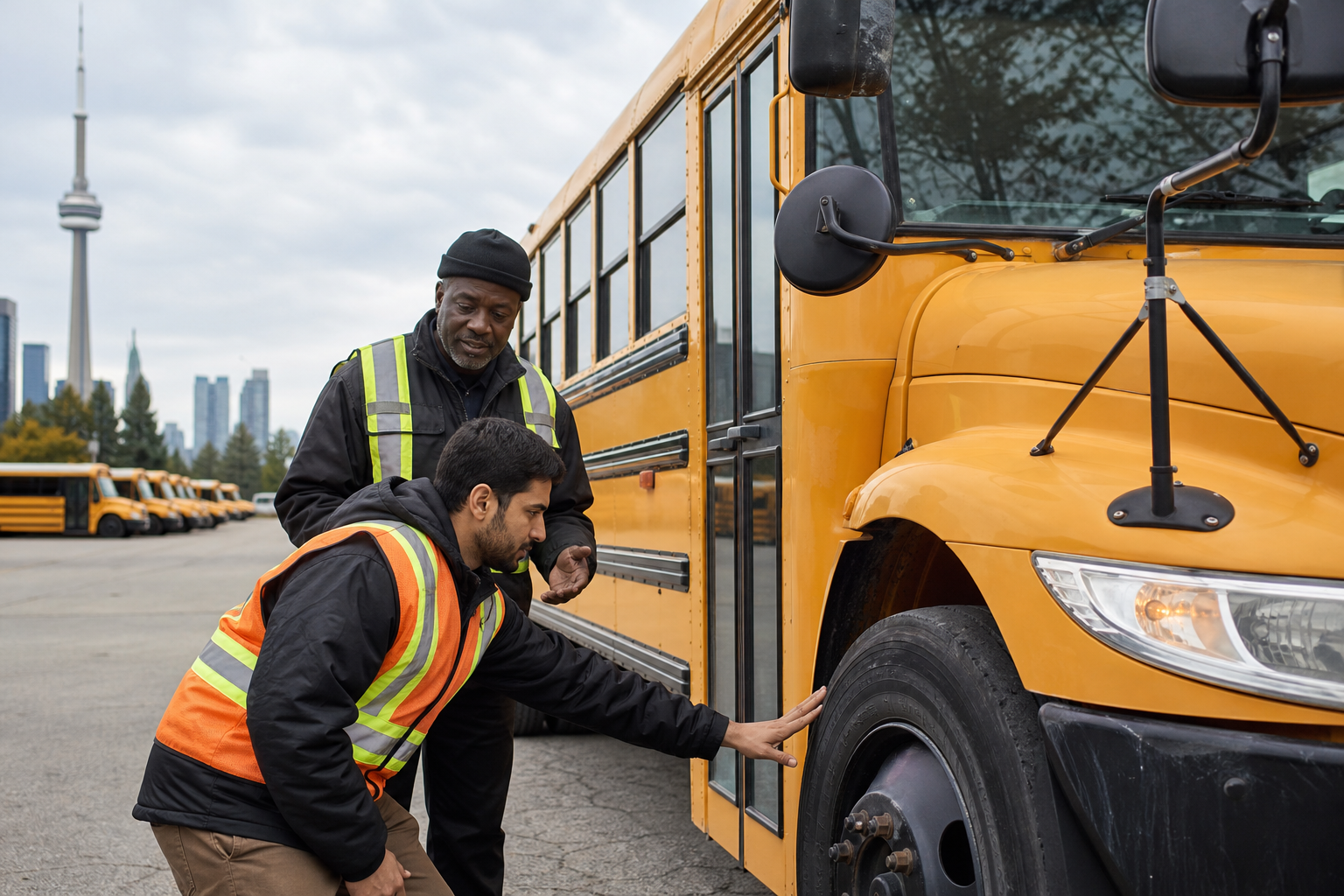
If you are searching for BZ training in Toronto, you are usually looking for school bus driver training. However, “BZ” is informal industry shorthand, not the official Ontario licence name. Ontario uses Class B or Class E for school-bus licences, so the right training path depends on the bus you plan to drive, its seating capacity, and whether it is used as a school-purpose bus.
Before enrolling, confirm your licence path, eligibility, School Bus Driver Improvement Course requirement, practical training coverage, road-test vehicle, schedule and total fees. This helps you avoid paying for a course designed for a different bus category.
Key Takeaways
- Ontario uses Class B or Class E for school-bus licences, with Class B covering buses carrying more than 24 passengers.
- A government-approved School Bus Driver Improvement Course (SBDIC) is mandatory for Class B and Class E applicants.
- Effective training should encompass inspections, passenger handling, railway crossings, observation, and road-test preparation.
- Class B school-bus training is distinct from Class C coach-bus training.
- Training prepares you for licensing but does not guarantee a licence, employment, or a job offer.
First, match the licence to the bus you plan to drive
The most important decision is not which course has “BZ” in its name. It is whether the licence matches the vehicle and the work you intend to do. Ontario distinguishes school-purpose buses from other passenger buses, and an employer’s vehicle requirements may also affect your choice.
| Licence path | Typical vehicle or use | What to verify |
|---|---|---|
| Class B | School bus carrying more than 24 passengers | Passenger capacity, school-purpose use, eligibility and required SBDIC |
| Class E | School bus carrying up to 24 passengers | Passenger capacity, vehicle classification, eligibility and required SBDIC |
| Class C | Coach or other passenger bus category, rather than a school-purpose bus | Employer vehicle, passenger capacity, licence prerequisites and road-test requirements |
Ontario states that a Class B or Class E licence is required to drive a school bus. Check the current requirements before paying a deposit or booking a road test. If you plan to operate a school-purpose bus, review the details for school bus driver training and compare them with the vehicle your prospective employer uses.
What “BZ training” means in Ontario

“BZ training” is a familiar search and marketplace term for school bus driver training. It should not be read as a separate official Ontario licence class. A provider using the term may be referring to preparation for a Class B school-bus licence, although some learners may need Class E instead.
JAZ Truck, Bus & Forklift Driving School publishes BZ school bus driver training for learners in the Toronto and Scarborough area. Its published course information describes Class B eligibility and practical topics, but ask the school to confirm which licence path and vehicle its current programme supports.
Requirements to confirm before enrolling
Eligibility can affect your training plan, documents and ability to proceed to testing. JAZ’s published BZ information states that Class B applicants must be at least 21, meet medical and vision standards, and satisfy specified driving-record requirements. These are important checks to make before committing to tuition.
Ontario’s current requirements are the final authority for licensing decisions. Depending on your circumstances, confirm:
- Age: Verify that you meet the applicable minimum for the class you are pursuing.
- Current licence: Ask which Ontario licence you must hold before beginning the process.
- Medical and vision standards: Confirm required forms, examinations and submission timing.
- Driving record: Check whether suspensions or specified convictions affect eligibility.
- Criminal record documentation: Class B and E applicants may need a Criminal Record and Judicial Matters Check or equivalent documentation.
- Testing steps: Establish which knowledge, practical and road tests apply to your intended class.
Do not assume another applicant’s checklist will be identical to yours. Resolve licence-status, medical or record-related concerns with the appropriate Ontario authority before purchasing training.
How the SBDIC fits with driving-school training
The School Bus Driver Improvement Course is separate from general hands-on driver training. Ontario requires applicants for a Class B or Class E school-bus licence to complete a government-approved SBDIC. Ontario specifies a minimum time commitment of 6.25 hours, and the certificate is valid for five years.
A driving school may offer practical instruction, classroom support and road-test preparation, while the SBDIC has its own approval and certificate requirements. Approval of the SBDIC does not automatically mean that every part of a private school’s broader training programme has government approval.
Ask whether the SBDIC is included in the quoted price, arranged separately or charged as an additional course. Also confirm whether completing it is a prerequisite for practical sessions or your intended testing sequence.
What effective BZ training should cover
Good school-bus preparation should connect licence requirements with the responsibilities of carrying students. JAZ’s published BZ course information identifies several practical areas learners should expect to discuss and practise.
Pre-trip bus inspection
Inspection practice helps learners develop a repeatable process for checking the bus before operating it. Ask how the provider teaches inspection routines and whether learners receive direct feedback on missed or incorrectly completed steps.
Passenger pickup and drop-off
School-bus driving involves more than steering and braking. Training should address controlled stops, observation around the bus and safe passenger procedures. Clarify whether these situations are practised in the training vehicle rather than only discussed in class.
Railway crossings and rules of the road
Railway crossings and traffic-law knowledge are identified in JAZ’s published course information. Ask how these topics are incorporated into practical preparation and whether instructors correct decision-making as well as vehicle handling.
Observation and road-test preparation
Observation skills support safe operation and are relevant during a road test. JAZ states that its BZ training includes a bus for the MTO road test. Confirm the current vehicle arrangement, what preparation includes, and whether additional practice or test-related charges apply.
BZ school-bus training versus Class C coach-bus training
Class B and Class C are not interchangeable. Class B or E is associated with school-purpose buses, while Class C applies to a different passenger-bus category. A coach-bus job may therefore require a different course, vehicle and testing path from a school-bus position.
If your intended vehicle is a coach bus rather than a school-purpose bus, compare the requirements for Class C coach bus training. JAZ’s published Class C information describes different vehicle and eligibility requirements, including a valid Ontario G or higher licence and medical and vision standards.
Ask the employer or fleet operator for the vehicle category, passenger capacity and licence requirement in writing. “Bus driver” is not precise enough to select training on its own.
How to evaluate BZ training in Toronto or Scarborough
Once you know the likely licence path, compare schools based on what the course actually provides. A lower advertised price may not represent the same practical access, test vehicle or included services as another programme.
- Does the provider identify whether training is for Class B, Class E or another class?
- Are instructors qualified, and how much direct feedback will you receive?
- How much of the programme is hands-on, and what bus will you practise in?
- Is a suitable vehicle available for the MTO road test?
- Are schedules flexible enough for your work or family responsibilities?
- Are the SBDIC, testing fees and additional practice included or separate?
- What are the cancellation, rescheduling and retest terms?
- Are current course dates, pricing and seat availability confirmed directly by the school?
JAZ operates from 1750 Brimley St Unit 100 in Scarborough and serves Toronto and Scarborough. Its business information describes MELT-certified commercial training, OSL-certified instructors, one-on-one behind-the-wheel coaching and flexible part-time scheduling across its programmes. Confirm which features apply to the current BZ course and request the terms in writing.
Pre-enrolment checklist for Toronto learners
- Identify the vehicle: Determine whether it is a school-purpose bus, coach bus or another passenger vehicle.
- Confirm the licence: Establish whether Class B, Class E, Class C or another class applies.
- Check eligibility: Review age, current licence, medical, vision and driving-record requirements.
- Plan the SBDIC: Confirm the government-approved course, certificate timing and whether it is included.
- Compare practical instruction: Ask about inspections, passenger procedures, railway crossings, observation and road-test preparation.
- Confirm the vehicle: Verify what bus is used for training and whether one is available for the road test.
- Document the cost: Request tuition, taxes, SBDIC charges, test-related costs, additional lessons and financing terms separately.
- Separate licensing from employment: Recruiting introductions or employment support are not job guarantees.
Frequently asked questions about BZ training in Toronto
Is BZ an official Ontario licence name?
No. BZ is informal shorthand commonly used for school-bus training. Ontario officially refers to Class B and Class E school-bus licences.
Do I need the School Bus Driver Improvement Course for Class B or Class E?
Yes. Ontario requires applicants for a Class B or Class E school-bus licence to complete a government-approved SBDIC. Confirm the current course and certificate process before enrolling.
Are Class B and Class C bus licences interchangeable?
No. Class B and Class E apply to school buses, while Class C applies to a different passenger-bus category. Match training to the actual vehicle and employer requirement.
Does BZ training guarantee that I will get my licence?
No. Training can prepare you for the required knowledge and road-test skills, but Ontario eligibility, testing and your individual performance determine licensing.
Does completing school-bus training guarantee employment?
No. Employers can set additional requirements involving experience, records, availability, insurance or internal training. Recruiting assistance is not a guarantee of hiring.
What should I ask a Toronto driving school before enrolling?
Ask which licence class the course supports, whether the SBDIC is included, what practical skills are covered, which bus you will use, how road-test preparation works, the full cost, and whether current dates are confirmed.
Choose the school-bus path that matches your goal
The best starting point for BZ training in Toronto is the bus itself. Confirm whether you need Class B or Class E for a school-purpose bus, or whether a different class such as Class C fits a coach-bus role. Then verify your eligibility, complete the required SBDIC and compare practical training, vehicle access, schedule and total cost.
For current BZ course scope, scheduling, pricing and enrolment details in the Toronto and Scarborough area, contact JAZ Truck, Bus & Forklift Driving School and confirm how its present programme fits your intended licence path.