
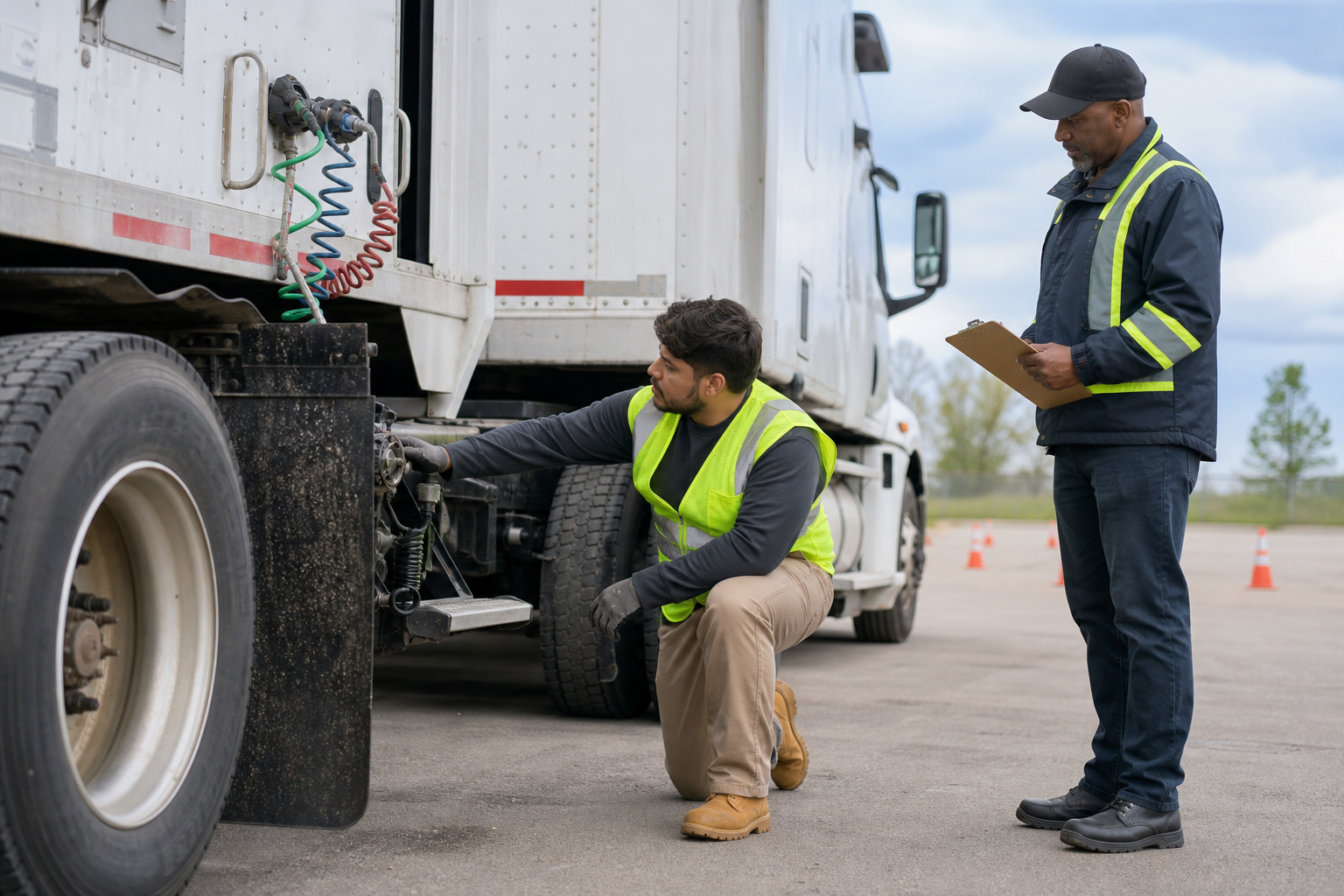
“Air brake practice exercises” is not the formal name of an Ontario licensing programme. Most learners use the phrase to mean study and inspection drills for the Air Brake (Z) Endorsement, including component identification, defect recognition, pressure checks, leak checks, and practical examination preparation.
The safest approach is to use Ontario’s Official Air Brake Handbook for theory, then complete vehicle-based exercises only with secure equipment and qualified supervision. Reading an inspection sequence is different from correctly applying it to an air-brake-equipped truck or bus.
Key Takeaways
- Study official Ontario checklists and diagrams before working around a vehicle.
- Practise identifying components and recognizing defects under supervision.
- Perform checks only on secured equipment with qualified instructors present.
- Understand the importance of brake adjustments and their impact on safety.
- Compare training programs based on practical coverage and instructor qualifications.
Quick summary

- Study official Ontario checklists, diagrams, inspection sequences, and defect descriptions before working around a vehicle.
- Practise naming components, identifying visible damage, and explaining what each inspection step is intended to confirm.
- Perform pressure, leak, operation, and brake-related checks only on properly secured equipment with qualified supervision.
- Stop and report a suspected defect. Do not repair, adjust, or certify an air-brake system without the required training and authorization.
- Compare Air Brake (Z) courses by practical coverage, instructor qualifications, equipment, prerequisites, and fit with your truck or bus licensing goal.
What air brake practice exercises should cover
Effective exercises follow the broad sequence used in air-brake inspection preparation. They should help you recognize the system, identify unsafe conditions, understand how it operates, and explain what to do when a defect is found. Ontario’s handbook provides checklists, charts, and circuit diagrams that can organize this study.
A useful exercise framework includes six areas:
- Component identification: Name the major air-brake and foundation-brake components and describe their basic purpose.
- Defect spotting: Recognize audible air leaks, cracks, damaged or missing parts, contaminated linings, and non-manufactured holes.
- System operation: Rehearse the order of checks and explain what normal operation should demonstrate.
- Pressure checks: Understand air-pressure build-up, gauge readings, and the purpose of air-loss testing.
- Leak checks: Know when an audible leak or pressure loss requires the inspection to stop and the issue to be reported.
- Brake adjustment concepts: Understand why correct adjustment matters without attempting an adjustment unless trained and authorized.
For structured practice with air-brake system components, review the school’s Air Brake (Z) training, which covers system maintenance, defect identification, and brake adjustment.
Self-study versus supervised hands-on practice

Self-study is useful for learning terminology and inspection logic, but it is not a substitute for practical assessment or permission to work on a commercial vehicle.
| Suitable for handbook-based review | Requires secure equipment and qualified supervision |
|---|---|
| Labeling diagrams and naming components | Locating components on a specific truck or bus |
| Memorizing the inspection order | Conducting pressure build-up or air-loss checks |
| Studying examples of defects | Assessing a real vehicle for defects |
| Explaining the purpose of brake adjustment | Measuring, adjusting, repairing, or certifying brakes |
| Reviewing official checklists | Completing a practical examination rehearsal |
Ontario safety guidance says an inspection should take place on a level, secure surface, with wheel chocks or blocks used to prevent vehicle movement. These controls are part of creating a safe inspection environment, not details to skip during practice.
Exercise 1: Identify air-brake components
Begin with a visual identification drill. Use an approved diagram or instructor-led vehicle walkaround and name each component without relying on prompts. Then explain its role at a high level and state what visible or audible condition could indicate a problem.
Include both air-system and foundation-brake components. Ontario guidance highlights inspection points such as damaged or missing foundation-brake parts, brake-lining problems, audible air leaks, cracks, and non-manufactured holes in air-brake chambers. The objective is recognition and accurate reporting, not unsupervised repair.
A strong answer should cover three points: what the part is, what it contributes to braking, and what condition would make it unsafe or require further attention. Repeat the drill until you can follow the inspection order aloud without guessing.
Exercise 2: Practise spotting defects
Defect recognition is more useful than memorizing a list without context. Ask an instructor to present one component or inspection area at a time, then describe what you see or hear, whether it appears normal, and what action should follow.
Practise distinguishing a visible concern from a conclusion you are not qualified to make. A crack, damaged lining, missing part, or audible leak should prompt you to stop, identify the concern clearly, and report it through the proper channel. It should not prompt you to improvise a repair.
Responsible emergency response preparation reinforces the same principle: secure the situation, keep people away from hazards, and escalate the issue rather than continuing an unsafe exercise.
Exercise 3: Work through system-operation, pressure, and leak checks
First rehearse the sequence without operating the vehicle. Explain what you would check, which gauges or signals you would observe, and what result would require further investigation. This exposes gaps in your understanding before you are beside operating equipment.
Ontario’s truck guidance describes air-pressure and air-leak testing expectations for a daily inspection test. The bus handbook also includes air-pressure build-up testing and inspection of listed air-brake components for air-brake-equipped vehicles. The exact vehicle and licensing pathway matter, so do not assume one rehearsal applies identically to every truck or bus.
If you are practising for tractor-trailer preparation, compare the programme’s air-brake coverage, pre-trip and brake checks, and confirm that practice uses representative equipment. Your instructor should demonstrate the procedure and observe you performing it before treating the skill as ready for assessment.
Exercise 4: Connect brake adjustment with pre-trip inspection
Brake adjustment should be studied as part of the broader inspection process, not as an isolated mechanical task. Learn why adjustment affects braking performance, what the relevant inspection points are, and how to recognize a condition that needs attention.
Do not treat an online checklist as permission to adjust or modify a vehicle. Brake work can expose you to vehicle movement, stored energy, compressed air, and moving components. A qualified instructor can show which checks are appropriate for your course and which tasks must be left to authorized personnel.
Your target vehicle also matters. A learner preparing for tractor-trailer work may need different equipment familiarity from someone preparing for a bus pathway. Ask how the course connects Air Brake (Z) preparation with your intended Class A, BZ, CZ, or DZ training.
Safety rules before any practical exercise
- Use a level, secure location and prevent vehicle movement with appropriate wheel chocks or blocks.
- Follow the instructor’s procedure for engine operation, pressure release, and access around the vehicle.
- Keep clear of moving parts and compressed air. Do not work beneath a vehicle as unsupervised practice.
- Do not adjust, repair, disconnect, or certify air-brake components unless properly trained, authorized, and supervised.
- Stop when you find or suspect a defect, secure the situation, and report it.
- Use the handbook as a study guide, not as a replacement for practical instruction or formal assessment.
How to use Ontario’s handbook effectively
Study in short, repeatable cycles. Read one checklist section, label the relevant components, rehearse the inspection order aloud, and explain what would count as a defect. Then ask an instructor to correct your sequence and demonstrate the practical technique on approved equipment.
Use official checklists and diagrams as preparation references, not as a source for inventing extra procedures. Ontario’s inspection guidance should take priority over outdated notes or informal practice questions.
What to ask before choosing Air Brake (Z) training
When comparing air brake training in Toronto or Scarborough, ask:
- Does the course include both theory and practical instruction?
- Will you practise component identification, defect recognition, pressure checks, leak checks, and brake adjustment concepts?
- What equipment will be used, and will the instructor demonstrate the inspection first?
- Are instructors certified or approved by a recognized safety organization?
- What licence or documentation is required before enrolment?
- How does the course fit your Class A, BZ, CZ, or DZ licensing plan?
- Where and when are classes held, and are practical sessions clear before payment?
JAZ Truck, Bus & Forklift Driving School states that its Air Brake (Z) course is available in Toronto and Scarborough, includes theory and practical instruction, and runs over two consecutive days. The school also states that applicants need a valid Ontario Class G licence or higher and that its instructors are certified or approved by the Ontario Safety League.
Air brake practice checklist
- Identify whether you need Air Brake (Z) preparation for a truck, bus, or another licensing pathway.
- Read the relevant Ontario handbook sections and study the checklists, diagrams, and inspection sequence.
- Practise naming air-brake and foundation-brake components from diagrams or instructor-led examples.
- Review common defects, including leaks, cracks, damaged or missing parts, and lining concerns.
- Rehearse pressure, air-loss, and system-operation checks verbally before using equipment.
- Complete hands-on checks only on secure equipment with qualified supervision.
- Ask for feedback on your sequence, defect descriptions, safety controls, and reporting decisions.
- Confirm that practical coverage matches your intended truck or bus licence.
Frequently asked questions
Are “air brake practice exercises” an official Ontario licensing programme?
No. It is an informal search phrase. Current terms include the Air Brake (Z) Endorsement, approved training or assessment, and the air-brake practical examination. Use Ontario’s official handbook and your provider’s current instructions.
Can I practise air-brake inspections without an instructor?
You can study diagrams, terminology, checklists, and inspection order independently. Vehicle-based pressure, leak, operation, and brake-related checks should be performed only with properly secured equipment and qualified supervision.
What should I study before an Air Brake (Z) practical examination?
Review component names, inspection sequence, system operation, air-pressure checks, leak recognition, foundation-brake defects, and safe reporting decisions. Then practise the physical procedure with an instructor who can correct your technique.
Does an Air Brake (Z) course require a full truck or bus licence?
Requirements depend on the provider and licensing pathway. JAZ states that its Air Brake (Z) course requires a valid Ontario Class G licence or higher. Confirm current prerequisites before enrolling.
How do air-brake exercises differ for tractor-trailer and bus training?
The inspection principles overlap, but equipment, vehicle layout, and the intended licence pathway can differ. Ask whether practical training reflects the type of truck or bus you plan to operate.
What should I ask an Air Brake (Z) training provider?
Ask about theory and practical coverage, equipment, instructor approval, defect-identification practice, pressure and leak checks, brake-adjustment concepts, prerequisites, schedule, and how the course fits your broader commercial licence plan.
Conclusion: practise the inspection process safely
The most useful air brake practice exercises combine handbook study with supervised application. Learn the components and inspection sequence first, practise recognizing defects and explaining pressure or leak checks, and never treat a study checklist as permission to repair or certify a vehicle.
If you need hands-on equipment, instructor feedback, and a defined Air Brake (Z) course, compare providers by practical coverage, safety controls, prerequisites, and fit with your truck or bus goal. JAZ Truck, Bus & Forklift Driving School offers a theory-and-practical Air Brake (Z) course in Toronto and Scarborough for learners with a valid Ontario Class G licence or higher. Visit JAZ Truck, Bus & Forklift Driving School for current course details.
Comments are closed