
Last updated: October 2026
What air brake training in Scarborough should include
Air brakes are not learned effectively by memorizing a few component names. A useful course connects the movement of compressed air to the controls, warning devices, brake chambers, foundation brakes, and decisions a driver makes before and during a trip.
When you speak with a provider, ask how the course balances explanation, demonstration, supervised practice, and feedback. The exact schedule can vary, but a complete learning experience should help you understand the system and demonstrate safe procedures in a realistic setting.
Core air-brake components and system flow
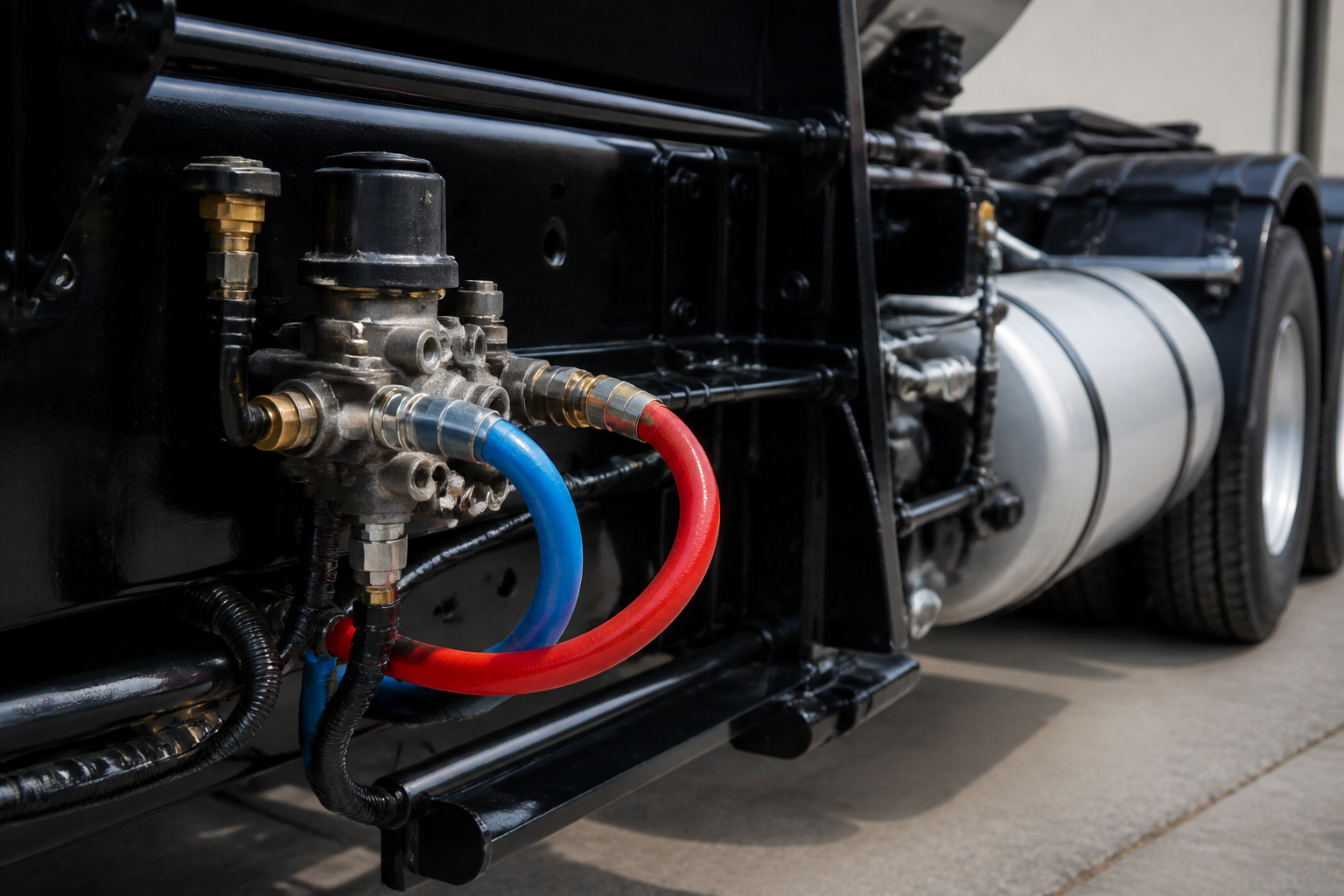
You should be introduced to the parts that create, store, control, and apply braking force. Depending on the vehicle and training setup, that may include the compressor, governor, reservoirs, air lines, hoses, valves, gauges, warning devices, brake chambers, slack adjusters, and foundation brakes.
Do not stop at naming each part. For every component, practise answering three questions: What does it do? Where would I find or recognize it? What change in sound, pressure, movement, or braking response could indicate a problem?
Ontario’s Official Air Brake Handbook is a useful reference for the terminology and knowledge expected for an Air Brake (Z) Endorsement. Use it alongside instructor-led practice rather than treating independent reading as a substitute for supervised training.
Controls, warnings, and safe operating routines
Training should cover the primary and secondary gauges, warning signals, parking and emergency controls, and the sequence used to bring a vehicle into service. You should learn how to observe pressure build-up, recognize warning conditions, and secure the vehicle correctly when stopping or parking.
Safe operation also includes smooth, progressive braking and appropriate use of the vehicle’s transmission retarding systems where instructed. The aim is controlled braking that supports stability and reduces unnecessary heat, not abrupt pedal applications or hurried reactions.
Inspection, defect reporting, and communication
A strong course teaches you to inspect more than the dashboard. You should practise looking at accessible lines, hoses, fittings, chambers, adjusters, mounts, and related components for signs that require attention. You also need to know how to describe a concern clearly and report it through the correct workplace process.
Ask whether the course includes repeated walk-throughs with feedback. One demonstration may make the sequence look simple, but repetition is what helps you notice details while maintaining a consistent order.
How Ontario’s Z endorsement process works
In Ontario, the Air Brake (Z) Endorsement relates to driving applicable vehicles equipped with air brakes or air-over-hydraulic brake systems. The provincial handbook explains the knowledge required for the endorsement, while the province’s truck driver licensing guidance explains how air-brake requirements fit within commercial licensing.
Training and testing are separate parts of the process. A private school can teach the system and prepare you for the required steps, but the official examinations are conducted through DriveTest. Confirm the current booking, identification, eligibility, and testing details with the relevant official source before relying on an older checklist.
Initial endorsement versus renewal information
Do not confuse information about renewing an existing endorsement with the route for obtaining one for the first time. Ontario changed the air-brake knowledge-test process for endorsement renewals in 2023 by introducing an online learning module; that change does not replace the initial endorsement route.
When comparing a Scarborough course, ask the provider to explain which part of the journey its training covers. A useful answer should distinguish instruction, any provider assessment or completion documentation, and the separate DriveTest knowledge and practical testing process.
Questions to ask before you register
- Is the course intended for someone seeking the initial Z endorsement, a commercial licence, or a refresher?
- What documentation or completion information will I receive?
- Which parts of the official testing process are practised, and which must be completed independently through DriveTest?
- What equipment will I inspect and operate during training?
- How are missed classes, rescheduling, and additional practice handled?
These questions reduce the risk of choosing a program based on an outdated description. They also help you plan your study time around the precise step you need to complete next.
How to compare air brake courses in Scarborough
Convenient location matters, especially if you are balancing training with work or other commitments. It should be one factor in a wider decision, however. Compare providers using the same questions so that a polished advertisement does not outweigh the quality of instruction you will actually receive.
Curriculum and learning sequence
Request a plain-English outline. It should show how the provider moves from system fundamentals to component identification, controls, inspections, fault recognition, and practical application. If the outline only lists broad promises such as “complete training” without explaining what you will do, ask for more detail.
The best sequence is understandable for a beginner: first learn the purpose and layout of the system, then observe a procedure, perform it with coaching, and finally repeat it with less prompting. This progression gives you a way to measure improvement.
Equipment and supervised practice
Ask whether you will work with a real commercial vehicle, a dedicated training aid, or both. A training aid can make components easier to see, while a vehicle gives you experience with gauges, controls, sounds, positioning, and the physical order of an inspection.
Find out how much individual practice each learner receives. A large group may still be effective if time is allocated carefully, but you should know whether you will personally trace lines, identify controls, narrate checks, and receive corrections rather than watch others perform every drill.
Instructor qualifications and feedback
Ask about instructor experience with commercial vehicles and air-brake instruction. JAZ Truck, Bus & Forklift Driving School describes its instructors as OSL-certified and combines classroom learning with hands-on, in-vehicle instruction and road-test preparation. Confirm the current details of any program directly with the school before registering.
Feedback should be specific enough to act on. “Be more careful” is less useful than “complete the warning-device check before moving to the service-brake check” or “explain what you are checking at this component.” Ask whether feedback is verbal, written, or both.
Scheduling, support, and transparency
Flexible scheduling can help part-time learners attend consistently. Confirm class times, the procedure for rescheduling, what happens after an absence, and whether study materials or checklists are included.
Also ask for the total price and what it includes before you commit. If financing is relevant, JAZ states that financing options are available through Health Smart Financial/PayBright; ask the provider for current eligibility and terms rather than assuming availability.
How to prepare before air brake training
You do not need to arrive as a mechanic. You can, however, make the first class more productive by becoming familiar with the vocabulary and by practising how to organize information. Preparation should reduce confusion, not encourage you to inspect or operate a vehicle without proper supervision.
Build a component vocabulary
Make a set of study cards for the compressor, governor, reservoirs, valves, gauges, chambers, slack adjusters, hoses, and foundation brakes. On each card, write the component’s basic purpose, how it may appear in a vehicle or diagram, and one question you still have.
Say the explanation aloud instead of only rereading it. If you cannot explain a term in simple language, mark it for discussion in class. This approach exposes gaps earlier than passive highlighting.
Draw the airflow path
Use the handbook and your instructor’s terminology to create a simple diagram showing how air is generated, stored, controlled, and delivered to the braking components. Add arrows and labels, but do not worry about artistic accuracy.
After drawing it, cover the labels and recreate the path from memory. Then compare the two versions and write down what you missed. The exercise helps you connect a component’s name with its role in the larger system.
Practise a spoken routine
Create a short script for the order in which you expect to conduct an air-brake check. The wording should follow your instructor’s approved procedure; do not invent pressure limits or testing steps from an online article. At home, rehearse the sequence using headings such as securement, pressure and warnings, service checks, and parking.
Speaking makes omissions easier to identify. Once the sequence is accurate, practise at a steady pace rather than rushing to finish.
Prepare a focused study kit
- A notebook dedicated to diagrams, instructor corrections, and questions.
- Index cards or a digital equivalent for components and definitions.
- Comfortable clothing and footwear suitable for supervised practical work.
- Work gloves or a flashlight only if the provider permits and recommends them.
- Water and a snack if the training schedule is extended.
Ask before taking photographs of equipment or using a phone during instruction. Safety, privacy, and the provider’s rules take priority over building a personal photo reference.
Hands-on drills that make the system easier to remember
Practical repetition should be deliberate. Ask the instructor to explain the objective of each drill, demonstrate it once when needed, and then let you perform it while receiving corrections.
Gauge and warning-device practice
Practise identifying each gauge and explaining what you are observing during the relevant part of the procedure. Include warning devices in your narration so you do not focus on pressure readings while overlooking an alert or control.
Do not memorize a number without understanding the condition in which it applies. Vehicle specifications and instructor procedures matter, so use the values and instructions provided for the vehicle you are training on.
Leak and component checks
Repeat the approved leak-check sequence until the order is familiar. Practise pointing to the relevant parts and describing what you see, hear, or feel without touching a component in an unsafe way.
Ask for correction whenever you are unsure whether a sound or condition is normal. Guessing during training can turn a correctable misunderstanding into a habit.
Control identification and securement
Have a partner or instructor name a control or indicator, then locate it and explain its purpose. This exercise is more useful than looking at a labelled diagram because it develops recognition in the cab.
Practise parking and securement only under instruction and in the approved area. The objective is to perform each step in the correct order, confirm the vehicle is held securely, and communicate what you have done.
Progressive braking
With an instructor, practise smooth application and release in an appropriate controlled environment. Concentrate on anticipation, pedal control, vehicle response, and the feedback you receive rather than trying to create an impressive stop.
Record one improvement and one question after each session. Small notes make the next lesson more targeted and help prevent the same error from recurring.
How to become confident with pre-trip air checks
Many learners feel overwhelmed because they are trying to remember the entire inspection at once. Break it into stable blocks, complete the blocks in the approved order, and keep your narration clear enough that an instructor can understand your reasoning.
Use named inspection blocks
Possible mental blocks include vehicle securement, air build-up and warnings, service-brake response, accessible components, and parking or shutdown. Your instructor’s procedure takes priority, but named blocks can help you remember where you are in the sequence.
Before moving to the next block, pause briefly and ask yourself what you have confirmed and what still requires attention. That pause is usually safer than skipping ahead because you feel pressured.
Trace, observe, and explain
Where permitted, use your hand or finger to follow the inspection path while you speak. Identify what you are looking at and describe the condition without making unsupported conclusions.
Use more than one sense. Gauges provide information, but so can visible damage, an unusual sound, vibration, or an unexpected control response. Report concerns instead of attempting an unsupervised repair.
Practise accuracy before speed
Timing yourself too early can make you rush and skip a step. First complete the process accurately with coaching, then repeat it until the order is consistent, and only then use a timer to understand your pace.
Keep a “miss log” after practice. Write the exact step you missed, the reason it matters, and the cue that will remind you next time. Review the log before the next session.
Common mistakes in air brake training – and how to avoid them
Most difficulties are fixable when identified early. They become more serious when a learner hides uncertainty, practises an incorrect sequence, or treats a classroom explanation as proof of practical competence.
Memorizing names without understanding purpose
Knowing that a component is called a governor is not the same as understanding its place in the system. Connect every term to its function, location, and the observation that would prompt you to ask an instructor for help.
Rushing because you feel watched
Pressure can make learners speak quickly, skip transitions, or reach for the wrong control. Slow your breathing, name the block you are beginning, and follow the approved sequence. Accuracy and safe communication come before speed.
Studying only the night before
Cramming may help you recognize a definition temporarily, but it does not create reliable physical recall. Use short sessions of 20 to 30 minutes, each with one goal such as component vocabulary, system flow, or inspection order.
Failing to ask for another repetition
Do not leave a session with a step that still feels unclear. Ask the instructor to demonstrate it again, perform it yourself, and explain what changed after the correction. One focused repetition can be more valuable than a long period of passive observation.
Confusing course completion with readiness
Completing instruction is an important milestone, but confidence should come from accurate practice and clear understanding of the next official step. Confirm what remains to be done through the current Ontario and DriveTest information, and keep reviewing the approved handbook.
How to maintain your air-brake skills after training
Air-brake knowledge is easier to retain when you revisit it periodically. Keep your notes, diagrams, and instructor corrections together so that review is based on the vehicle and procedure you actually learned.
- Redraw the basic system flow from memory, then check it against your approved materials.
- Review your component cards and remove terms you can explain confidently only after testing yourself.
- Rehearse the inspection sequence verbally before a supervised practical session.
- Keep a record of questions or unfamiliar conditions to discuss with an instructor or qualified supervisor.
- Do not diagnose, adjust, or repair an air-brake system unless you are authorized and trained to do so.
JAZ Truck, Bus & Forklift Driving School serves Toronto and Scarborough and offers commercial driver training that includes the Air Brake (Z) endorsement among its programs. Its stated approach combines classroom learning, hands-on instruction, and road-test preparation; contact the school to confirm current course availability and suitability for your licence goal.
Air brake training in Scarborough FAQ
Do I need air brake training to obtain an Ontario Z endorsement?
You need to meet Ontario’s requirements for the applicable Air Brake (Z) Endorsement and complete the required testing process. Training is designed to prepare you, but it is separate from the official DriveTest examinations. Confirm the current initial-endorsement requirements with Ontario and DriveTest before booking.
What should I compare when choosing an air brake course in Scarborough?
Compare the curriculum, instructor experience, hands-on equipment, individual practice time, feedback process, schedule, included materials, and explanation of the DriveTest steps. A course should make clear what it teaches and what remains your responsibility after training.
Can I start air brake training without mechanical experience?
Yes. A beginner can prepare by learning basic component names and arriving with questions. The important factor is whether you receive clear explanations, supervised practice, and enough repetition to connect system theory with safe inspection and operation.
How can I feel less nervous during an air-brake inspection?
Practise the approved sequence in named blocks, narrate what you are checking, and focus on accuracy before speed. Keep a log of missed steps and repeat those sections with instructor feedback. Familiarity with the order usually reduces pressure more effectively than last-minute cramming.
Plan your Scarborough air brake training
If you are comparing providers, preparing for the Ontario Z endorsement, or looking for hands-on guidance near Scarborough, contact JAZ Truck, Bus & Forklift Driving School to discuss your licence goal, schedule, and current course options.
Comments are closed