
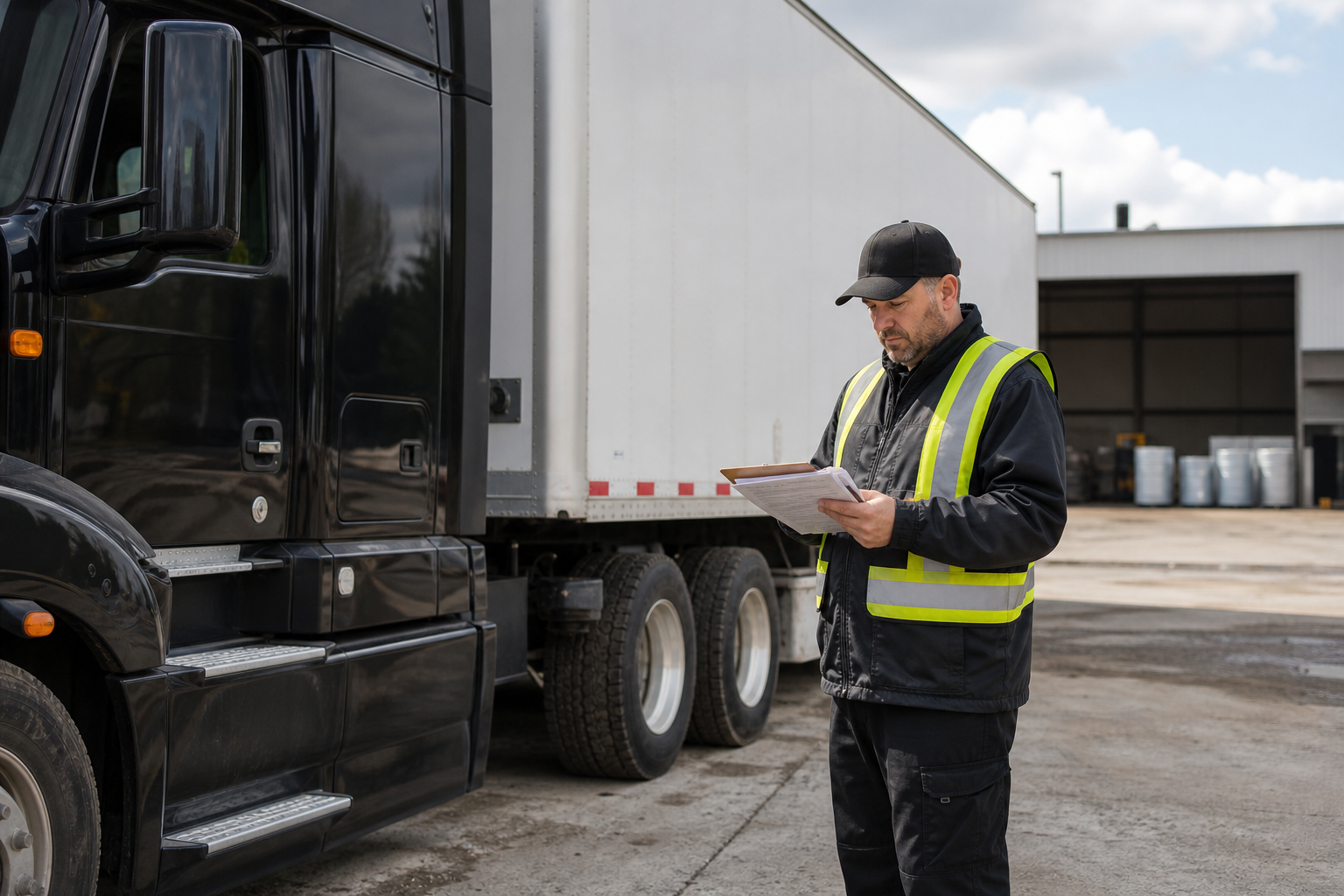
Dangerous goods training, formally Transportation of Dangerous Goods (TDG) training, applies to people who handle, offer for transport, or transport dangerous goods. In Canada, road, rail, and marine TDG certificates are valid for three years, while air certificates are valid for two years. The employer determines the required training level and issues the certificate after successful completion. TDG training is not a separate Ontario driver’s-licence endorsement.
What dangerous goods training means in Ontario
TDG training teaches people how to work safely and legally with regulated products during handling, preparation for shipment, and transportation. Transport Canada’s guidelines help employers identify appropriate training, but the guidelines do not replace the training requirements in the Transportation of Dangerous Goods Regulations. Transport Canada’s TDG training guidance explains that distinction.
The requirement is tied to what you do, the goods involved, and the transport mode. A person who handles, offers for transport, or transports dangerous goods must be adequately trained and hold a training certificate, unless working under the direct supervision of someone who is trained and holds a valid certificate. The federal TDG training bulletin sets out this basic rule.
For an Ontario truck driver, TDG training may be one part of a broader commercial-driving pathway. For a warehouse worker, shipper, receiver, or forklift operator, the relevant duties may begin before a vehicle leaves the yard. The job title alone does not answer whether you need training.
Who needs TDG training? Start with the task, not the job title
Use your actual duties as the starting point. You should ask whether you will perform any of the following activities:
- Handle dangerous goods: load, unload, package, move, store temporarily, or otherwise work directly with regulated products.
- Offer dangerous goods for transport: prepare or present a shipment for a carrier, including decisions about classification, documents, safety marks, and containers.
- Transport dangerous goods: drive or otherwise operate the vehicle or conveyance carrying the goods.
If your role includes one of these activities, your employer should identify the required TDG training before assigning the work. A person who has not completed the required training may work under the direct supervision of a trained person with a valid certificate, but supervision is not a substitute for planning the correct training path.
How the requirement may apply to different roles
- Tractor-trailer drivers: If you transport dangerous goods by road, you need training that matches the goods, vehicle duties, and employer’s operation. The driver must know how to interpret shipping information, recognize safety marks, follow loading and emergency procedures, and respond appropriately to an incident.
- Shippers: A shipper who prepares a regulated load may have responsibilities before the driver arrives. Those duties can include selecting or confirming the classification, preparing shipping documents, applying safety marks, and using an appropriate container.
- Receivers: A receiver may handle containers during unloading, inspect information, move products within a facility, or place them into storage. The required training depends on the work actually performed.
- Forklift operators: Moving a dangerous product with a lift truck can involve both TDG responsibilities and powered-lift-truck safety requirements. Forklift certification alone does not automatically satisfy TDG training obligations.
- Warehouse workers: Workers who handle, sort, stage, or load regulated products may need TDG training even if they never drive on public roads.
- Bus-related workers: A bus driver does not automatically need TDG training simply because they operate a commercial passenger vehicle. The question is whether the person handles, offers for transport, or transports dangerous goods as part of the assigned work.
Ontario’s Ministry of Transportation states that dangerous-goods drivers receive training from their current employer. The employer determines the required level and issues the certificate after successful completion, so a certificate from one role or employer should not be assumed to cover a different assignment. Ontario’s MTO Truck Handbook legislation guidance explains this employer-specific responsibility.
The nine classes of dangerous goods in plain language

Dangerous goods are grouped into nine classes according to the type of hazard they present. The class is only one part of the decision. The specific product, shipping name, quantity, packaging, transport mode, and applicable rules determine the required marks, documents, containers, and procedures.
| Class | Plain-language hazard | Representative examples |
|---|---|---|
| 1 | Explosives | Products designed to explode or produce a pyrotechnic effect. |
| 2 | Gases | Compressed, liquefied, or refrigerated gases, including flammable or toxic gases. |
| 3 | Flammable liquids | Liquids that can ignite readily, such as some fuels, solvents, or coatings. |
| 4 | Flammable solids, substances liable to spontaneous combustion, or substances dangerous when wet | Solids that ignite easily, heat up in contact with air, or react dangerously with water. |
| 5 | Oxidizing substances and organic peroxides | Materials that can cause or intensify combustion, including certain reactive chemical products. |
| 6 | Toxic and infectious substances | Products that can cause serious harm through exposure, or substances containing infectious organisms. |
| 7 | Radioactive materials | Materials that emit ionizing radiation and require specialized controls. |
| 8 | Corrosives | Acids, bases, and other products that can damage skin, materials, or vehicle components. |
| 9 | Miscellaneous dangerous substances and articles | Regulated products presenting hazards that do not fit neatly into Classes 1 through 8. |
These categories are a foundation for training, not a permission list. A worker should not identify a product only by a familiar trade name or assume that every item in a broad category has the same requirements. The product’s classification and transport information must be confirmed through the employer’s procedures and current regulatory materials.
What a TDG certificate proves, and what it does not prove
A TDG certificate shows that the person has completed training considered adequate for the duties and transport mode identified by the employer. It supports the person’s ability to perform assigned dangerous-goods work, subject to the certificate’s scope and the employer’s procedures.
It does not automatically prove that you are authorized to handle every class of dangerous goods, work for every employer, operate every vehicle, or transport goods by every mode. It also does not replace a commercial driver’s licence, a forklift operator assessment, an Air Brake (Z) endorsement, workplace orientation, or site-specific authorization.
For road, rail, and marine transportation, a TDG certificate is valid for three years. For air transportation, the certificate period is two years. Transport Canada’s basic-competency guidance states these validity periods and explains that the person must be trained and certified or work under direct supervision.
The employer still has to determine whether the training matches the work. Ontario also identifies practical transport requirements such as shipping documents, safety marks, suitable containers, and a trained driver or direct supervision. Ontario’s commercial-vehicle safety requirements outline these responsibilities.
What effective TDG training should cover
A useful course should connect regulatory concepts to the decisions you will make at work. The exact content depends on your duties, goods, employer, and mode, but you should expect the training conversation to address several core areas.
- Classification: how to identify the applicable dangerous-goods class and recognize when product information needs confirmation.
- Shipping documents: what information must accompany the load and who prepares or checks it.
- Safety marks: how labels, placards, and other marks communicate hazards during handling and transportation.
- Containers and loading: why packaging, containment, segregation, load placement, and secure handling matter.
- Emergency response: what to do after a spill, leak, fire, collision, damaged container, or other incident, including when to isolate the area and seek help.
- Workplace procedures: how the employer’s instructions, equipment, facility layout, reporting process, and supervision affect the work.
- Documentation and responsibilities: which duties belong to the consignor, carrier, driver, receiver, or other person involved in the shipment.
Ontario’s commercial-vehicle guidance places responsibility on operators to ensure employees and drivers have the training necessary to transport or handle dangerous goods. The Commercial Vehicle Operators’ Safety Manual provides the Ontario context for that responsibility.
Road, rail, marine and air training are not interchangeable
TDG training is mode-specific. A road-focused certificate should not be treated as air-transport qualification, and the two-year air certificate period should not be applied to a road driver’s certificate.
| Transport mode | Certificate validity stated by Transport Canada | What to confirm |
|---|---|---|
| Road | Three years | Goods, vehicle duties, employer scope, documents, marks, and emergency procedures. |
| Rail | Three years | Rail-specific duties, equipment, procedures, and employer requirements. |
| Marine | Three years | Marine responsibilities and the applicable employer and regulatory requirements. |
| Air | Two years | Air-mode training and requirements. Do not assume road training transfers to air work. |
If your work changes from road transportation to air cargo, or from handling at a warehouse to another transport role, ask whether additional or different training is required. The certificate’s expiry date is only one part of the decision. Its scope must fit the new duties.
TDG training versus the other credentials you may need
Several types of training can appear together in a transportation or warehouse job, but they solve different problems. One credential should not be used as proof that another requirement has been met.
| Training or authorization | What it addresses | What it does not replace |
|---|---|---|
| TDG training | Handling, offering for transport, or transporting dangerous goods within a defined scope and mode. | Commercial licensing, forklift authorization, air-brake preparation, or employer orientation. |
| Forklift operator training | Safe operation of powered lift trucks, including inspection, manoeuvring, load handling, and workplace hazards. | TDG training when the goods and duties trigger TDG requirements. |
| Class A or DZ commercial-driver training | Vehicle operation, licensing preparation, road-test skills, inspections, and commercial-driving responsibilities. | A TDG certificate unless the employer separately confirms the required TDG training and documentation. |
| Air Brake (Z) preparation | Air-brake system knowledge, inspection, and the Ontario Z endorsement pathway where applicable. | TDG training or dangerous-goods authorization. |
| Workplace authorization | Permission to operate specific equipment or perform duties at a particular site after employer orientation and assessment. | The underlying licence, certificate, or regulated training requirement. |
JAZ Truck, Bus & Forklift Driving School offers forklift training in the Toronto and Scarborough area with one-on-one, hands-on instruction. You can review the school’s forklift safety training as a related equipment-training pathway, but forklift training does not by itself establish that you have completed the TDG training required for a particular assignment.
JAZ describes its Class A program as MELT-certified training that combines classroom and hands-on instruction with road-test preparation. That commercial licensing pathway does not by itself establish TDG training, so ask the school and your prospective employer separately whether TDG training is included, required, or issued for the job you want.
A practical TDG training journey from enquiry to workplace
Follow this sequence before enrolling or accepting a dangerous-goods assignment:
- Identify the actual duties. Write down whether you will handle, prepare, load, unload, receive, store, offer for transport, or drive with the goods.
- Identify the goods and mode. Ask which products and dangerous-goods classes are involved, and whether the work is by road, rail, marine, or air.
- Ask the employer what level is required. The employer should identify the training scope, the certificate issuer, and any additional site or equipment requirements.
- Choose training that matches the assignment. Do not enrol in a generic course without checking whether it covers the goods, duties, and transport mode you will actually perform.
- Complete instruction and assessment. Ask how learning is evaluated and what successful completion means. Do not assume an assessment score, course length, or delivery format unless the provider states it.
- Receive the appropriate documentation. Confirm who issues the certificate, what duties and mode it covers, and when it expires.
- Complete workplace orientation. Learn the employer’s procedures for documents, loading, reporting, spills, damaged containers, emergency contacts, and site movement.
- Track changes and renewal. Revisit the training when the certificate approaches expiry, your employer changes, your duties expand, the goods change, or the transport mode changes.
How TDG responsibilities look in real work situations
A tractor-trailer driver before departure
Hypothetical example: A driver is assigned a load containing regulated products. The driver should know how to check the shipping information and safety marks, confirm that the load and containers appear suitable, and follow the carrier’s emergency and reporting procedures. The driver should also ask whether the assigned TDG certificate covers the goods and road duties involved.
A shipper preparing a load
A shipper may be responsible for information that must be correct before the carrier arrives. The key questions include how the product is classified, whether the container is appropriate, which safety marks are required, and who prepares the shipping document. The shipper’s responsibilities are not transferred simply because a driver will perform the delivery.
A receiver unloading at a warehouse
A receiver may handle containers, inspect incoming information, move goods, or place them into a designated area. The receiver should know which activities are covered by their training and when a supervisor must be involved. Storage procedures, restricted areas, spill reporting, and damaged-container procedures may also be part of the employer’s workplace orientation.
A forklift operator moving regulated products
A forklift operator may need both powered-lift-truck training and TDG training if the work involves handling dangerous goods. The operator should understand the load, the container, the route, pedestrian controls, and the employer’s response process. Forklift training addresses equipment operation, while TDG training addresses the regulated goods and transportation-related duties. Related reading: Load Securement Training in Ontario: What Truck and Forklift Operators Should Learn.
A bus-related worker
A bus driver transporting passengers does not automatically require TDG training. If the assigned work includes carrying regulated goods, handling shipments, or another TDG activity, the employer should define the required scope. Passenger-vehicle training, commercial licensing, and TDG certification remain separate questions.
Questions to ask before you enrol or accept the job
- Which specific goods and dangerous-goods classes will I handle or transport?
- Will I handle, offer for transport, transport, load, unload, receive, or store the goods?
- Is the work by road, rail, marine, or air?
- What level of TDG training does the employer require for this assignment?
- Who issues the certificate, and will the employer accept a certificate from an outside provider?
- What duties, goods, vehicle, workplace, and transport mode does the certificate cover?
- How long is the certificate valid, and how is renewal tracked?
- What assessment is required for successful completion?
- What documents, safety marks, containers, loading procedures, and emergency procedures will the training cover?
- Can I work under direct supervision before completing the training, and what exactly will that supervision involve?
- Do I also need forklift training, a Class A or DZ licence, an Air Brake (Z) endorsement, workplace authorization, or site-specific emergency training?
Choose the next training conversation for your goal
TDG training is best treated as one part of a role-specific safety and compliance plan. Before relying on a certificate, match it to your goods, duties, employer, workplace, and transport mode. If you are pursuing tractor-trailer work in Toronto or Scarborough, JAZ Truck, Bus & Forklift Driving School provides information about Class A tractor-trailer training; ask JAZ and the prospective employer directly whether separate TDG training is required, because the school’s verified information does not establish a standalone JAZ TDG certification course.
Comments are closed