
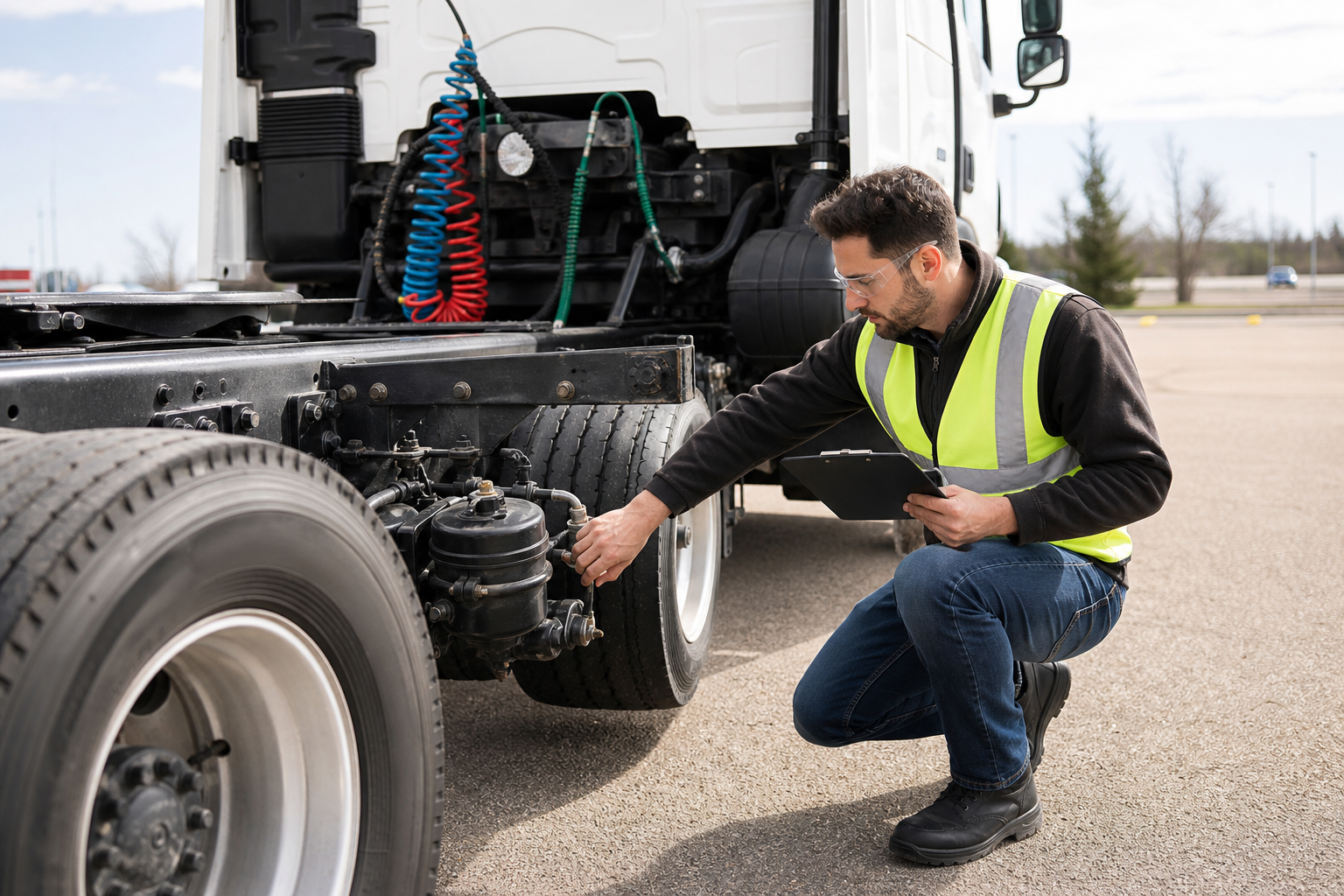
An effective Ontario air brake study guide should cover system components, pressure and warning devices, leak and brake-adjustment checks, braking technique, and the difference between knowledge and practical testing. Use the Official Air Brake Handbook for current requirements, then combine reading with supervised instruction because online study alone does not replace required testing or hands-on preparation.
This guide takes you from air-brake theory to a practical study routine for Ontario’s Air Brake (Z) Endorsement. It applies to Class A, DZ, BZ and CZ learners, with a separate note for forklift operators.
Air brakes in plain language: what changes from hydraulic braking
Hydraulic brakes transmit pedal force through fluid. Air brakes use compressed air to control braking force, so the system must build and maintain pressure before safe operation. Air pressure also powers safety devices and helps release the brakes when the system functions correctly.
Heavy commercial vehicles use air systems because compressed air can operate braking equipment across a tractor, trailer and multiple axles. If pressure falls too far, spring brakes can apply to help hold the vehicle.
The main driving difference is planning. Air brakes do not respond exactly like passenger-car hydraulic brakes. You must manage speed early with smooth, progressive braking, sufficient following distance, careful downhill control and heat management.
Ontario requires a Z air-brake endorsement to operate an air-brake-equipped motor vehicle. The Official MTO Driver’s Handbook directs applicants to the Official Air Brake Handbook for qualification requirements.
The five air-brake components you need to understand
Study each component by learning what it does, what you observe during an inspection and what a suspected defect means.
| Component | What it does | What to connect it to | Inspection decision |
|---|---|---|---|
| Compressor and governor | The compressor produces air. The governor controls loading and unloading as pressure rises. | Pressure build-up, cut-in and cut-out behaviour. | Abnormal build-up or failure to maintain pressure requires assessment. |
| Air reservoirs | Storage tanks hold compressed air for service, parking and emergency circuits. | Gauges, moisture, drains and available pressure. | Low pressure or an imbalance is a safety concern. |
| Control valves | Valves direct and regulate air to the brake circuits. | Pedal response, parking-brake control and warning devices. | An unexpected control response is not normal operation. |
| Brake chambers and pushrods | Air pressure moves the chamber mechanism, while the pushrod transfers that movement to the brake. | Leaks, pushrod travel and brake application. | Excessive or uneven movement needs measurement. |
| Foundation brakes | The wheel-end assembly creates friction to slow the vehicle. | Adjustment, drums or discs, wear, heat and stopping performance. | Damage, overheating or poor adjustment requires reporting. |
These five groups connect the air supply, storage, control, actuation and wheel-end braking functions in order. That relationship is more useful than memorizing component names in isolation.
How Ontario’s Air Brake (Z) endorsement pathway fits together
The Z endorsement is an air-brake qualification added to an Ontario driver’s licence. It is not the same as completing a study guide or enrolling in a commercial driving course.
For a new applicant, Ontario states that the air-brake knowledge test is taken at a DriveTest centre. After the knowledge test, the applicant can book a practical test. The practical-test version depends on whether the vehicle uses a tractor-trailer air-brake system, as explained on Ontario’s truck driver’s licence information page.
- Identify the vehicle and licence pathway you need.
- Confirm eligibility, documents and related commercial-licensing requirements.
- Study the current Ontario handbook and system terminology.
- Take the applicable knowledge test through the official process.
- Practise inspections and operation with qualified supervision.
- Complete the practical test for the vehicle configuration.
A focused course may support part of this pathway but may not replace broader Class A, DZ, BZ or CZ training. Begin by choosing an air brake course that matches your commercial driving goal.
A supervised air-brake inspection sequence

An inspection is an ordered safety decision, not a memorized performance. You should explain what you are checking, what an acceptable result means and what condition would prevent movement.
1. Secure the vehicle and identify the equipment
Secure the vehicle according to the applicable procedure. Identify the primary and secondary gauges, warning devices, parking-brake control, reservoirs, chambers, pushrods and adjustment mechanism.
2. Observe pressure build-up and gauge behaviour
Watch each gauge as pressure builds. Learn the normal relationship between pressure, compressor operation and governor control for the training vehicle. Unusual build-up time or pressure that will not hold should be treated as a defect question.
3. Review the low-air warning check
Ontario’s handbook states that this check begins above 621 kPa (90 psi). As pressure is reduced, the warning device must activate at or above 380 kPa (55 psi) on both primary and secondary air-tank gauges.
Do not silence or ignore a low-pressure warning. A warning device that fails to activate at the required point must be reported and resolved before operation.
4. Check for leakage and pressure loss
Learn how the applicable leakage test is timed and interpreted for your vehicle. Listen for escaping air, watch the gauges and distinguish normal system sounds from a continuing leak. Unexpected pressure loss means stopping the process and obtaining qualified assessment.
5. Examine chambers, pushrods and adjustment
Inspect chambers, hoses, lines, mounting points and pushrods for visible damage or abnormal movement. Brake adjustment and pushrod stroke require the correct method, measurement and equipment. Do not estimate adjustment by eye.
Ontario’s practical-test materials identify wheel chocks or blocks, a stopwatch or watch with a second hand, and a means of measuring pushrod stroke as required equipment. Review Ontario’s air-brake inspection checklists and charts before test day.
6. Check service, parking and emergency functions
Under supervision, learn how these functions should respond on the training vehicle. Understand which circuit or control is involved and recognize an unexpected response before entering traffic.
Useful preparation includes system fundamentals, gauges, warning devices, start-up and shutdown routines, pre-trip air checks, smooth braking, parking and emergency practices. Review air brake training preparation to organize these topics.
How to study braking technique without memorizing isolated numbers
Air-brake technique starts before touching the pedal. Choose a safe speed, leave following distance, look ahead and plan downhill speed control before momentum builds.
For normal braking, apply the service brake progressively and smoothly. The purpose is controlled deceleration without harsh weight transfer, wheel lock or unnecessary heat.
On a long or steep downgrade, use approved speed-control methods and transmission-retarding equipment as instructed. Do not rely on constant heavy braking to correct a speed that should have been managed earlier.
Emergency situations require vehicle-specific instruction from a qualified instructor. This guide is not an unsupervised driving exercise.
Choose the right preparation method
| Method | Best use | What it cannot replace |
|---|---|---|
| Official handbook | Learn Ontario terminology, requirements and inspection concepts. | Physical practice and vehicle-specific coaching. |
| Online questions | Check definitions and basic decisions. | The official test or practical competence. |
| Classroom instruction | Ask questions and correct misunderstandings. | Supervised vehicle practice. |
| Hands-on instruction | Practise gauges, warnings, leaks, components and inspection order. | The official Ontario testing process. |
| Official testing | Complete the knowledge and practical requirements. | Ongoing safe training. |
You can use online materials to study, but online study does not complete the new-applicant knowledge and practical pathway. Ontario’s online air-brake learning module replaced the renewal knowledge-test requirement beginning September 1, 2023. Renewal is different from obtaining a new endorsement.
Training duration varies by provider, learner background, vehicle and course scope. Ask what is included, how much practical time is provided and whether the instruction matches your vehicle and test pathway. For targeted review, compare your weak areas with air brake exam preparation topics.
Which parts apply to your vehicle?
Class A tractor-trailer learners
Prioritize tractor and trailer air circuits, primary and secondary gauges, trailer protection, air connections, brake adjustment and the practical-test version for a tractor-trailer system.
DZ straight-truck learners
Focus on the air system installed on the straight truck, including reservoirs, controls, chambers, foundation brakes and the vehicle-specific inspection sequence.
BZ and CZ bus learners
Study air brakes alongside vehicle inspection, passenger safety, mirror use, turning and smooth stopping. School buses and coaches differ in controls and equipment. Review air brake fundamentals alongside bus practice.
Forklift learners
Not every forklift uses an air-brake system. Identify the equipment and workplace requirements first. Air-brake study applies only when the equipment has an air system and the training requires it.
A seven-day study plan that turns reading into recall
- Day 1: Draw the airflow path from compressor to reservoirs, valves, chambers and foundation brakes.
- Day 2: Make cards for each component’s purpose, observation and defect decision.
- Day 3: Read the Ontario requirements and inspection chapters.
- Day 4: Rehearse gauge behaviour and warning-device checks.
- Day 5: Say the inspection sequence aloud without notes.
- Day 6: Complete supervised practice on the actual training vehicle.
- Day 7: Answer scenario questions and prepare documents and equipment.
Instead of rereading “low-air warning,” narrate the check: identify both gauges, state the starting pressure, explain how pressure is reduced, identify the warning point and describe the response if it fails. This tests recall, sequence and judgment together.
Mini practice quiz: reason through the decision
Which component creates compressed air?
Answer: The compressor creates air, while the governor controls loading and unloading.
At what pressure should the Ontario low-air warning check begin?
Answer: Above 621 kPa (90 psi). The warning must activate at or above 380 kPa (55 psi) on both primary and secondary gauges.
A gauge falls noticeably during a leakage check. Should you continue driving?
Answer: No. Treat unexpected pressure loss as a defect question, stop the process and obtain qualified assessment.
Why does pushrod stroke matter?
Answer: Pushrod movement transfers chamber force to the foundation brake. Excessive or uneven travel can indicate an adjustment or brake-system problem.
Does an online quiz prove practical-test readiness?
Answer: No. A quiz checks recall. Practical readiness also involves inspection order, equipment, measurements, warning devices and vehicle-specific decisions.
When formal air-brake training is the sensible next step
Formal instruction is useful if air-brake terminology remains abstract, you have never inspected a commercial vehicle, you are unsure how to interpret gauges or you need feedback before a practical test.
JAZ Truck, Bus & Forklift Driving School lists an Air Brake course in the Toronto and Scarborough area. Its training information identifies OSL-certified instructors, hands-on instruction with current equipment and one-on-one behind-the-wheel classes. Related reading: Classe 1 Truck Course: Pass with Confidence in 2026.
Before enrolling, ask whether the course matches your endorsement goal, which classroom and practical topics are included, what documents and equipment you need, and how the schedule fits your official testing date.
Frequently asked questions
How many questions can I miss on the Ontario air brake exam?
The current accepted Ontario evidence does not establish a universal number or passing percentage. Confirm the current standard through the applicable Ontario licensing authority instead of relying on figures from another province or an unofficial quiz.
Can I complete the Ontario air brake endorsement online?
Online materials can support study, but they do not by themselves complete the new-applicant knowledge and practical pathway. The 2023 online renewal module is distinct from obtaining a new Z endorsement.
How long does air brake training take in Ontario?
No single duration applies to every learner or provider. Course length depends on scope, vehicle, experience and whether you need focused Z preparation or broader commercial driver training.
Do forklift operators need the same air brake training as truck and bus drivers?
No. The relevant training depends on the forklift’s braking system and workplace equipment. A forklift without air brakes does not create the same Z endorsement study need as an air-brake-equipped truck or bus.
Plan your next supervised step
Use the Ontario handbook to verify current requirements, identify weak areas in your notes and arrange supervised practice before treating yourself as test-ready. Toronto and Scarborough learners can review the JAZ Air Brake (Z) Course as one formal training option.
Comments are closed